

The Duke’s Christmas Bargain
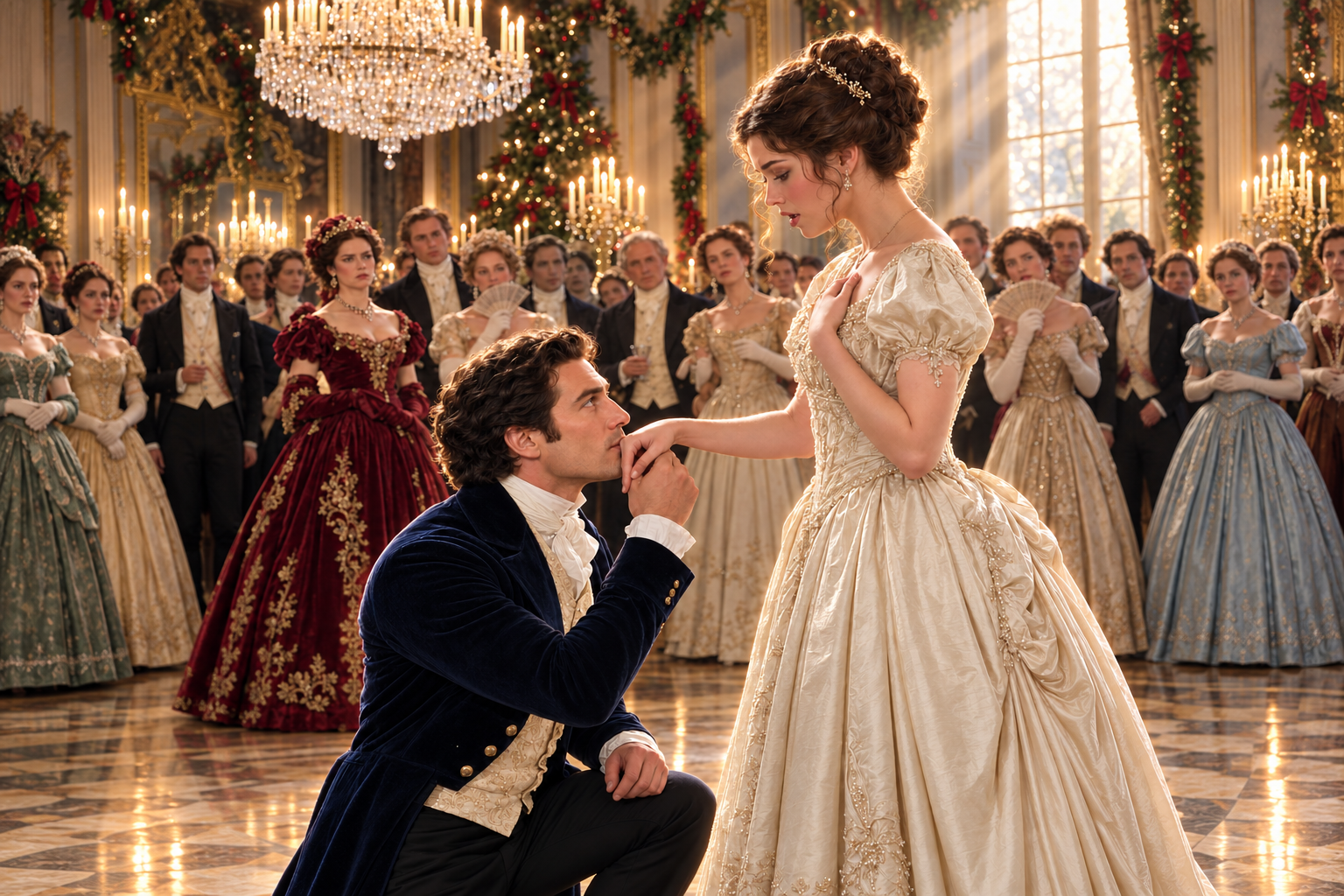
“Act as my betrothed until Twelfth Night,” said the Duke of Orwater, “and I will settle your father’s physician’s bill and see your sister’s school fees paid in full.” What he neglected to mention was that neither of them was permitted to fall in love. On that point, too, he would be proven wrong.
Part One
“Act as my betrothed until Twelfth Night, Miss Elfenstone,” Peveral Marchman, Duke of Orwater, said without any greeting at all, “and I will settle your father’s physician and see your sister’s schooling paid through. There is a single condition attached, and I require your word on it before I explain another thing further. You must not come to care for me, nor I for you. Whatever the household sees, whatever the county sees, whatever the assembled ton witnesses at my Christmas ball, it is all theater. Nothing beyond that.”
Avisia Elfenstone went perfectly still in the chilly, book-lined library of Orwater Hall. An open ledger sat before her on the table, the estate’s audited figures still wet at the bottom of the page. She had been adding a column when the Duke let himself in and spoke as though the whole matter were already agreed.
She had known him for three winters in the particular way a woman who manages a great household’s lesser accounts comes to know its owner: by his silhouette crossing a window, by his low instructions to a groom in the yard, never through actual conversation. He had never before bothered to have one with her.
“Your grace,” she said carefully, “I fail to see what use I could be to a duke needing a fiancée.”
“Because you are precisely what I do not want,” he answered, and there was no cruelty in the words, only a directness she would learn was simply how the man was built. “Lady Imogen Fair Haven has come back to the county widowed, and my aunt tells me she intends to take up again what she once ended. I refuse to be chased around my own ballroom at Christmas like game before the hounds. I need a woman at my side whom nobody could suspect of angling for the position, someone sensible enough not to mistake a few weeks of pretending for anything genuine, and with reasons of her own for holding her tongue.”
“And you have settled on me because I balance your household books and have never once made eyes at you on the stairs.”
Something shifted at the edge of his mouth, not quite amusement. “That, and other reasons. Yes.”
She should have turned him down at once. No duke summons a vicar’s daughter to his library at nine in the evening to propose a false engagement, and no woman with any sense entertains the notion past his first sentence. But her father had brought up blood into his handkerchief three mornings running. The Sethbury physician would not return without money first. And that very morning, Tamson’s letter from her school had arrived with a line added in the headmistress’s tight script, regretting that the coming term’s fees remained unpaid.
Avisia had read the letter twice through, folded it small, and tucked it into her sewing box, because there had been nothing else worth doing with it.
“How much,” she said, disliking how plainly she asked it, “and for how long?”
“A hundred pounds to your father before Christmas Eve, and your sister’s fees covered through to the end of her schooling. In return, you will appear on my arm from now until Twelfth Night, at services, at the assemblies, at my aunt’s card parties, and finally at the ball itself on Christmas Eve, where I mean the engagement to be announced past any doubting. Once Twelfth Night passes, we end it quietly. A quarrel, perhaps, or second thoughts on your part, or some unworthiness discovered in me. The details won’t matter much. You return to your father’s house, reputation untouched, settlement in hand, and I am a free man once more.”
He delivered the whole of it in the flat, businesslike tone of someone reading lease terms aloud. Avisia understood this was deliberate, he wanted her to hear it exactly that way: commerce, nothing more.
She looked him over across the table. Dark hair pushed back from a brow that carried, she thought, more tiredness than a man not yet forty should own. Eyes that studied her now with the same complete focus he must once have given his brother’s account books, weighing risk. A mouth that, she suspected, had not smiled freely in a very long time.
They called him the Iron Duke in whispers across three counties. Until this moment, she had never wondered whether the name cost him anything.
“And should I refuse?”
“Then I find another way to be free of Lady Imogen. You return to keeping my books. And we never speak of this again.”
He hesitated.
“But your father still coughs blood at dawn, Miss Elfenstone. I think you know that.”
It was an unkind thing to say, and she saw it land in him too, his jaw tightened the moment the words left his mouth, as though he hadn’t planned to say it, hadn’t meant to say it at all, and regretted it instantly even as it hung there in the cold air between them.
It was the first unguarded thing she had witnessed him do.
And it dissolved more of her resistance than every settlement he had offered.
“One condition of mine, then,” she said. “If we are to stand engaged before the whole county, your grace, I will not be kept from the truth of it. I would know why Lady Imogen troubles you so, why your aunt worries, and what kind of Christmas ball requires a hired bride to get through.”
He weighed her for a long moment, and she had the sense, not for the last time, of being measured on some scale whose units she didn’t yet understand.
“Sit, then,” he said finally, pulling out the chair across from her as though she were a steward come to review harvest figures rather than a woman he’d just asked to fake a betrothal to. “It will take longer to explain than I meant to spend on it.”
She sat. He remained standing.
“My brother Edmund held the title before me,” he began, pacing to the cold hearth and back again. “This house hosted a Christmas ball every year of his life, from the year our father died until the year Edmund himself died, two winters past, in a carriage overturned on the Sethbury road, his wife beside him. There has been no ball here since. My niece Lucy is six and has no memory of music in this house at Christmas. My mother, the Dowager Duchess, believes, and she’s likely right, that Orwater cannot remain a house of mourning forever. She has set her heart on bringing the ball back this year, for Lucy if nothing else. I’ve agreed to it.”
He turned to face her, his expression unreadable by candlelight.
“What I have not agreed to is being hunted through my own ballroom while I do it.”
Part Two
“And Lady Imogen?”
His mouth went thin. “Lady Imogen Fair Haven was Miss Imogen Vane back when I was a younger son with no prospects of a title. She broke off our engagement three weeks before the wedding to marry the Earl of Rosemuir instead, an earl with land already in hand was the surer bet over a second son with none.”
He said it without any heat at all, which somehow made it land harder than rage would have.
“Rosemuir has been dead a year now. She’s discovered, I gather, that a widowed countess isn’t quite the prize she imagined. And that the Duke of Orwater, the very man she once threw over, has become, through no doing of my own, a rather better one. My aunt believes she means to renew her suit at the ball, publicly, where turning her down would cost me in gossip regardless. I won’t give her that opening. A public engagement settles the matter cleanly.”
Avisia turned this over for a moment. It explained the bluntness, the flat terms, his insistence on securing her promise before he’d say another word. A man burned once by calculation builds his defenses to match. Hers, she supposed, was meant to be a wall he could see straight through, precisely because there was nothing behind it worth mistaking for feeling.
“You believe that if I understand from the start that none of it is real, I cannot hurt you the way she did.”
“I believe clarity spares us both considerable trouble.”
“And Lucy, does she know her uncle intends to produce a fiancée for her Christmas ball as though I were some ornament hired for the mantelpiece?”
For the first time something crossed his face that wasn’t calculation, a brief flicker, quickly smoothed over, of a man caught out.
“Lucy knows only that her uncle means to give her a Christmas with music in it, and that a kind lady will be staying at the hall through the season. She is six years old, Miss Elfenstone. She will not concern herself with the fine print of an engagement contract.”
“No,” Avisia agreed. “But she will concern herself, I expect, with whether the kind lady is kind in truth, or only performing kindness for a hundred pounds.”
She watched that register with him, watched the discomfort deepen slightly before he brought it back under control.
“I will not treat a grieving child unkindly to satisfy some business arrangement, your grace. Whatever else I agree to, that I will not perform.”
“I wouldn’t ask it of you.”
“Then we agree on that much, at least.”
She drew a slow breath. Beyond the library window, the season’s first real snow had begun, fine and soundless against the black glass. Somewhere above them in the sleeping house, a small girl who couldn’t remember Christmas music lay dreaming of nothing in particular, perhaps.
Avisia thought of her father’s handkerchief. Of Tamson’s careful, hopeful handwriting, asking whether the fees might still be found somehow.
And she thought, too, though she would never have admitted it for any sum, of the strange pull she felt toward a man who had just confessed his deepest wound to her across a ledger table simply because she had asked him to, plainly.
“Very well,” she said. “I accept your terms, your grace. I will be your fiancée until Twelfth Night. I will not come to love you, and you will not come to love me. And when it’s finished, we part as strangers, settlement between us.”
She stood and offered her hand across the table, ink-stained fingers belonging to a woman who kept another man’s books, meeting the gloved hand of the most feared duke in three counties.
“Though I confess I’ve never before shaken on a broken heart before having actually acquired one.”
He took her hand. His grip was warm through the leather, warmer than she’d expected from a man built so carefully cold. He held it a breath longer than the business of agreement required before releasing it and stepping back, as though the table between them weren’t distance enough.
Part Three
“You will move into the hall tomorrow,” the Duke said, his voice gone brisker now, the brief warmth tucked away somewhere she couldn’t follow. “My aunt will see you properly dressed. It won’t do for my betrothed to be taken for a poor relation, whatever the truth underneath it. Mrs. Bell will show you to the Rose Room.”
At the door, hand on the latch, he paused without quite turning back to her.
“Thank you, Miss Elfenstone. For your father’s sake, I’m glad of it. For my own, I’m sorry I had to ask.”
He was gone before she could answer. She stood alone in the library a long while afterward, the ledger still open, snow thickening past the glass, turning that final sentence over and over as though close enough examination might reveal it to be something other than exactly what it was.
The first crack, however small, in the wall he’d built with his own single rule not an hour before.
She slept poorly that night in her father’s narrow house in Wickmare, packing by candlelight the few gowns fit to be seen and the one that wasn’t. She told herself twice, then a third time, that a hundred pounds and a paid term of schooling were reason enough for anyone to agree to nearly anything. And that she would remember, when the pretending grew difficult, exactly what the Duke of Orwater had asked of her, and exactly what he hadn’t.
Her father, once told only that she’d accepted a position at the hall through Christmastide, helping prepare the ball and manage the ducal accounts, studied her over his spectacles with the particular searching look of a man who’d buried a wife and learned, in the years since, to read his daughter’s face for what she left unsaid.
“You’ve always been careful, Avisia,” he said. “Be careful now.”
“I’m always careful, Papa.”
“I didn’t say cautious,” he said, and coughed, and took her hand, and didn’t let go of it for some time.
Orwater Hall in daylight was an entirely different creature than the cold, candlelit library she’d left the night before. A great gray house of a hundred windows among bare elms, its forecourt already busy with wagons of fir unloading for the coming ball, its doors thrown open by a footman who bowed to her as though she’d always belonged there.
Avisia stood a moment on the step with her single trunk beside her, feeling every inch the vicar’s daughter she was, reminding herself she’d agreed to be looked at and had better learn quickly how to bear it.
The Dowager Duchess Anora received her in a small sitting room done in faded blue silk, a woman past sixty with her nephew’s dark eyes gone silver, and a directness that made clear at once where the Duke had learned his bluntness, though age had softened hers into something closer to warmth.
“So,” Anora said, setting down her tea and studying Avisia from head to hem with an attention that felt less like judgment than like being read. “You’re the young woman my nephew has decided will rescue us all from Imogen Fair Haven.”
“I understand I’m to be his fiancée for the season, your grace.”
“You understand a great deal more than that, I suspect, or Peveral wouldn’t have chosen you.” Anora’s mouth curved. “He isn’t a fool, whatever the county murmurs behind their fans. He wouldn’t hand so delicate a matter to a woman without the sense to manage it. Tell me plainly, Miss Elfenstone, did he explain the whole of it, or only the part that suited him?”
“He explained. Lady Imogen. Edmund. Lucy.” Avisia hesitated. “He asked one condition of me before he’d say anything further at all.”
“That neither of you fall in love.”
Anora said it without surprise, stirring her tea as though the words cost nothing. “Yes. He would. My nephew has spent two years constructing a very careful house out of grief and duty, Miss Elfenstone, every stone placed exactly where it bears the most weight and the least feeling. He means for this arrangement to be one more such stone, useful, load-bearing, entirely without warmth. I won’t pretend to you that I expect him to succeed in keeping it so. But I won’t tell him that either, or he’ll only build the wall higher.”
She set down her cup.
“Now. You’ll want to meet Lucy before anyone else in this house has the chance to feed you nonsense about her uncle’s temperament.”
They found Lucy Marchman in the nursery, stretched on her stomach on the hearthrug, building an elaborate and structurally questionable stable out of carved wooden animals. She looked up at Avisia with her father’s fair coloring and her uncle’s dark, weighing eyes, and asked without any preamble whatsoever:
“Are you going to marry Uncle Peveral?”
“I’m going to pretend to, for a little while.” Avisia said it because she’d promised herself in the carriage she wouldn’t lie to this particular child, whatever the county at large required of the bargain. “Would that trouble you very much?”
Lucy weighed this with the grave seriousness only a six-year-old can properly summon.
“Mama and Papa used to dance in the hall before Christmas,” she said. “There isn’t any dancing now. Will there be dancing again, if you pretend to marry him?”
“There will be dancing,” Avisia said, and something in her chest ached at the plain, unguarded want in the child’s voice, want that had clearly gone unspoken in this house for two long years, because nobody had thought to ask a grieving six-year-old what she missed. “A great deal of it. Would you help me learn the steps, so I don’t embarrass your uncle in front of the whole county?”
Lucy’s face transformed entirely, wariness gone in an instant, replaced by the particular delight of a child handed a purpose.
“I know all the steps,” she announced. “Papa taught me. Before, “
She stopped. The sentence folded in on itself.
Avisia knelt on the hearthrug beside her without a second thought for the state of her one good gown.
“Then you’ll teach me,” she said, and watched the child steady herself again, grateful, a little astonished, as though kindness without conditions attached were some foreign language she was only now learning to read.
Part Four
She didn’t see the Duke again until the dance lesson three evenings later, held in the long gallery because the ballroom itself remained half-covered in dust sheets, its chandeliers not yet lowered for cleaning. Because, Anora informed her dryly, Peveral had never once in his life agreed to be taught anything in a room large enough to hold an audience.
He arrived precisely on the hour, dressed with the careless perfection of a man who’d never had to think about his tailoring, and bowed to her with a formality that made the dancing master, a small, nervous man from Sethbury named Mr. Croft, visibly relax.
“Your grace has danced before, I trust,” Avisia said, because the silence wanted filling, and because teasing him had somehow grown easier than formality now that she’d knelt on his niece’s hearthrug and heard the child’s small, unhealed grief.
“I’ve danced at a great many balls I had no wish to attend, Miss Elfenstone, which I’m told doesn’t count as the same accomplishment.”
“We’ll discover the truth of that shortly enough.”
Mr. Croft set them their figure, and the music began, a single violin, thin and sweet in the high-ceilinged gallery. Avisia discovered within the first turn that the Duke of Orwater danced like a man who’d learned the steps out of necessity and never once for pleasure. Correct. Controlled. Entirely without the ease that should have come naturally to a body so evidently strong and well-made.
His hand at her waist stayed light, almost cautious, as though he feared to hold her more firmly than the figure demanded. When the turn brought them close, his eyes met hers for the length of a held breath before he looked deliberately past her shoulder instead.
“You’re counting,” she said, low, as the figure turned them again.
“I’m ensuring I don’t tread on your gown. Which I’m reliably informed is your only good one, and which I’d rather not ruin before it’s had the honor of being seen at the ball.”
“How do you know it’s my only good one?”
“Because my aunt told me. And because I noticed the mend at the hem myself, three winters ago, the first week you came to keep the accounts. I’ve thought of it every time I’ve passed you in a corridor since.”
He said it evenly, seemingly unaware how much the admission gave away.
Avisia missed a step entirely.
His hand tightened at her waist to steady her, and for one suspended moment, the violin holding a long note above them, they stood closer than the figure required. His breath faintly warm at her temple. His eyes no longer looking past her shoulder at all.
“Your grace,” she said very quietly, “that’s a good deal more attention than a man pays to a woman’s mended hem, unless he means something by it.”
He released her at once, stepping back into the figure with a correctness so sudden and complete that Mr. Croft, watching from the corner, applauded the recovery as though it had been intentional all along.
“It means only that I’m observant, which any man managing an estate must be. Shall we continue, Miss Elfenstone, or has my footwork already condemned me past hope?”
“Your footwork is adequate,” she said, matching his sudden formality, though her pulse hadn’t yet settled. “Your excuses want a good deal more practice.”
He did smile, briefly, involuntarily, gone almost before it arrived. But she’d seen it. And she carried the sight of it through the remainder of the lesson like a coal banked carefully against the cold.
It was Lady Imogen Fair Haven who arrived unannounced just as the lesson ended, sweeping into the long gallery in deep violet silk with the particular grace of a woman who’d never once doubted her welcome anywhere. Beautiful in the practiced, weathered way of someone who’d spent a decade perfecting the art of being looked at. Her eyes moved from the Duke to Avisia and back with an assessment so quick and so complete that Avisia felt catalogued and dismissed within a single glance.
“Orwater.” Imogen extended a gloved hand he had no choice but to take. “I hadn’t heard you’d taken up dancing lessons. How delightfully domestic. And this must be your Miss Elfenstone. I confess I’d pictured someone rather grander, given how quickly the whole county’s been made to hear of your engagement.”
“Miss Elfenstone has no need of grandeur, Lady Rosemuir.”
The Duke said it flat and certain, as though stating a fact requiring no confirmation, and Avisia noted with a small warm flare of gratitude that he didn’t so much as glance her way to check whether the compliment landed.
“No,” Imogen said, her gaze traveling once more, unhurried, over the mended hem of Avisia’s gown, the plainness of her hair, the faint ink stain still visible on one finger despite a week’s careful scrubbing. “I dare say she has not.”
She smiled. It was a lovely smile. There was nothing warm inside it at all.
“How did you and the Duke meet, Miss Elfenstone? I find myself quite consumed with curiosity.”
Avisia felt the trap close half a second before she saw its shape. A simple question, asked before witnesses, that she and the Duke had never troubled to agree on an answer to. In the rush of terms and settlements, neither of them had thought to invent a courtship to match the fiction of their engagement.
She opened her mouth with no idea at all what might come out of it.
And felt, in the same instant, the Duke’s hand settle at the small of her back, warm and certain, drawing her half a step nearer.
“She kept my accounts three winters before I troubled to notice what was in front of me,” he said before Avisia could speak at all, his voice carrying the particular flat conviction of a man realizing something was entirely true even as he said it. “I’m not, as you may recall, Lady Rosemuir, a man given to noticing things quickly. I’m told it’s one of my chief faults.”
“Among others,” Imogen murmured.
But something in her composure had thinned slightly, and her gaze, returning to Avisia, held for the first time something that wasn’t quite contempt, something nearer to calculation, as though she’d expected to find a fiction and instead found a question she couldn’t yet answer.
Part Five
She didn’t stay long after that, taking her leave with every courtesy the occasion required and none of the warmth. Only once the sound of her carriage faded down the long drive did the Duke’s hand, still resting lightly at Avisia’s back, seem to recall itself and withdraw. He stepped away with the same abrupt correctness he’d shown mid-dance, as though putting safe distance between them were a duty he’d momentarily, dangerously forgotten.
“That did not feel like performance, your grace.”
“It was performance,” he said, though he didn’t quite look at her saying it. “Imogen Fair Haven has spent ten years learning to read a room for the one true thing in it. If she’d seen us hesitate, she’d have known everything at once. I did what the moment required.”
“Of course,” Avisia said.
And told herself she believed him. Walking back to the Rose Room alone through the darkening corridors of a house not yet dressed for Christmas, she found she didn’t believe him in the least, and that the not-believing frightened her considerably more than Lady Imogen’s cold, assessing eyes ever could.
The following Sunday, Anora insisted, over Avisia’s quiet protest, that a newly engaged couple couldn’t possibly fail to appear together at the parish church in Wickmare, where the whole county would be watching for exactly the sort of confirmation only a shared pew could properly provide.
“You’ll ride with him in the ducal carriage,” Anora said, adjusting the collar of Avisia’s best pelisse with the brisk authority of a woman who’d dressed a great many young women for a great many trials. “You’ll sit beside him in the family pew, empty of anyone but Peveral and Lucy for two years, which will draw every eye in the church the moment you occupy it. You’ll smile as though there’s nowhere in England you’d rather be. And you’ll let him hand you down from the carriage in full view of the churchyard, because that single gesture will silence gossip before it starts better than a hundred pounds of settlement ever could.”
The carriage ride passed in a silence Avisia found considerably more fraught than the short distance between Orwater Hall and the little gray church warranted. The Duke sat across from her in his dark Sunday coat, watching the frosted hedgerows slide past the window with an attention she suspected had less to do with scenery than with avoiding a conversation he didn’t yet know how to have with her outside the safe boundaries of accounts and terms.
“Your grace,” she said finally, because the quiet had grown heavier than she could comfortably bear, “I’ve kept your ledgers three winters and never once seen you at a loss for words. Is it my presence that unsettles you, or merely the prospect of the whole parish watching us pretend?”
“Both, in equal measure, I expect,” he admitted, and something in the honesty of it eased the tightness in her chest more than any polished reassurance could have. “I haven’t sat in that pew beside anyone but Lucy since Edmund’s funeral, Miss Elfenstone. I confess I don’t entirely know how to do it without thinking of who, by every right of family and expectation, ought to be sitting there instead.”
“Then think instead of who is sitting there now,” Avisia said, gentler than she’d intended, and let the rest wait for a quieter hour.
He looked at her then with an expression she was coming slowly to recognize, not quite gratitude, not quite surprise, but some new thing built from both. The look of a man discovering that a woman hired to solve one problem had begun, without any apparent effort, to ease a dozen others he’d never thought to name in their bargain at all.
The church was exactly as Anora had predicted, full to bursting by the time their carriage drew up outside it, half the parish having contrived some excuse to arrive early enough to watch the Duke of Orwater hand a plain young woman down from his own carriage in full view of the churchyard gate.
He did it with a correctness that gave nothing away, and a gentleness that, to Avisia’s eye, gave away a great deal more. His hand closed firm and warm around hers as she stepped down onto the frosted path, and he didn’t release it at once, holding it a beat longer than the descent required while the assembled parish watched and murmured, several openly craning their necks for a better view.
It was afterward, in the churchyard, that the true trial of the morning arrived in the person of Mrs. Pru Cathcart, wife of the parish’s largest landholder and, by common consent, the most thorough gossip between Wickmare and Sethbury. She descended on them the moment the last of the congregation’s curtsies had faded.
“Your grace,” she said, dipping a curtsy so shallow it barely counted. “And Miss Elfenstone. My dear, how very sudden this all is. Why, I’ve known you since you were in short skirts, keeping your father’s accounts in that neat little hand of yours. I confess I had no notion at all that his grace had so much as noticed you existed, let alone, ” She paused, savoring the unfinished cruelty of it. “, let alone this.”
“Then you haven’t been watching closely enough, Mrs. Cathcart.”
The Duke’s voice carried the same flat certainty she’d heard him use against Lady Imogen days before.
“I’ve watched Miss Elfenstone balance my estate’s accounts to the last farthing three winters running without a single error. I did not find and correct a mistake in the quarter’s figures before she found it first. I’ve come slowly to understand that a woman capable of such precision and such quiet patience is worth considerably more than the county’s notice, however belatedly I arrived at the understanding myself. I don’t consider my own tardiness a failing in her, Mrs. Cathcart. Only in myself.”
Mrs. Cathcart’s mouth opened and closed once, entirely without sound, and she recovered only enough to murmur something about wishing them joy before retreating toward her own carriage with the particular haste of a woman whose ammunition had proved unexpectedly damp.
Part Six
“You didn’t need to defend me so thoroughly,” Avisia said once they were alone again on the frosted path, though she couldn’t quite keep the warmth from her voice.
“I found I wanted to,” he said simply, “which surprises me nearly as much as it appears to surprise you.”
Tamson found them then, breathless from running the length of the churchyard in her Sunday boots, her face alight with the particular delight of a sixteen-year-old confronted with genuine romance for the first time in her life.
“Avisia! Is it true? Papa says you’re to be a duchess, and I told him he must be exaggerating because you’ve never once mentioned a duke in any of your letters, not in three years, and I read every one of them twice.”
“It’s rather a recent understanding, Tamson.” Avisia was aware of the Duke beside her in a way that made her considerably more careful with her wording than she might otherwise have been. “But yes. It’s true enough.”
Tamson turned her bright, unguarded gaze on the Duke himself, entirely without the deference an experienced courtier might have shown him.
“You’ll be kind to her, your grace. She’s been kind to everyone else her whole life and had precious little of it returned. What with Mama gone and Papa’s health what it is, I should like to know someone means to be kind to her for a change, before I let myself be glad about any of this.”
“Tamson, ” Avisia began, mortified.
But the Duke only crouched slightly, meeting the girl’s eyes at a nearer level, and answered her with a gravity that suggested he took the question exactly as seriously as it deserved.
“I mean to try, Miss Tamson. With everything I have. I can’t promise you I’ll always succeed, I’m told I have a talent for cold correctness that wants considerable improvement. But I promise you I mean to try every day. And I’d rather you held me to that than let me forget it.”
Tamson studied him a moment longer, weighing the answer with the same unguarded seriousness her sister had shown him in the library three weeks before. Then, apparently satisfied, she produced a smile of such open delight that it settled something in the Duke’s own careful composure, something braced for judgment that found warmth instead.
They rode back to the hall with considerably less silence than they’d carried on the way out, Avisia recounting, at his gentle prompting, small stories of her sister’s childhood and her father’s long, patient ministry in the parish. The Duke listened with an attentiveness she hadn’t expected from a man reputed across three counties to care for nothing beyond his accounts and his solitude.
“You asked me once,” he said as the hall’s gray towers came into view above the bare elms, “why I chose you for this arrangement when I might have found any number of women with better claim to grandeur and less to lose by the pretending. I told you it was because you wouldn’t mistake the pretense for anything real. I begin to think that wasn’t the whole truth even then, though I lacked the honesty to say so at the time.”
“What was the whole truth, your grace?”
He didn’t answer at once, watching the hall grow nearer through the window. When he spoke again his voice had gone quieter, more careful, as though he were feeling his way toward a confession he hadn’t planned to make so soon.
“I’ve watched you three winters, Miss Elfenstone, doing careful, unthanked work no one troubled to acknowledge, without once complaining of it. I’ve thought more than once that a man might do a great deal worse than build his life beside a woman who doesn’t need watching to do the right thing well. I didn’t admit that to myself as a reason when I asked you in the library. I find I can’t honestly deny it as one now.”
Avisia held that confession carefully, the way she might hold something fragile passed to her without warning, and didn’t answer it beyond a small, private smile she let him see, which he returned briefly before the carriage drew up before the hall’s great doors, and the careful correctness settled over him once more, the way it always did, the instant they came within sight of watching eyes.
By the second week of Advent, Orwater Hall had begun, cautiously, then all at once, to remember how to be a house at Christmas.
Avisia hadn’t planned it so. She’d only asked Mrs. Bell, on her third morning, whether the great hall might want dressing for the season the way the account books described it having been dressed in years past. Mrs. Bell had looked at her with an expression Avisia couldn’t quite read and said only: “His grace hasn’t asked for the boughs to be cut since the year the old master died, miss. But I’ve kept the greenery lists all the same.”
So Avisia and Lucy and half the household staff tramped into the home wood on a bright, hard-frosted morning to fill three wagons with fir and holly and long ropes of ivy, Lucy shrieking with delight when a startled hare bolted from beneath a holly bush. Even Mr. Fenwick, the Duke’s steward, a dry and careful man of fifty Avisia had privately thought incapable of levity, was talked into climbing a low branch after a particularly fine spray of berries, and returned to earth with his coat torn and his dignity considerably improved by the loss of it.
The Duke found them at it in the late afternoon, riding back from some errand in Sethbury. Avisia watched him rein in at the edge of the clearing and simply sit his horse a long moment, watching. His niece laughing with her whole body for what was, Avisia understood without being told, very possibly the first time in two years. His staff at ease in a way she suspected his grief hadn’t permitted for a good while. Watching, too, though he wouldn’t have named it, the woman he’d hired to perform a betrothal directing the whole glad chaos of it with red cheeks and pine needles caught in her hair.
“You’ve conscripted my entire household into cutting greenery,” he said once he’d come close enough to be heard, and there was something in his voice she hadn’t heard there before, not quite accusation, not quite wonder, some unsteady thing between the two.
“I’ve conscripted your household into remembering Christmas, your grace. The greenery’s merely the excuse.”
She held out a sprig of holly heavy with berries, without quite thinking whether the gesture crossed some line of theirs she hadn’t yet learned the shape of.
“Will you carry some back? Or will the Iron Duke of Orwater be remembered as the only man in the county who refused to help decorate his own hall?”
He took the holly. His fingers brushed hers taking it, bare skin against bare skin in the cold air, both of them having shed their gloves for the work of the wood. Neither moved to correct the contact for a moment longer than passing a sprig of holly strictly required.
Part Seven
“Lucy hasn’t laughed like that,” he said quietly, watching his niece rather than Avisia now, “since before the accident.”
“She told me,” Avisia said, matching his quiet, “that her parents used to dance in the hall before Christmas, and there’s been no dancing since. I didn’t think it my place to ask more than that.”
Something crossed his face, grief, still raw after two years despite every careful stone he’d set against it. For a moment she thought he might turn from her, retreat into the correctness that was his habitual armor. Instead he said:
“Edmund was driving too fast on the Sethbury road, because Cordelia was laughing at something, and he always drove faster when she laughed. As though he couldn’t bear for the moment to end before he’d wrung every last second from it.”
He caught himself visibly, the way a man stops at the edge of a cliff he’s walked toward without quite noticing.
“I’ve thought more times than I can count that if I’d been in the carriage instead, if I’d simply been a duller brother, a slower driver, ” He stopped. “Forgive me. That isn’t a confidence I meant to burden you with, Miss Elfenstone. It isn’t part of our arrangement.”
“No,” Avisia agreed gently. “It isn’t part of our arrangement. I asked anyway, and you answered, because I think some part of you has been waiting two years for someone to ask.”
She didn’t reach for his hand, though she wanted to. She’d already learned, in two short weeks, the precise distance he could bear before retreating behind formality again, and she judged, watching his jaw, that they stood very near its edge.
“You aren’t responsible for your brother’s happiness in the last moment of his life, your grace. I hope you know that, whatever the rule between us permits me to say it.”
He didn’t answer directly, but he rode back to the hall at a walk beside the wagons rather than cantering ahead as his errand’s urgency might have justified. When Lucy, tired and pink-cheeked and glowing, fell asleep against Avisia’s shoulder in the jolting wagon bed, he looked up to find her watching the two of them with an expression he made no particular effort to smooth away before their eyes met.
The message came at dawn, carried on foot by a boy from Wickmare too breathless from running to do more than gasp that the Reverend Elfenstone had taken a turn in the night, and that the physician had been sent for but hadn’t yet come.
Avisia was down the stairs and into her cloak before she’d finished reading the letter, the ring on her finger cold against skin gone suddenly numb with fear. She didn’t see the Duke until reaching the stable yard, already shouting for a horse, and found him there before her, his own mount already being led out, his greatcoat thrown over a shirt still open at the collar as though he’d dressed in under a minute.
“I’ve already sent word to Dr. Hilleran in Sethbury,” he said before she could ask how he’d known, “told him to spare no expense and no delay, and to charge the whole of it to my account rather than wait for your father to protest the cost. My own carriage is being brought round for you now, faster and warmer than riding, and I’ve had hot bricks put in it. Besides, ” He paused, meeting her eyes. “I’m coming with you. Unless you’d rather I didn’t.”
“You needn’t. This is no part of our arrangement, your grace.”
“I’m well aware of what is and isn’t part of our arrangement, Miss Elfenstone.” Something in the low urgency of his voice silenced her more thoroughly than any argument could have. “This isn’t that. Get in the carriage.”
The road to Wickmare had never seemed so long. Avisia sat rigid against the squabs, hands knotted in her lap, the Duke across from her saying nothing at all for the better part of a mile, until at last, without any evident calculation, he reached across the narrow space and closed his hand over both of hers. Still and warm and entirely steady.
“Hilleran is the best physician in three counties,” he said. “I’ve used him for Lucy and for my mother’s rheumatism, and I trust him with lives that matter to me. Your father will have the very best care that money and my name together can command, and I promise you it’s considerable.”
He paused.
“I’m sorry. I know ‘sorry’ does very little against fear. But I’m sorry all the same, and I didn’t want you to sit in this carriage without someone saying it to you.”
She didn’t trust her voice, so she only turned her hand beneath his and gripped it hard. He let her, and didn’t once suggest the gesture exceeded the terms of their bargain.
Her father, when they reached the small vicarage, was pale and short of breath but conscious, propped against a mound of pillows with Tamson white-faced beside him. Dr. Hilleran arrived within the hour, his horse nearly ridden to lather, summoned by a rider the Duke had sent ahead at a gallop the moment Avisia climbed into the carriage.
The examination was long and grave, ending with a diagnosis of a weak heart, long strained by a lifetime of insufficient means, and a winter chill settled badly on already tired lungs. “Serious,” Hilleran said carefully, “but not, with rest and warmth and proper nourishment through the season, beyond hope. He’ll want a fire kept through the night for some weeks yet, and food richer than a country parson’s stipend generally allows. No undue exertion of any kind.”
“He shall have all of it,” the Duke said before Avisia could speak. “Send whatever’s needed from the hall’s own stores, coal, meat, wine, if it will help him. Bill the whole of your attendance directly to me. I don’t want the Reverend troubling himself over accounts while his heart mends.”
Avisia, standing in the cramped hallway of her father’s house, watching the Duke of Orwater arrange with brisk, unhesitating generosity for a country parson’s comfort as though it were the most natural thing in the world, felt something in her chest crack open that she’d been holding carefully shut for two weeks.
“You didn’t have to do all this,” she said once he’d gone and Tamson had been sent to sit with their father, the two of them alone a moment in the small, cold parlor.
“The settlement already provides for his physician.”
“The settlement provides for a debt paid,” he said. “This isn’t that.”
He looked at her with an intensity that made her want, unaccountably, to step back from it.
“I find I no longer much care to distinguish between the two, Miss Elfenstone. Whatever terms we agreed to in my library a fortnight past, your father is unwell, and I have the means to ease it, and I find I want to ease it a great deal more than the arrangement between us strictly requires. I don’t know what to call that. I’m not certain I wish to know.”
“Peveral.”
She said his given name, unused between them until that moment, slipping out unbidden in the rawness of the morning. Something in his face opened at the sound of it, undefended, before he caught himself.
“That isn’t part of the performance either,” he said quietly.
“No,” she agreed. “It isn’t.”
Part Eight
Three days later, once her father had been pronounced stable and improving and she’d returned to the hall to resume the season’s preparations, Lady Imogen found the Duke alone in his study and closed the door behind her before he could object to the privacy.
“You went to Wickmare yourself,” Imogen said without preamble. “In your own carriage, with hot bricks, and sat the whole day at a dying parson’s bedside. That isn’t the conduct of a man performing an engagement. Peveral, I’ve known you a long time. I know precisely what you look like when you’re pretending, and what you look like when you aren’t. You weren’t pretending in that parlor.”
“I don’t answer to you for how I choose to be kind to a woman in my employ, Imogen.”
“No,” she agreed. “You don’t. But you might answer to yourself, before you ruin us both further.”
Something in her voice shifted, the cool composure cracking to reveal, briefly, an older grief beneath it.
“I was a fool at nineteen, Peveral. I chose land over love because I was frightened of what love without security would cost me. I’ve spent every year since Rosemuir’s death regretting it in the particular, precise way one only regrets a thing once it’s entirely beyond recovering. I came back to Orwater hoping some ember might remain of what we had, however carelessly I once smothered it. I didn’t expect to find you’d gone and fallen in love with your bookkeeper instead.”
“I haven’t, ” he began, and stopped, because the denial wouldn’t come. Because he found, standing in his own study with the words half-formed, that he couldn’t in honesty finish the sentence.
“You have,” Imogen said softly, and for the first time there was no calculation in her voice at all, only something that might, in another woman, have been pity. “I’d advise you, as someone who once made the opposite mistake and has regretted it every day since, not to let your own rule cost you what my caution cost me. But that isn’t my place to say, I suppose. I’ve said quite enough for one visit.”
She gathered her gloves.
“I shan’t trouble you again, Peveral. Whatever I came to Orwater hoping to reclaim, I find it was buried a good deal deeper than I had the right to dig for. I wish you joy of her, if you have the courage to take it.”
She left him alone in the study with the fire burned low. It was there, an hour later, that Avisia found him, come to bring the week’s accounts as she’d done for three years running, and found instead a man staring into a dying fire with an expression she’d never before seen on him.
Not the careful correctness. Not the flat competence. Something raw and unresolved. A man caught between the wall he’d built and the woman who’d begun to see straight through it.
“Your grace,” she said uncertainly, the ledger still in her hands.
“I told you once,” he said, not turning from the fire, “that I wouldn’t fall in love with you. I believed it entirely when I said it. I’d built my whole life since Edmund died on believing a man could choose not to feel a thing simply by refusing it permission.”
He turned then, and the look he gave her held nothing of that war left in it at all.
“I find I was wrong, Miss Elfenstone. I find I’ve been wrong for some time now. I don’t know what to do with the wrongness, because I promised you a rule, and I meant it as a kindness, a way to keep you safe from a man who couldn’t be trusted to love anyone well, myself least of all. I don’t know how to break my own rule without breaking the safety I meant it to give you.”
Avisia set the ledger down very carefully on the nearest table, because her hands had begun to shake and she didn’t trust the numbers to survive them.
“Perhaps,” she said, “you might ask me whether I still want the safety of a broken rule, before you decide on my behalf that I do.”
He looked at her a long moment, something fierce and frightened moving behind his eyes. Then he crossed the room in three strides and stopped a bare foot from her, close enough that she could see the war being fought in his face, between everything he’d promised himself two years ago and everything he wanted, standing in this quiet room, more than he’d wanted anything since the carriage overturned on the Sethbury road and took his old life with it.
Then the study door opened without warning.
Mrs. Bell stood in the frame, pale and urgent, a letter in her hand.
“Your grace, Lady Imogen’s brother is below stairs, asking most particularly to see you both together. He says he’s come about the engagement. He says he has proof it’s a sham.”
Sir Aldus Fair Haven was a heavier, coarser echo of his sister, without her polish or her sudden, surprising honesty. He stood in the Duke’s study with his hat still on his head and a folded letter held between two fingers as though it were a winning hand he’d waited a long while to play.
“I have here a letter from a housemaid formerly of this establishment, dismissed last spring for thieving, willing to swear before a magistrate that she overheard Miss Elfenstone here discussing the terms of a paid arrangement with your steward, Mr. Fenwick, on the very night your engagement was first announced to the household. A hundred pounds and a sister’s school fees, I believe, were the figures mentioned. I imagine the ton would find that a great deal more interesting than a Christmas ball.”
The Duke’s voice came quiet and cold. “Get out of my house, Fair Haven. You’ll have your answer before the ball, and it won’t be the one you’re hoping for. I don’t pay ransoms for the privilege of my own honesty.”
Sir Aldus left with his threat still hanging in the room, unresolved. For the whole of the next two days the Duke said nothing more of it, closeted with Fenwick and with his solicitor, and once, briefly, with his aunt, whose raised voice carried as far as the corridor before the study door shut against it.
It was on the third evening, in the great hall itself, half-dressed now in fir and ivy for the ball two nights hence, that he called the household together, Mrs. Bell, Fenwick, the maids, the footmen, all of them standing uncertain among the half-hung garlands, and told them plainly what Sir Aldus had threatened, and why it would come to nothing.
“I asked Miss Elfenstone to pretend to be my fiancée,” he said before them all, his voice carrying the flat, unhesitating certainty she’d heard him use against Lady Imogen and Mrs. Cathcart both. “The bargain was mine to propose, mine alone. She didn’t seek my notice, nor my title, nor my money, I brought all three to her door and asked her to accept them in exchange for a kindness to her family I was glad, and remain glad, to give. If there’s dishonesty in this house, it’s mine, freely admitted, and I’ll answer for it to anyone who asks. Miss Elfenstone will answer to no one. Whatever the housemaid overheard, she heard the truth of a bargain I made, not a lie Miss Elfenstone told. I’ll say as much to Sir Aldus, to the magistrate if it comes to that, and to the whole of the ton at the ball itself, should anyone there have the poor manners to ask.”
He looked, then, only at Avisia.
“I’d rather the truth cost me something than let a lie cost you anything at all.”
It wasn’t, in the end, a private declaration. It was made before the whole household, in a half-decorated hall, pine needles still caught in the Duke’s own dark hair from an afternoon spent hanging garland himself. It was, Avisia thought, watching him say it without a single hedge or softening, more binding than any proposal made in private could have been.
That should have settled it. For a day, it nearly did.
But three nights later, beneath the mistletoe hung in the long gallery, the Duke leaned down as though to kiss her, and stopped a bare inch from her mouth, his hand still at her jaw.
“I’ve told the whole household the truth of our bargain,” he said, low. “I haven’t yet told you the truth of what I want to ask you next. I find I’m afraid to ask it wrongly. Give me four days, Avisia. Let me be certain I’m asking for the right reasons, and not merely because Sir Aldus has frightened me into haste.”
She waited through all four days. She sat with Lucy over her stitching, rode to Wickmare to see her father sitting up and eating broth with something like his old appetite, and told herself each morning that four days wasn’t so very long to wait for a man to be certain of his own heart.
But by dawn on Christmas Eve, the day of the ball itself, his answer still hadn’t come.
She packed her trunk before the household had properly woken, left a short note for Anora on the writing desk in the Rose Room, and walked out into the snow before anyone could think to stop her.
He caught her a mile short of Wickmare, riding bareheaded through the snow, his greatcoat unbuttoned as though he hadn’t troubled to fasten it before mounting. In the middle of the quiet, frozen road, snow catching in his lashes and his heart laid bare before her, he said the words she’d stopped hoping to hear.
“I love you. Not as performance. Not as a term of any settlement. Not as a wall I’ve decided is safe enough to lower for an afternoon. I love you as I haven’t let myself love anything since Edmund died, entirely, and with a great deal of fear attached to it, that I no longer wish to let govern me. I told the whole household the truth of our bargain because I couldn’t bear for Sir Aldus’s lie to touch you. I’m telling you now the truth of my own heart, four days later than I ought to have, because I was afraid of it, and I’m done being afraid. I’m asking you, Avisia Elfenstone, not to pretend to be my fiancée any longer, but to truly be it. And then, when you’re ready, to be my wife.”
He kissed her then, in the middle of the snow-quiet road. Gently, and then not gently at all. Avisia Elfenstone, who’d come to Orwater Hall three weeks before to pretend at a betrothal for a hundred pounds and her father’s health, understood in the warmth of that single, unguarded kiss that she’d gained instead something no settlement in England could have purchased for her.
That night, the Christmas ball was the finest Orwater Hall had seen in a generation. At midnight, before the whole assembled county, Sir Aldus among them, his letter long since rendered worthless, his face fixed in a rictus of a smile he couldn’t afford to abandon, the Duke of Orwater went down on one knee and asked her again, this time with no pretense at all.
She said yes.
They married the following spring in the small stone church at Wickmare, where Avisia’s father, restored now to a careful but steady health, insisted on performing the ceremony himself. The whole county turned out to see it, filling the little church far beyond its usual Sunday congregation.
Every Christmas Eve after that, for the whole of their long life together, the Duke of Orwater would find his wife somewhere in the crowded, laughing hall, by the hearth, or the punch bowl, or kneeling on the floor to settle some dispute among the youngest guests, and cross to her without fail, take her hand, and hold it a moment longer than strict propriety required.
He never did learn to dance without counting the steps.
But he never again needed to look past her shoulder while he did it.
THE END