
J-Pouch Surgery: What to Expect Before and After
J-pouch surgery is a reconstructive procedure that helps people who need their colon removed regain a more natural way of passing stool. Surgeons build a small internal pouch from the end of the small intestine (the ileum) and connect it to the anus, so in many cases a permanent external ostomy bag isn’t needed. It’s most often performed for ulcerative colitis and certain other conditions affecting the large intestine.
Getting ready for j-pouch surgery means understanding the stages involved, what recovery looks like, how your diet will need to change, and what complications to watch for. The surgery can dramatically improve quality of life, but it takes time for the body to adjust to its new way of storing and passing waste. Recovery differs from person to person, and changes in bowel frequency, urgency, or digestion are common afterward. Here’s what to expect before and after the procedure, from preparation through long-term outcomes.
The Steps of the J-Pouch Surgery Procedure
For people managing severe ulcerative colitis or familial adenomatous polyposis (FAP), j-pouch surgery is a major turning point: it removes diseased tissue while avoiding the need for a permanent external bag.
Understanding how the surgery works means breaking down a multi-step timeline that balances organ removal, tissue reconstruction, and healing time.
Staging Strategies: One, Two, or Three Operations?
A colorectal surgeon decides whether to complete the reconstruction in one, two, or three separate operations, based on the patient’s nutrition, overall health, and current medications (such as high-dose steroids or immunosuppressants).
| Staging Approach | Ideal Candidate | Major Milestones | Risk vs. Benefit |
|---|---|---|---|
| Two-Stage (most common) | Stable, elective patients with good nutrition and low steroid exposure | Stage 1: colon and rectum removal, pouch creation, temporary loop ileostomy. Stage 2: ileostomy reversal (“takedown”) | Benefit: high success rate; protects healing tissue with a temporary bypass bag. Risk: managing a temporary stoma for 8 to 12 weeks |
| Three-Stage | Severely ill, malnourished, or emergency patients on high-dose immunosuppressants | Stage 1: colon removal with end ileostomy (rectum left intact). Stage 2: rectum removal, pouch creation, loop ileostomy. Stage 3: final ileostomy takedown | Benefit: reduces surgical stress during severe illness, allowing the patient to come off steroids and regain weight. Risk: three separate hospital stays and recoveries |
| One-Stage (rare) | Exceptionally healthy FAP patients with no active inflammation or steroid use | Single surgery: complete colon and rectum removal with immediate pouch-to-anal connection, no temporary stoma | Benefit: avoids extra surgeries and any ostomy bag. Risk: higher chance of leaks at the connection site, which can cause pelvic infection |
A Closer Look at the Surgical Procedures
Here’s how the anatomy changes during each phase of a standard two-stage procedure.
Total Proctocolectomy and Internal Reservoir Creation
The first operation can be done as traditional open surgery (one vertical incision) or laparoscopically (several small entry points using a camera and specialized tools). The laparoscopic approach usually means smaller scars and a quicker early recovery.
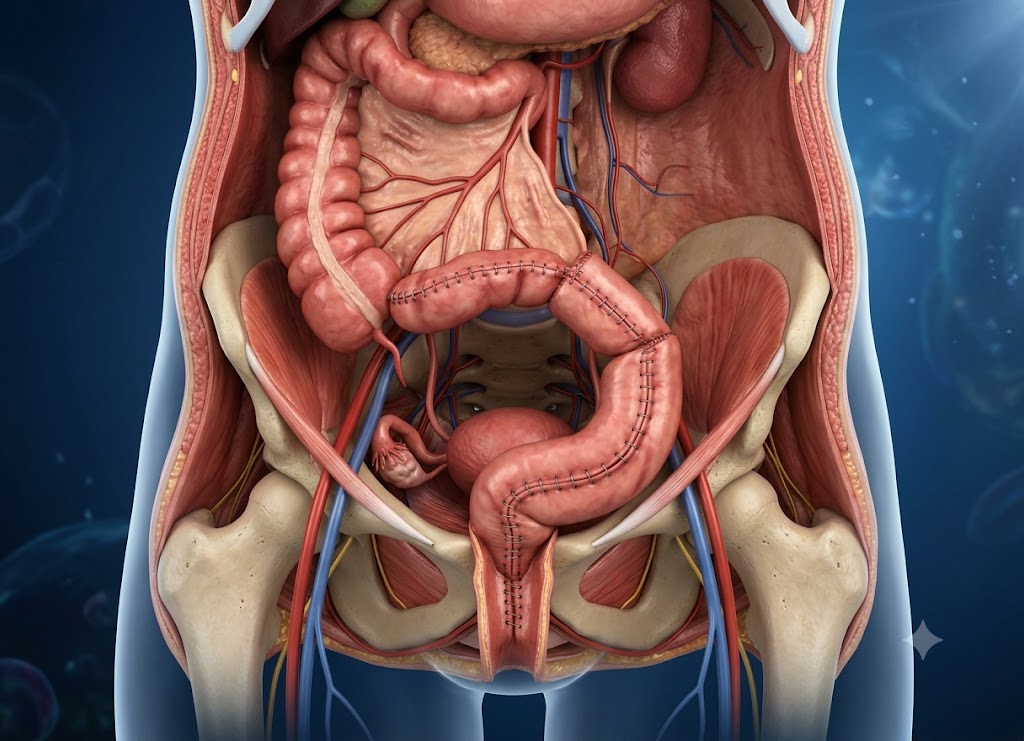
During this operation, the surgeon removes the entire diseased colon and rectum. To take over the storage role the rectum used to play, the surgeon takes the last 12 to 15 inches of small intestine, folds it back on itself, and staples the inner walls together to form a J-shaped reservoir.
The base of this new pouch is brought down into the pelvis and stitched or stapled to the top of the anal canal. The surgeon carefully preserves the anal sphincter muscles, which are what maintain bowel control.
Step 2: The Protective Temporary Ileostomy
Once the pouch is connected to the anal canal, the surgeon brings a loop of healthy small intestine through a small opening in the abdominal wall to create a temporary stoma. This diversion protects the healing tissue.
If stool flowed into the new pouch right away, bacteria and digestive enzymes in the waste could irritate the fresh suture lines. That raises the risk of an anastomotic leak, a serious complication where the internal connection doesn’t seal properly, potentially leading to a pelvic infection, sepsis, or pouch failure.
Routing waste to an external bag for 8 to 12 weeks gives the internal seams a clean, low-stress environment to heal fully.
Step 3: The Final Ileostomy Takedown
The last milestone is the reversal surgery, which is shorter and less invasive than the initial operation.
The surgeon makes a small incision around the stoma to free the loop of intestine from the abdominal wall, trims the temporary opening, and stitches or staples the two ends back together to restore a continuous digestive path.
The reconnected bowel is placed back inside the abdomen and the skin is closed. After a short hospital stay of 2 to 5 days, the digestive tract wakes up and the patient begins passing stool through the pouch and anus for the first time.
What Is the Recovery Process After J-Pouch Surgery?
Recovery unfolds gradually over several months. It includes hospital time for each surgical stage, at-home healing, and a longer adaptation period as the pouch starts functioning. Patience is essential, since the digestive system needs real time to adjust to such a major change.
Typical Recovery Timeline After Each Surgery Stage
There are three main recovery phases, and this pattern repeats, in a modified form, after each surgical stage: the immediate hospital stay, the first weeks at home, and long-term adaptation.
Hospital Stay (3 to 7 Days Per Stage) After the pouch creation surgery and the final takedown, you’ll typically stay in the hospital for several days while the team manages pain, watches for infection or ileus (temporary bowel paralysis), confirms you can eat and drink, and provides guidance for the road ahead.
First 6 to 8 Weeks at Home This is a critical healing window. Fatigue is common as the body puts energy into tissue repair. Expect restrictions on lifting anything heavier than 5 to 10 pounds and on strenuous activity, to protect against hernias and let incisions heal. Rest, good nutrition, and hydration are the priorities.
Long-Term Adaptation (3 to 12 Months) This phase starts once the pouch takes over after the final takedown. Bowel movements begin very frequent, liquid, and urgent. Over several months to a year, the pouch gradually stretches, its capacity grows, and the body learns to absorb more water from stool, leading to fewer, more manageable movements with better control.
What to Expect Right After the First Surgery in the Hospital
Immediately after the colon removal and pouch creation, expect a stay focused on pain control, close monitoring, gradual movement, and a slow return to eating.
Pain is usually managed at first with a patient-controlled pump for small, safe doses of IV medication, transitioning to oral medication as you improve. The team will monitor vital signs, incision sites, and fluid output closely.
You’ll be encouraged to get up and walk short distances soon, often the day after surgery, which helps prevent blood clots, supports lung function, and helps the bowel wake up. Diet is reintroduced gradually, starting with clear liquids and moving to full liquids, soft foods, and eventually low-residue solid food.
How Do You Manage a Temporary Ileostomy at Home?
Living with a temporary bypass bag involves a routine of emptying and changing the appliance, careful skin care, and some dietary adjustments.
Emptying and Changing the Appliance Empty the bag several times a day, typically when it’s about one-third to one-half full, so it doesn’t get too heavy and pull away from the skin. Change the whole appliance every 3 to 5 days, or sooner if it starts to leak.
Skin Care The skin around the stoma is delicate and can get irritated by stool or adhesive. Clean it with warm water only (soap can leave a residue that affects adhesion), dry it well, and apply a fresh skin barrier before the next appliance.
Dietary Adjustments Ileostomy output is typically liquid or paste-like since it hasn’t passed through the colon. Foods like bananas, rice, applesauce, toast, pasta, and potatoes help thicken stool. Chew thoroughly and avoid high-fiber foods like raw vegetables, nuts, seeds, and popcorn at first to prevent blockages, and stay well hydrated with water and electrolyte drinks.
Adapting to the J-Pouch After the Final Surgery
Life after the final takedown means adjusting to a new normal: increased frequency and urgency at first, careful skin care, and patience while the pouch matures.
The internal reservoir takes time to develop its full function. In the beginning, expect 8 to 15 or more bowel movements a day, often liquid and urgent, because the small intestine isn’t built to store stool or absorb water the way the colon does.
Over 6 to 12 months, the pouch typically stretches and works more like a true reservoir, and the body adapts to absorb more fluid. Stool thickens and frequency usually settles to around 4 to 8 times a day, often including just one movement overnight.
Skin care around the anus matters a lot during this stretch. Frequent, liquid stool carries digestive enzymes that irritate the skin, sometimes causing painful soreness known as “butt burn.” Keeping the area clean and dry helps; using a bidet or peri-bottle instead of dry toilet paper is often gentler, and a thick zinc oxide barrier cream after each bowel movement protects the skin. Identifying and avoiding foods that trigger frequency or acidity can also improve long-term comfort.
Who Is a Good Candidate for J-Pouch Surgery?
Because this surgery fundamentally changes internal anatomy, surgeons look well beyond the primary diagnosis. A good candidate needs suitable anatomy, a compatible disease type, and a realistic understanding of the months-long healing process.
Medical Conditions Where J-Pouch Surgery Is Recommended
An internal pouch only works when the disease is confined to the large intestine, since the surgery removes all affected tissue and can be curative while preserving a natural path for waste.
Ulcerative Colitis (UC). UC causes chronic inflammation and ulcers limited to the innermost lining of the colon and rectum. When severe UC stops responding to medication, or dysplasia (precancerous changes) develops, removing the colon and rectum becomes necessary. A j-pouch offers a way to leave behind symptoms like bloody diarrhea and urgent cramping, without a permanent external bag.
Familial Adenomatous Polyposis (FAP). FAP is a rare inherited condition that causes hundreds to thousands of precancerous polyps throughout the colon and rectum. Left untreated, the risk of these turning cancerous approaches 100%, often by a patient’s 20s or 30s. A preventive j-pouch is the standard recommendation, removing the cancer risk while preserving normal bowel control, which matters a great deal for the young adults typically facing this diagnosis.
Why Crohn’s Disease Is Generally Not Eligible
A common question is whether this surgery works for everyone with inflammatory bowel disease. Generally, it doesn’t apply to Crohn’s disease.
Unlike ulcerative colitis, Crohn’s can affect any part of the gastrointestinal tract, from mouth to anus, and it penetrates the full thickness of the bowel wall rather than staying on the surface.
If a pouch is built from small intestine tissue in a Crohn’s patient, the disease has a high chance of recurring inside the new reservoir, potentially causing severe inflammation (pouchitis), strictures, abscesses, and fistulas. Pouch failure rates in Crohn’s disease can reach as high as 50% within ten years, often requiring another surgery to remove the pouch and create a permanent ileostomy, which is why a confirmed Crohn’s diagnosis is a major reason not to proceed.
Factors That Determine Eligibility
Anal sphincter muscle function. Since the pouch connects directly to the top of the anal canal, continence depends entirely on the native sphincter muscles. A doctor may order an anorectal manometry test beforehand to check muscle strength and nerve coordination. Prior childbirth injuries, trauma, or pelvic surgery that weakened the sphincter can raise the risk of permanent incontinence, in which case another approach may be better.
Overall physical health. A multi-stage reconstruction is demanding on the body. Patients need to be healthy enough to handle anesthesia and recover from long abdominal surgeries; severe heart or lung disease, significant obesity, or malnutrition can make the risks too high. If a patient is malnourished or in the middle of a severe UC flare, surgeons often choose the three-stage approach so the body can recover strength before the more complex pouch creation.
Personal motivation and expectations. The adaptation period after the final surgery is long and demanding. Good candidates understand the early hurdles ahead, including managing a temporary stoma, adjusting to frequent stools, and treating skin irritation, and are willing to actively manage their diet and skin care while the pouch matures over its first year.
What Are the Benefits and Risks of J-Pouch Surgery?
Choosing j-pouch surgery means weighing real life improvements against real surgical and long-term risks. It’s a highly successful alternative to a permanent bag, though not an exact replica of a healthy colon; it trades a chronic illness for a new, manageable system.
The Main Advantages
Avoiding a permanent external bag. For most patients, this is the biggest lifestyle benefit. An internal reservoir supports body image, clothing choices, and personal intimacy, since there’s no external pouch attached to the abdomen.
A more natural route for elimination. The procedure uses existing anatomy to preserve a conventional way of using the bathroom. Bowel movements will be more frequent and looser than with a healthy colon, but voluntary sphincter control means the patient decides when to go.
Removal of diseased tissue. For severe ulcerative colitis, removing the colon and rectum eliminates the source of chronic bleeding, pain, and urgency, often allowing patients to stop heavy medications like steroids and biologics.
Eliminating colorectal cancer risk. Both long-standing UC and FAP carry a high cancer risk. Removing the colon and rectum eliminates that threat and the need for frequent surveillance colonoscopies.
Potential Short-Term and Long-Term Complications
Short-term risks (days to weeks after surgery)
- Anastomotic leak: one of the most serious early risks, where the connection between the pouch and anal canal doesn’t heal properly, potentially causing a pelvic infection or sepsis. This is exactly why surgeons use a temporary stoma to protect the tissue while it heals.
- Ileus: a temporary slowdown of the bowel after anesthesia, causing bloating, nausea, and vomiting, usually managed with bowel rest and IV fluids.
- Early obstruction: temporary swelling or a kink in the rearranged intestine can cause a blockage requiring close monitoring.
- General surgical risks: wound infection, internal bleeding, or blood clots, as with any major abdominal surgery.
Long-term risks (months to years after surgery)
- Pouchitis: the most common long-term issue, affecting roughly half of all patients at some point, with symptoms resembling an old colitis flare. Most cases clear up with a short course of antibiotics.
- Adhesion obstructions: scar tissue can form after abdominal surgery and occasionally twist or block the intestine, requiring urgent evaluation.
- Anastomotic stricture: the connection point can narrow over time, usually resolved with a quick outpatient dilation procedure.
- Cuffitis: inflammation of the small remaining strip of rectal tissue just above the anus, typically treated with topical anti-inflammatory medication.
- Pouch failure: in roughly 5 to 10% of cases over many years, the pouch may fail due to chronic inflammation, fistulas, or leaks, requiring removal and a permanent ileostomy.
Comparing a J-Pouch to a Permanent Ileostomy
After colon and rectum removal, patients generally choose between two long-term paths.
| J-Pouch Routine | Permanent Ileostomy | |
|---|---|---|
| System | Internal reservoir | External appliance |
| Bathroom use | Conventional toilet | Continuous output into a bag |
| Frequency | 4 to 8 movements per day | Manual bag emptying as needed |
| Main trade-off | Risk of pouchitis | No urgency or skin burn |
The choice comes down to trade-offs. A j-pouch keeps everything internal but requires a longer adjustment period, more frequent bowel movements, and some ongoing risk of pouchitis. A permanent ileostomy is simpler and more predictable, since the stoma drains continuously into an external bag emptied on your own schedule, with no urgency or skin irritation, but it does mean wearing an appliance at all times. Neither is a failure: they’re different solutions to the same underlying problem.
Long-Term Considerations for Living With a J-Pouch
Living with an internal reservoir takes an active, ongoing approach, since your new anatomy changes how the body handles food, fluids, and waste.
Mastering the J-Pouch Diet
The main goal is managing the thickness and frequency of bowel movements, since the body can no longer solidify waste the way the colon used to.
Foods that help thicken stool: bananas, white rice, smooth applesauce, smooth peanut butter, skinless potatoes, and oatmeal all act like a natural sponge, supporting fewer and more predictable bowel movements.
Common dietary triggers:
- Insoluble fiber (raw leafy greens, broccoli, cauliflower, nuts, seeds, fruit skins) can be hard to digest and may irritate the pouch or cause temporary blockages; cooking vegetables well makes them easier to tolerate.
- High-sugar foods and drinks pull water into the small intestine, causing watery, urgent diarrhea.
- Spicy and acidic foods, including citrus and tomato-based sauces, can make stool more acidic and cause painful skin irritation.
Staying hydrated. Without a colon to reclaim fluids, dehydration is an ongoing risk. Drink plenty of fluids throughout the day, including electrolyte drinks or salted broths, and limit caffeine and alcohol, which act as diuretics.
Diagnosing and Managing Pouchitis
Pouchitis affects up to half of patients at some point and involves inflammation of the pouch lining, often resembling an old UC flare.
Signs to watch for: a sudden rise in frequency and urgency, watery or bloody stool, cramping, pelvic pressure, or unexpected incontinence, all of which warrant prompt medical evaluation rather than waiting it out.
Diagnosis. A doctor typically reviews symptoms and performs a pouchoscopy, using a small flexible camera to check the lining for redness, swelling, or ulcers, and may take tissue samples to confirm inflammation.
Treatment. A 10 to 14 day course of antibiotics usually clears an acute episode. For chronic cases, doctors may prescribe long-term, low-dose antibiotics. High-potency probiotics, such as Visbiome, can help maintain a healthy bacterial balance and reduce future flares.
Structural Variations: J-Pouch vs. K-Pouch and S-Pouch
While the J-pouch is now the standard, other configurations have been used historically.
The J-pouch. Formed by folding the small intestine into a J shape and connecting it to the top of the anal canal, using the natural sphincter muscles for control. It has the highest long-term success rate with the fewest mechanical complications.
The K-pouch (Kock pouch). An internal, continent ileostomy also built from small intestine tissue, but disconnected from the anus. It’s tucked inside the abdominal wall and connects to a small opening on the belly, with a tissue valve preventing leakage. Emptying requires inserting a catheter 3 to 5 times a day. It avoids an external bag but is a more complex surgery with a notable risk of valve slippage requiring further surgery.
The S-pouch. An older design that folds the bowel into an elongated S shape, historically used when the small intestine’s blood supply was too tight to reach the pelvis in a J shape without tension. It functions similarly but its longer exit channel often caused incomplete emptying, sometimes requiring a catheter through the anus. Modern surgical techniques have made this design largely unnecessary today.
Understanding Pouch Failure
Despite the daunting name, long-term success rates exceed 90% at specialized centers. Pouch failure means the reservoir becomes unmanageable and needs to be surgically removed in favor of a permanent end ileostomy, a last resort used only after other options have been exhausted.
Common causes include:
- Misdiagnosed Crohn’s disease, where full-thickness inflammation eventually attacks the pouch tissue, causing fistulas, strictures, and ulceration.
- Refractory pouchitis, where chronic inflammation stops responding to antibiotics, biologics, or anti-inflammatories.
- Severe surgical complications, such as ongoing leaks or long-standing pelvic infections that permanently damage surrounding tissue.
For the small number of people who ultimately need the pouch removed, switching to a permanent external ileostomy isn’t a failure. For those who’ve endured years of chronic pain, incontinence, or inflammation, it often brings real relief and a return to an active, healthy life.
Conclusion
J-pouch surgery offers many people with ulcerative colitis and similar conditions an effective alternative to a permanent ileostomy. The procedure builds an internal pouch from the small intestine, allowing stool to pass naturally through the anus once healing is complete. While the adjustment period brings frequent bowel movements, dietary changes, and a need to watch for complications, many patients see major improvements in symptoms and quality of life. Working closely with a colorectal surgeon and care team supports proper preparation, recovery, and long-term management.
Frequently Asked Questions
1. What is j-pouch surgery?
J-pouch surgery removes the colon and creates an internal pouch from the end of the small intestine, shaped like a J and connected to the anus so waste can leave the body the usual way. It’s most often performed for ulcerative colitis that no longer responds to medication, and sometimes for inherited colorectal cancer risk or other colon conditions.
2. Why is j-pouch surgery performed?
It’s typically recommended for severe ulcerative colitis when medications stop working or complications arise, and for conditions like precancerous changes or genetic cancer risk affecting the colon. Removing the diseased colon eliminates many symptoms caused by ongoing inflammation, and a healthcare team evaluates each case individually before recommending surgery.
3. How many stages does j-pouch surgery involve?
Usually two or three, depending on health, disease severity, and surgeon recommendation. In the first stage, the colon and rectum are typically removed and the pouch is created with a temporary ileostomy to allow healing; a later procedure closes the ileostomy and reconnects the digestive path. Healthier patients may qualify for a two-stage approach.
4. What should I expect after j-pouch surgery?
More frequent bowel movements, urgency, and changes in stool consistency are normal as the body adapts. Diet adjustments, hydration, and sometimes medication help manage these changes, and improvement often continues for months as the pouch matures. Regular follow-up helps catch any complications early.
5. What are the possible complications of j-pouch surgery?
Possible complications include pouchitis, bowel obstruction, infection, bleeding, dehydration, and pouch function issues. Pouchitis, inflammation of the pouch lining, is one of the more common long-term issues and can cause increased frequency, discomfort, or urgency. Ongoing medical follow-up helps manage these risks.
6. Can you live a normal life after j-pouch surgery?
Many people return to active, fulfilling lives after j-pouch surgery. While bowel habits change, most patients report a better quality of life once free from the severe symptoms of their original disease, and gradually develop routines that fit their lifestyle. Continued care and communication with healthcare providers support long-term success.