
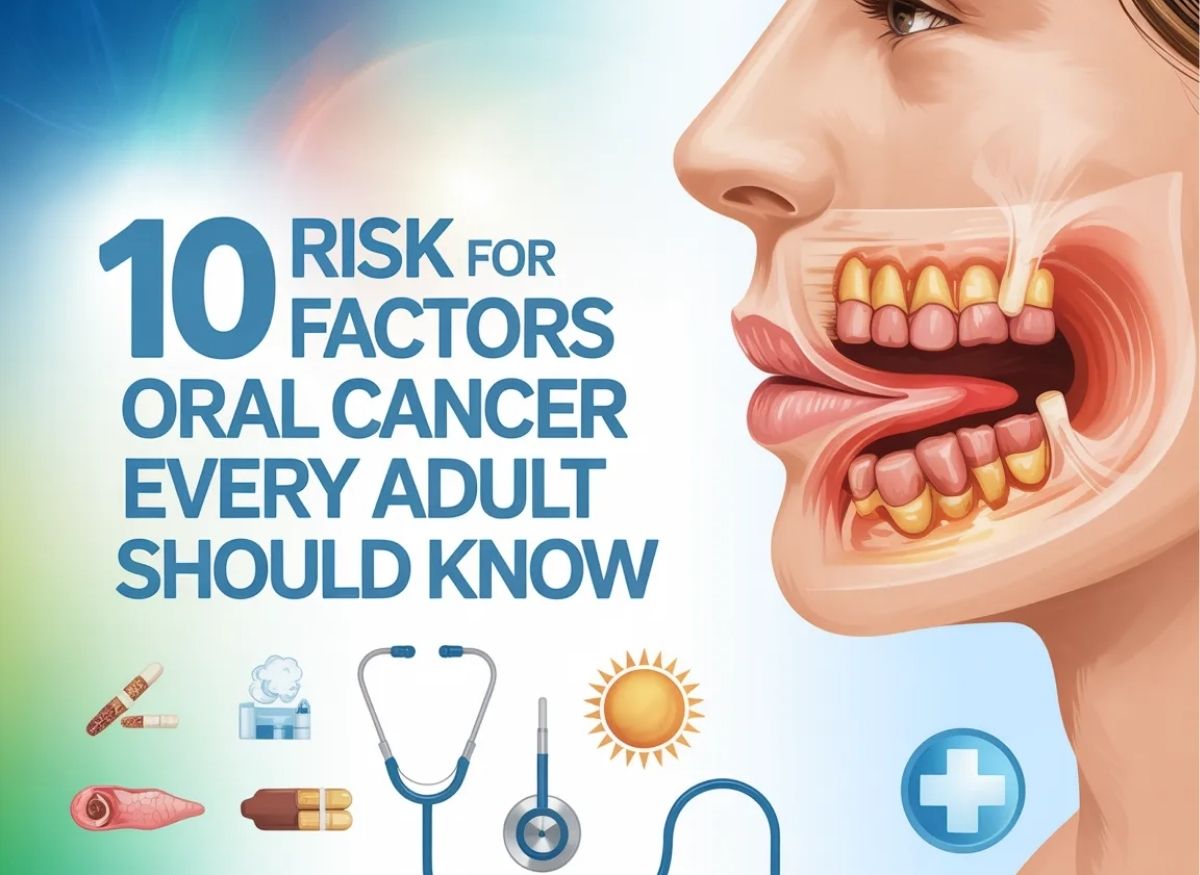
10 Risk Factors for Oral Cancer Every Adult Should Know
Oral cancer can affect any part of the mouth, including the lips, tongue, gums, cheeks, and the roof or floor of the mouth. It’s often overlooked, but it can have devastating consequences if untreated. Early detection is key, and understanding the risk factors is an important part of protecting yourself.
Certain habits and health conditions raise the risk considerably. Smoking, heavy drinking, and a poor diet all make cancerous lesions in the mouth more likely. Some risk factors, such as age and family history, are beyond your control, but many can be reduced through healthier choices.
This article covers the major risk factors for oral cancer, the symptoms to watch for, when to see a professional, how to prevent it, how it affects daily life, and how risk varies across populations.
What Is Oral Cancer?
Oral cancer is the uncontrolled growth of cells that invade and damage surrounding healthy tissue. It is a significant subset of head and neck cancers, arising when the normal cycle of cell death and renewal breaks down.
Most cases begin in squamous cells, the thin, flat, scale-like cells lining the lips and the inside of the mouth. These cells are normally replaced regularly, but when genetic mutations occur they begin to multiply abnormally, forming an oral neoplasia (a new, abnormal growth). As it progresses, the cells lose their organized structure and boundaries and become a solid malignant tumor. The early stages are often silent, because the immune system fails to recognize the mutated cells as a threat.
Whether it appears as tongue cancer or as a persistent, non-healing sore on the soft palate or floor of the mouth, the underlying process is the same. The goal of early intervention is to stop the cancer before it reaches the deeper muscle layers or jawbone. Once it does, it gains easier access to the lymphatic system and blood vessels, greatly raising the risk of spread (metastasis) to the lymph nodes in the neck. Telling a benign cyst from a potentially fatal tumor is the most critical step in achieving a good outcome and preserving the ability to speak, swallow, and breathe normally.
10 Risk Factors for Oral Cancer
Oral cancer is rarely caused by a single event. It usually results from long-term exposure to environmental triggers combined with biological vulnerabilities. Knowing the drivers helps with both prevention and early detection.
- Excessive drinking. Alcohol irritates the mouth and acts as a solvent, stripping the protective lining and making tissues more permeable to other toxins. Heavy drinking alone is a risk factor, but the greater danger is its combined effect with tobacco. People who both drink heavily and smoke face a far greater risk than those who do only one, not merely double.
- Smoking and tobacco use. The original names smoking as a major risk factor throughout, and it is the most significant partner to alcohol in the combined risk described above.
- Human papillomavirus (HPV). The HPV-16 strain has emerged as a major driver of oral cancers, particularly in younger adults with no tobacco history. HPV-driven cancers often start in the oropharynx, including the tonsils and base of the tongue, so symptoms such as a persistent sore throat or trouble swallowing can appear without any visible sore in the front of the mouth.
- Excess UV radiation. Prolonged, unprotected sun exposure is the main risk factor for lip cancer. As on the facial skin, the border of the lips can develop actinic cheilitis, scaly precancerous patches that can eventually harden into an invasive tumor. The lower lip is most often affected because it gets more direct sunlight.
- Male sex. Men have historically been diagnosed at about twice the rate of women, largely because of higher rates of heavy tobacco and alcohol use. As tobacco use among women rises in some regions, the gap is narrowing.
- Poor diet. A diet consistently low in fruits and vegetables creates a pro-inflammatory environment in the mouth. Without enough antioxidants, the body is less able to repair oxidative damage to cells, so minor genetic errors are more likely to progress to oral neoplasia.
- Chronic mechanical trauma. Long-term irritation from sharp or broken teeth, jagged fillings, or ill-fitting dentures causes constant inflammation. Trauma itself is not a carcinogen, but the repeated cycle of injury and rapid repair can eventually trigger a mutation.
- Weakened immune system. Immunosurveillance is the body’s process of finding and destroying mutated cells. People with HIV/AIDS, or those on immunosuppressants after an organ transplant, are at higher risk because their bodies are less able to neutralize abnormal cells early.
- Age. Risk rises significantly with age, and most cases are diagnosed in adults over 45. This reflects cumulative exposure: over decades, small cellular insults add up until the body’s repair mechanisms can no longer keep pace.
- Family history. The introduction names family history as a risk factor beyond your control, though the original doesn’t discuss it further.
Recognizing Oral Cancer Symptoms
Early symptoms often mimic benign problems such as canker sores, small abrasions, or toothaches. The defining feature of a malignancy is persistence. A typical mouth sore heals within 10 to 14 days, while cancer-related changes stay the same or worsen.
- Persistent growth. A lump, a localized thickening, or a crusty or eroded area on the lips or gums that doesn’t resolve. These growths often feel firm and may be fixed to the tissue beneath.
- Tongue symptoms. Because the tongue is muscular and richly supplied with blood vessels, changes may be functional as well as visible: persistent numbness or a sense of “thickness” that interferes with movement. Red or white patches (erythroplakia or leukoplakia), typically on the sides of the tongue, are often painless at first, so people ignore them until they become painful ulcers. Speech may sound “mushy,” as if talking with a hot potato in the mouth, and painful swallowing (odynophagia) can radiate toward the ear.
- General warning signs. Unexplained bleeding in the mouth not tied to an injury or gum disease, a persistent “globus” sensation (the feeling that something is stuck in the throat, which can indicate a tumor further back), and a sore throat or hoarseness lasting several weeks all warrant prompt evaluation.
- Gum symptoms. Gum cancer can be mistaken for advanced gum disease. Teeth loosening for no apparent dental reason, or a sore spot under dentures that doesn’t heal after adjustment, may signal a tumor invading the bone. The area may look ragged and bleed easily when touched or brushed.
- Nerve and muscle symptoms. Persistent ear pain (referred pain, because of shared nerve pathways) is a classic but often overlooked sign. Difficulty or pain moving the jaw or tongue, or a restricted ability to open the mouth fully (trismus), suggests invasion of the deep muscles or the jaw joint.
When to See a Specialist
Knowing when to seek help is among the most important factors in survival. Most benign mouth sores improve within a week. If you notice a growth, a persistent red or white patch, or an ulcer that hasn’t healed within 14 days, see a healthcare provider, with a dentist or oral surgeon as a good first choice.
This “two-week rule” separates a temporary inflammatory response from the early stages of a neoplasm. A canker sore is usually painful and self-limiting, whereas a malignancy often starts as a painless change in the texture or color of the mouth’s lining. Because early signs are so quiet, people often delay until the growth is obstructive or painful, by which time deeper tissues may be involved and treatment is more complex.
Early detection is associated with better outcomes. When a tumor is still contained and hasn’t reached the lymphatic system, prospects are best. Once it spreads to the lymph nodes in the neck or to distant organs, survival drops significantly. A five-minute visual screening by a professional can catch a lesion before it becomes a systemic problem, and only a biopsy can give a definitive diagnosis. Many precancerous conditions, such as leukoplakia, can be monitored or treated before turning malignant. The risk of waiting it out far outweighs the inconvenience of a checkup.
Prevention
Many oral cancers are heavily influenced by lifestyle and monitoring. Protecting the lining of your mouth is your first line of defense.
- Monthly self-exams. Using a bright light and a mirror, check the sides and underside of the tongue, the roof of the mouth, and the full length of the gums. Look for unusual growths, thickening, or red or white patches that don’t rub off. Knowing what’s normal for your mouth helps you spot changes early.
- Follow the two-week rule. Have any sore, lump, or irritation that lasts more than 14 days checked. Minor problems such as viral sores or “pizza burns” should show clear signs of healing within that window.
- HPV vaccination. For those eligible, the HPV vaccine protects against a specific and rising type of oral cancer. HPV-16 is now a leading cause of cancers at the back of the throat and base of the tongue, areas hard to see in a self-exam. It’s especially valuable for younger adults who are at low risk for tobacco-related cancers.
- Diet and hydration. Drinking plenty of water helps maintain the protective film that buffers the mouth against toxins, and a diet rich in fruits and cruciferous vegetables (broccoli, kale, cauliflower) provides antioxidants that support DNA repair and neutralize free radicals.
- Regular dental checkups. Twice-yearly cleanings are perhaps the most overlooked tool. Dentists and hygienists are trained to spot subtle changes, including in “danger zones” like the floor of the mouth and back of the throat, and can refer you for a biopsy at the earliest moment.
How Oral Cancer Affects Daily Life
A diagnosis reaches far beyond medical treatment. The mouth is the gateway for nutrition, communication, and social expression, so a tumor can disrupt the most basic functions of daily life.
- Eating and nutrition. Chewing and swallowing can become extremely difficult, often causing rapid, unintended weight loss and nutritional deficiencies that weaken the immune system during treatment. Many patients need a liquid or soft-food diet, which can end the pleasure of shared meals and lead to social withdrawal.
- Speech and social isolation. Loss of clear speech is often the most emotionally taxing effect. A tumor invading the tongue or throat impairs articulation, and speech may sound muffled or slurred. The frustration can lead people to avoid calls and professional interactions, which is why speech therapy is a critical part of recovery.
- Chronic pain. The mouth is one of the most nerve-rich areas of the body, and a tumor compressing nerves or invading the jawbone can cause constant pain, made worse by talking or drinking, leading to fatigue and disturbed sleep. Effective pain management is essential to maintaining quality of life.
- Mental health. Uncertainty about the outlook, changes in appearance after surgery, and fear of recurrence often trigger anxiety and depression. Counseling, psychiatric support, and survivor groups are vital, because treating the mind matters as much as treating the tumor.
Risk Across Different Populations
Incidence and severity are not evenly distributed.
- Men vs. women. Oral cancer has historically been much more common in men, particularly over 50, largely because of more long-term tobacco and heavy alcohol use. Men are also statistically less likely to seek early attention for a persistent growth, so they are often diagnosed at a more advanced stage.
- Younger people. Although oral cancer is traditionally a disease of older adults, cases are rising among younger people. Some are linked to early smoking or drinking, but many are driven by HPV, often in otherwise healthy non-smokers. These tumors typically arise in the oropharynx, which makes them harder to detect in a standard visual exam.
- Older adults. Most cases occur in people over 60, often from the “cumulative insult” of decades of exposure or poor oral hygiene. In older adults a tumor may grow more slowly or be masked by other dental issues such as ill-fitting dentures, so regular screenings are essential. Catching it early can mean the difference between a minor procedure and high-risk major surgery.
Conclusion
Recognizing the risk factors is the first step toward prevention and early detection. Some, like age and genetics, can’t be controlled, but quitting smoking, drinking less, and maintaining good oral hygiene can significantly lower your risk. Regular dental checkups and self-exams for sores, lumps, or persistent pain are essential for catching problems early.
If you notice persistent sores or difficulty swallowing, see a healthcare provider for an accurate diagnosis. Early diagnosis leads to better treatment outcomes and quality of life.
Frequently Asked Questions
Are oral cancer symptoms always painful?
No, and that’s one of the most dangerous myths. In the earliest, most treatable stages, oral cancer is often completely painless. A person may notice a strange growth or persistent red patch but assume it’s a harmless callus because it doesn’t hurt. Significant pain usually appears only once the tumor has invaded deeper muscle, nerves, or the jawbone, often meaning a more advanced stage. Any persistent, painless change in the mouth should be evaluated promptly.
How is tongue cancer treated?
When the cancer is confined to a small area of the tongue, surgeons can often remove the tumor with clear margins (a partial glossectomy), sometimes followed by targeted radiation to eliminate any remaining microscopic cells. The challenge is the tongue’s mobility and rich lymphatic drainage, so the key is catching the disease before it spreads to neck lymph nodes. Once it reaches the cervical lymph nodes, treatment becomes more aggressive and the outlook more guarded.
What’s the difference between mouth cancer and oral carcinoma?
In practice they’re largely interchangeable. “Mouth cancer” is the everyday term describing where the disease is found, while “oral carcinoma,” usually squamous cell carcinoma (SCC), is the medical name for the type of cell that has become malignant. Over 90% of malignancies in the oral cavity begin in squamous cells, so oncologists and pathologists use the latter term. Whether called oral neoplasia, a mouth tumor, or tongue cancer, it usually refers to the same process: the flat, protective lining of the mouth turning into an invasive, uncontrolled growth.