
10 Subtle Symptoms of Testicular Cancer You Shouldn’t Ignore
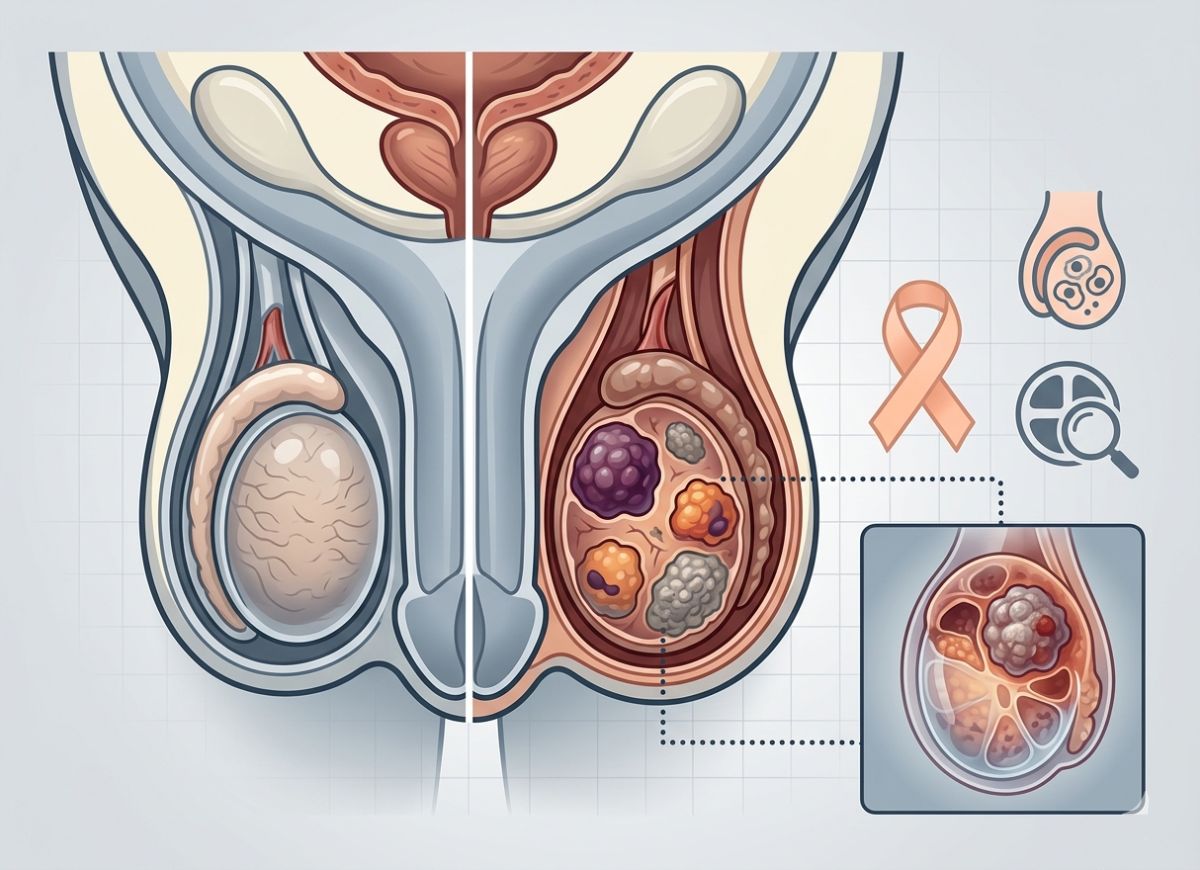
Testicular cancer is rare, but it is serious. It most often affects men between 15 and 35, though older men can get it too. The American Cancer Society estimates that about 9,000 men in the US are diagnosed each year.
The outlook is good. When the cancer is found early, the cure rate is above 95%. Even so, many men put off seeing a doctor because they feel embarrassed or scared.
The early signs are easy to miss. A small ache or a little swelling is often written off as nothing. That delay has a cost: roughly 20% of cases are found only at a later stage, when full recovery is less likely.
Early signs can also be quiet. A lump may not hurt at first. A feeling of heaviness or a slight change in size or shape is easy to blame on something else.
This article covers ten subtle symptoms to watch for. Spotting them early makes treatment simpler and more successful. It may feel awkward to deal with, but it can save your life.
10 Subtle Symptoms of Testicular Cancer
Dull Ache or Pulling Sensation in the Scrotum or Testicles
This is not a sharp or stabbing pain. It is a low, steady discomfort deep in the scrotum, often described as a nagging ache or a constant pull.
Men often blame it on a hard workout, long hours of sitting, or sex. Because it is mild, they assume it will pass. If the ache lasts more than a week or two with no clear cause, get it checked.
Heaviness in the Scrotum or Testicles
A testicle affected by cancer can feel denser or heavier than the other one. The feeling builds slowly over weeks or months. It may seem like something is off-balance, or like the area is fuller than before.
This one is easy to miss because few men compare the weight of their testicles day to day. The change is so gradual that it starts to feel normal.
Change in Size, Shape, or Firmness
A distinct lump is the classic sign, but the whole testicle can change without one. It may grow larger or shrink compared with the other side, or feel unusually firm or hard.
It is normal for one testicle to be a bit bigger or to hang lower. What matters is a change from your own baseline. A testicle that turns uniformly hard, like a stone, is a major red flag even with no separate bump. Regular self-exams are the best way to notice a slow change like this.
Lower Back Pain
Back pain is one of the most commonly misread symptoms. When testicular cancer spreads, it often reaches the lymph nodes deep in the abdomen, in front of the spine (the retroperitoneal nodes). As they swell, they can press on nerves and cause a deep, dull, lasting ache.
People usually assume they strained their back lifting something or slept badly. The difference here is that the pain doesn’t improve with rest, stretching, or over-the-counter painkillers, and there is no clear muscle or bone cause.
Dull Ache in the Lower Abdomen or Groin
A vague ache low in the abdomen or groin can also point to testicular cancer. The tumor may cause referred pain along the spermatic cord, which runs from the scrotum through the groin into the abdomen. It can also be another sign that the cancer has reached the lymph nodes.
Men often assume it’s a pulled groin muscle, a hernia, or a stomach problem. If the ache keeps coming back with no explanation, especially alongside any change in the scrotum, see a doctor. The pain is usually mild but constant and bothersome, not sharp or severe.
Sudden Fluid Buildup in the Scrotum (Hydrocele)
A hydrocele is a collection of fluid in the sac around a testicle. It is common in babies. In adults, a sudden or fast-growing buildup can be the body reacting to a problem such as an infection, an injury, or sometimes a tumor.
A tumor can irritate the surrounding tissue so that it makes extra fluid. That fluid can hide the tumor and make the testicle hard to feel. You may only notice that one side of the scrotum looks bigger and swollen. Any new or fast-growing swelling should be checked with an ultrasound.
Breast Tenderness or Growth (Gynecomastia)
This symptom is rare but very telling. Some tumors, especially non-seminoma germ cell tumors, make the hormone hCG, the same hormone produced in pregnancy. In men, it can upset the balance between testosterone and estrogen and stimulate breast tissue, causing swelling, tenderness, and sometimes pain in the chest.
Gynecomastia has other causes, including puberty, aging, and medication side effects. Still, if it appears for the first time in a young or middle-aged man, treat it as a possible sign of testicular cancer until a doctor says otherwise.
Unexplained Fatigue
Deep, lasting tiredness that rest doesn’t fix is common in many advanced cancers. The body uses a lot of energy fighting cancer cells, and the cancer itself can release substances that cause exhaustion.
This is more than feeling worn out after a long day. It is a draining lack of energy that gets in the way of everyday life.
Shortness of Breath or a Persistent Cough
The lungs are among the most common places for testicular cancer to spread. Tumors there can interfere with breathing and cause a lasting cough (sometimes with blood), chest pain, or breathlessness with very little effort.
These symptoms are often first treated as a chest infection or asthma. If they don’t clear up with standard treatment, spread of the cancer should be considered.
Swelling in One or Both Legs (Deep Vein Thrombosis)
If the cancer spreads to large lymph nodes in the abdomen or pelvis, the swollen nodes can press on the big veins that carry blood from the legs back to the heart, such as the iliac vein or the inferior vena cava. Blood flow slows down and a clot can form. This is called deep vein thrombosis (DVT).
DVT usually causes swelling, pain, and redness in one leg. A piece of the clot can break loose and travel to the lungs, causing a life-threatening pulmonary embolism. Unexplained leg swelling should always be treated as a medical emergency.
How Do Subtle Symptoms Compare to Common Signs of Testicular Cancer?
Subtle symptoms such as a dull ache, heaviness, or referred pain are vague and hard to pin down. The most common sign is very different: a firm, usually painless lump on the testicle.
The key difference is how easy each is to identify. A lump is physical. You can feel it during a self-exam, so it is a clear warning sign. Subtle symptoms are sensations that only you can feel, so they are easy to explain away as a muscle strain, everyday aches, or normal variation. That is why men who only look for a lump can miss other early warnings.
A lump has a size, shape, and firmness you can judge. A dull ache or heaviness is hard to measure and can come and go, so people tend to downplay it. Knowing that testicular cancer can appear without a lump is important. It encourages men to get checked for any lasting, unexplained change in the scrotum or related areas.
Main Difference Between a Subtle Ache and a Classic Lump
A classic lump is a distinct, hard, usually painless mass on the testicle. A subtle ache is a general feeling of discomfort, pressure, or dragging in the scrotum that is easy to brush off.
A lump feels like a small pea or a piece of gravel attached to or inside the testicle. It has clear edges and feels firm to hard. You can touch it and tell that it doesn’t belong there. Finding one is often a moment of alarm, and it gives you something concrete to act on, even though being painless can cause some men to wait.
An ache is different. It is a background feeling, not a specific spot. Men describe it as a nagging discomfort, a sense of fullness, or a pull that comes and goes. Because it isn’t sharp or disabling, it is easy to rationalize:
- “I must have pulled something at the gym.”
- “I’ve just been sitting too long.”
- “It’s a random ache, it’ll go away.”
This vagueness is the main danger. Subtle symptoms don’t feel like cancer the way a hard lump does. The discomfort can last for weeks or months, and you slowly get used to it and assume it’s minor. With no obvious problem to point to, it is easy to keep putting off a doctor’s visit.
Is Sharp, Sudden Pain a Symptom of Testicular Cancer?
Sharp, sudden pain is not typical of testicular cancer. It can happen in a small number of cases, for example when a tumor bleeds, but it is far more often caused by other conditions such as testicular torsion or epididymitis.
Any testicular pain should be checked. Still, the classic form of testicular cancer is painless. Sharp pain usually points to more urgent problems that get diagnosed quickly, while painless tumors are often diagnosed late.
It helps to know the difference:
- Testicular torsion is an emergency where the testicle twists on the spermatic cord and its blood supply is cut off. It causes sudden, severe pain, often with swelling, nausea, and vomiting, and needs immediate surgery to save the testicle.
- Epididymitis is inflammation or infection of the epididymis, the tube at the back of the testicle. Pain comes on more gradually, with swelling, redness, and warmth, and it is usually treated with antibiotics.
Because both conditions are painful and alarming, men seek help fast. A tumor can occasionally cause sudden pain if it grows quickly or bleeds, but that is the exception. Waiting for pain is a risky way to judge for cancer. No pain is actually more common, and it should not reassure you if you have found a lump or another change.
What Should You Do if You Notice These Symptoms?
If you notice any of these symptoms, subtle or obvious, book an appointment with your primary care doctor or a urologist right away. The most important thing is not to wait. Don’t assume it will go away on its own.
The cause may well be harmless, but only a medical professional can tell through a physical exam and tests such as an ultrasound. Early diagnosis is the biggest factor in a good outcome.
The first hurdle is getting past hesitation, embarrassment, or fear. Testicular health is part of your overall health, and doctors handle these concerns professionally and sensitively. The first visit usually involves talking through your symptoms and a quick, painless physical exam.
If the doctor is concerned, the next step is normally a scrotal ultrasound. It is non-invasive and can clearly tell a solid mass (which could be cancer) from a cyst or a hydrocele.
Early detection matters because the disease is highly curable at an early stage. The five-year survival rate is over 95% when the cancer is still inside the testicle, and early treatment is more effective and much less intensive.
Delay gives the cancer time to spread to the lymph nodes, lungs, liver, or brain. It is still treatable at that point, but cure rates fall, and the treatment (extensive chemotherapy and radiation) is tougher and carries a higher risk of long-term side effects.
Here is how treatment differs by stage:
- Stage I (confined to the testicle): The standard treatment is a radical inguinal orchiectomy, surgery to remove the affected testicle through a small cut in the groin. For many men this is the only treatment they need, followed by a period of monitoring to make sure the cancer doesn’t return.
- Stage II (spread to the retroperitoneal lymph nodes) or Stage III (spread to distant organs): Treatment is more complex. It usually means orchiectomy followed by several rounds of intensive chemotherapy. Some men also need major abdominal surgery to remove lymph nodes (RPLND) or radiation therapy.
These treatments can have lasting effects, including damage to fertility, kidney function, and hearing, and a higher risk of other cancers later in life. Acting on the very first subtle sign can mean the difference between one fairly simple surgery and months of exhausting, life-changing treatment.
How to Perform a Proper Testicular Self-exam
Check each testicle separately once a month, ideally after a warm shower or bath. Gently but firmly roll it between your thumbs and fingers, feeling for hard lumps, nodules, or changes in size, shape, or texture.
The point of the exam is not to diagnose yourself. It is to learn what is normal for your body so you can quickly notice any change.
Step 1: Pick the right time and place.
Do the exam once a month, during or after a warm shower or bath. The warmth relaxes the scrotal skin, so the testicles hang lower and are easier to feel.
Step 2: Check one testicle at a time.
Use both hands. Place your index and middle fingers under the testicle and your thumbs on top for a steady grip.
Step 3: Roll, don’t squeeze.
Roll the testicle smoothly and gently between your thumbs and fingers, covering its whole surface. Feel for hard lumps, smooth round bumps, small nodules, or any change in size, shape, or firmness. A normal testicle feels smooth, oval, and fairly firm, but not rock-hard.
Step 4: Know your normal anatomy.
This helps you avoid needless panic. Behind each testicle is the epididymis, a soft, rope-like structure that can be slightly tender. It stores and carries sperm, and many men mistake it for a lump.
With regular checks you’ll learn to tell it apart from the testicle itself. It is also normal for one testicle to be slightly larger or to hang lower. Look for changes from what is normal for you. If you find a hard lump, pain, swelling, or anything else unusual, contact your doctor without delay.
Different Types of Testicular Cancer
Most testicular cancers start in germ cells, the cells that make sperm. They fall into two main groups, seminomas and non-seminomas, and the type affects both treatment and outlook.
Seminomas tend to grow slowly and respond well to radiation and chemotherapy. There are two subtypes:
- Classical seminoma makes up more than 95% of seminomas and usually appears in men aged 25 to 45.
- Spermatocytic seminoma is rare and tends to affect older men, with an average age at diagnosis of around 65. It grows very slowly and is less likely to spread.
Non-seminomas usually develop earlier, from the late teens to the early 30s. They are more aggressive and grow and spread faster. They often contain more than one cell type, such as embryonal carcinoma, yolk sac carcinoma, choriocarcinoma, and teratoma.
Many tumors are mixed, with both seminoma and non-seminoma cells. Because of their more aggressive nature, these are treated as non-seminomas. Lab analysis of the exact cell makeup is essential for planning the most effective, personalized treatment.
Testicular Cancer vs. Epididymitis or Hydrocele
It helps to know how testicular cancer differs from common non-cancerous conditions, but only a medical professional can give a definite diagnosis. Epididymitis and hydrocele can cause swelling or discomfort like cancer, though they usually look a little different.
Epididymitis is inflammation of the epididymis, the coiled tube at the back of the testicle. It is usually caused by a bacterial infection and comes on suddenly with pain.
- It typically causes moderate to severe pain, tenderness, and warmth, whereas a cancerous lump is often painless or only mildly achy.
- It may come with fever, discharge from the urethra, or pain when urinating. These are not typical of early testicular cancer.
- The swelling and tenderness sit in the epididymis at the back of the testicle, not in a hard lump on the testicle itself.
A hydrocele is a collection of fluid in the sac around the testicle that makes the scrotum swell. It is generally painless and feels smooth, like a water balloon. A doctor can tell it apart from a tumor by shining a light through the scrotum (transillumination). Light passes through the fluid of a hydrocele but not through a solid tumor.
A hydrocele is harmless, but any new swelling should be checked to rule out a more serious cause. Knowing these differences can be reassuring, but self-diagnosis is unreliable. Any lasting lump, swelling, or pain in the scrotum needs prompt medical attention.
Can Testicular Cancer Affect Fertility?
Yes. Testicular cancer and its treatment can significantly affect fertility, which matters a lot for men of reproductive age. The risk comes from both the disease and the therapies used to treat it.
The cancer can reduce sperm production in the affected testicle, and sometimes in the healthy one, through hormonal changes or other effects on the body. The bigger impact usually comes from treatment:
- Surgery (orchiectomy): Removing the cancerous testicle is the standard first treatment. A man can stay fertile with one healthy testicle, but fertility may suffer if the remaining one has existing problems or doesn’t produce enough sperm.
- Chemotherapy: The strong drugs that kill cancer cells can also damage sperm-producing cells, causing a temporary or permanent drop in sperm count.
- Radiation: High-energy rays aimed near the pelvis or abdominal lymph nodes can scatter and affect the remaining testicle, possibly stopping sperm production.
Because of these risks, patients are strongly advised to talk to their medical team about fertility preservation before treatment starts.
The main option is sperm banking (cryopreservation). Sperm samples are collected, frozen, and stored for later use in procedures like in-vitro fertilization (IVF). It is very effective and keeps the option of having biological children open after treatment ends.
The Typical Survival Rate for Testicular Cancer
Testicular cancer is one of the most curable solid cancers, especially when found early. A survival rate is the percentage of people with a given type and stage of cancer who are still alive after a set time, usually five years from diagnosis.
The overall five-year relative survival rate for men with testicular cancer is about 95%. That reflects how effective modern treatment is and how much early detection matters. The numbers are even better when the cancer hasn’t spread. By stage:
- Confined to the testicle: 99% five-year survival. This is why regular self-exams and paying attention to subtle symptoms matter so much.
- Spread to nearby abdominal lymph nodes (retroperitoneal): 96%.
- Spread to distant organs such as the lungs, liver, or brain: 73%. This is more serious, but even advanced testicular cancer is often curable with aggressive chemotherapy.
These figures give real hope and context to anyone facing a diagnosis. They are also a strong reason to get checked promptly, since early action leads to better results.
FAQs
1. Is testicular cancer serious?
Yes, it is serious, but the outlook is generally very good, especially with early detection. It is one of the most treatable cancers, with an overall survival rate above 95% according to the American Cancer Society. Self-exams and regular check-ups allow quick action, which lowers the risk of complications.
If left untreated, though, the cancer can spread and become much harder to treat, and it can become life-threatening. How serious it is depends largely on how quickly it is diagnosed and at what stage treatment begins.
2. Does testicular cancer spread quickly?
It can, especially if it isn’t diagnosed early. It usually starts in one testicle and, if untreated, may spread to nearby lymph nodes or to organs such as the lungs, liver, or bones.
Spread can be fast when the cancer is aggressive or has gone unnoticed for a long time. When it is caught early, the cure rate is very high and prompt treatment usually stops it from spreading. Regular monitoring and early diagnosis are the keys to preventing metastasis.
3. How long can a man live with testicular cancer?
Survival is high, especially with early detection. Many men live long, healthy lives after treatment, and most men diagnosed early can expect a normal life expectancy.
The exact outlook depends on the stage at diagnosis, the type of cancer, and how well it responds to treatment. Men with advanced or metastatic disease may need longer treatment and follow-up but can still do well with proper care.
4. Where does testicular cancer start?
It usually starts in the testicles, the male glands that make sperm and the hormone testosterone. Most cases begin in the germ cells, which produce sperm.
The two main types, seminomas and non-seminomas, both start in these cells. Seminomas grow more slowly and respond well to radiation. Non-seminomas grow faster and may need more aggressive treatment. In rare cases, testicular cancer can begin in other tissues, but germ cell tumors are by far the most common.
5. Can ejaculating too much cause testicular cancer?
No. There is no scientific evidence that frequent ejaculation causes testicular cancer, and sexual activity is not a cause of the disease. Known risk factors include a family history of the disease, undescended testicles, and other genetic factors.
Smoking and exposure to environmental toxins may also play a role, but there is no direct link to how often a man ejaculates. It is better to focus on known risk factors and early detection through self-exams than on myths about sexual health.
6. Can you have testicular cancer without a lump?
Yes. A lump is one of the most common symptoms, but some men don’t notice one, or any swelling, in the early stages. Other symptoms can appear without a visible lump, such as heaviness in the scrotum, discomfort or pain in the testicle, or a sudden change in shape or size.
Sometimes the symptoms are vague, like lower back pain or fatigue, and are easily blamed on something minor. That is why regular self-exams and check-ups matter even when you find no obvious lump.
7. How do you self-check for testicular cancer?
Stand in front of a mirror and look for swelling or changes in the look of your scrotum. Then gently roll each testicle between your fingers and feel for lumps or changes in texture.
Testicles should feel smooth and firm, with no pain or tenderness. The best time to check is after a warm shower, when the scrotum is relaxed. If you find a lump, swelling, or tenderness, or have any discomfort, get medical advice promptly.
8. What are the red flags of testicular cancer?
The main red flags are a sudden, painless lump or swelling in a testicle, a feeling of heaviness in the scrotum, and changes in the shape or size of a testicle.
Other warning signs include pain or discomfort in the testicle or scrotum that doesn’t go away, lower back pain, abdominal discomfort, and fatigue. In more advanced cases, chest pain or shortness of breath may mean the cancer has spread. If you notice any of these, see a doctor as soon as possible.
Conclusion
Testicular cancer is less common than many other cancers, but it can have a big impact, especially when it is found late. The good news is that it has a high cure rate, particularly with early detection.
Knowing the subtle symptoms and checking yourself regularly can help you catch changes before they become serious. Even without a lump, pay attention to other signs such as swelling or discomfort, which may point to a problem.
The subject can feel awkward or embarrassing, but early detection can make all the difference. With the right approach, treatment works very well and many men go on to live long, healthy lives.
The key is awareness: know the warning signs, check regularly, and see a doctor if anything seems off. Staying informed and proactive is the best defense against this treatable cancer.