
8 Goiter Symptoms That Signal an Enlarged Thyroid
Goiters, or enlarged thyroid glands, are more common than you might think. Roughly 5% of the global population experiences some form of thyroid disorder, and goiters are among its most visible signs.
The causes range from iodine deficiency to autoimmune disease, and it’s important to catch warning signs early. An enlarged thyroid can bring a range of uncomfortable and concerning symptoms, and ignoring them may lead to more serious health problems.
If you notice unusual swelling in your neck, or your daily routine is suddenly disrupted by shifts in energy, a goiter may be worth considering. Unfortunately, many people dismiss early signs or mistake them for something less significant. Studies suggest only about 30% of people with thyroid enlargement seek medical attention early, often blaming stress or aging.
So how do you know when to be concerned? Goiters often produce telltale symptoms affecting the neck, breathing, and overall health. A visible neck lump, trouble swallowing, or sudden changes in temperature sensitivity (feeling unusually hot or cold) can all point to thyroid enlargement. More than 60% of people with goiters also report fatigue, weight fluctuations, and irritability, which can signal a thyroid imbalance.
Understanding these symptoms is crucial to addressing a goiter before it worsens. Early detection matters, since untreated thyroid problems can affect the heart, metabolism, and overall well-being. Below, we cover the 8 most common goiter symptoms, along with causes and treatment options.
The 8 Key Symptoms
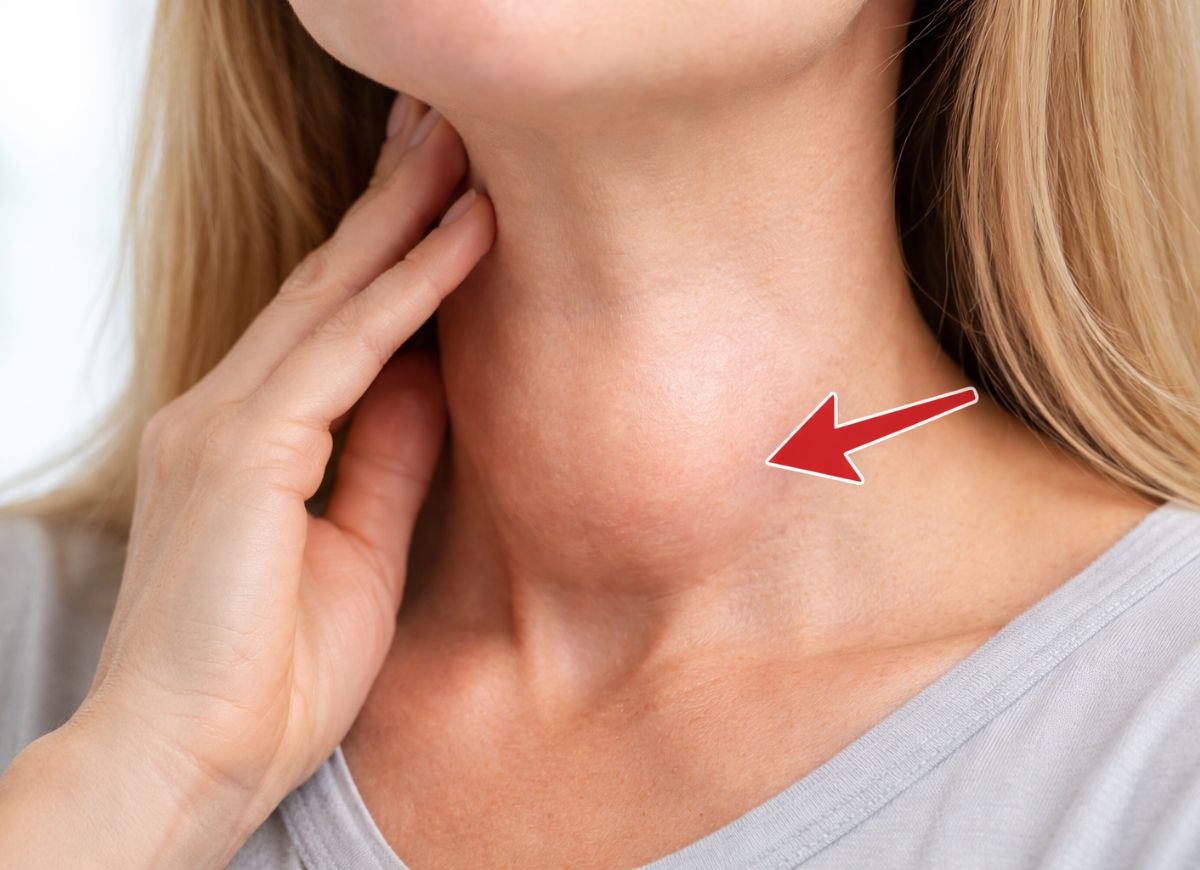
1. Visible lump or swelling. The hallmark sign. Swelling appears at the front of the neck, just below the Adam’s apple, ranging from barely noticeable to a large mass that changes the neck’s contour. The lump typically moves up and down when you swallow, because the thyroid is attached to the larynx (voice box). The enlargement can be symmetrical, affecting the whole gland (diffuse goiter), or uneven, caused by one or more distinct nodules (nodular goiter).
2. A feeling of tightness in the throat. Many people describe constant pressure, or a sense that their collar is too tight even when it isn’t, caused by the enlarged gland pressing against surrounding tissue and skin. It’s a subjective feeling of fullness or constriction that can occur even if the goiter isn’t large enough to cause real breathing or swallowing problems, and it can be a source of real discomfort and anxiety.
3. Prominent neck veins. With a very large goiter, especially one extending down into the upper chest (a substernal goiter), the gland can compress major veins in the neck and upper chest, such as the jugular veins. This obstructs blood returning to the heart and raises pressure in the veins, making them visibly distended or bulging. When triggered by raising the arms, this is known as Pemberton’s sign, and it indicates significant compression that warrants prompt medical evaluation.
4. Difficulty swallowing (dysphagia). The esophagus lies directly behind the thyroid and trachea, so an enlarging thyroid can push back and compress it, especially making solid foods hard to swallow. People may feel food sticking in the throat or chest, with discomfort, coughing, or choking at meals, and may adapt by avoiding certain foods, taking smaller bites, and chewing more thoroughly.
5. Difficulty breathing (dyspnea). The trachea sits in front of the esophagus and behind the thyroid, so a large goiter can narrow the airway. This may cause shortness of breath, especially during exertion or when lying flat, since gravity lets the goiter press harder on the windpipe. A high-pitched, noisy breathing sound called stridor can indicate significant airway obstruction and is a medical emergency.
6. Hoarse voice and coughing. The recurrent laryngeal nerves, which control the voice box muscles, run along the sides of the thyroid. A growing goiter can stretch or compress them, causing hoarseness, a weak or breathy voice, or vocal fatigue. Pressure on the trachea can also irritate its lining, causing a chronic dry cough that persists without any respiratory infection.
7. Symptoms of hyperthyroidism (overactive thyroid). When the goiter stems from a condition like Graves’ disease or toxic multinodular goiter, the thyroid makes too much hormone, speeding up metabolism:
- Unexplained weight loss despite normal or increased appetite
- Heart palpitations: a rapid, fluttering, or pounding heartbeat
- Increased sweating and heat intolerance
- Nervousness, anxiety, and irritability, a persistent “on edge” feeling
- Tremors, typically a fine shaking in the hands and fingers
- Fatigue and muscle weakness, feeling tired but “wired”
8. Symptoms of hypothyroidism (underactive thyroid). When the cause is something like Hashimoto’s disease or severe iodine deficiency, the thyroid underproduces hormones, slowing metabolism:
- Unexplained weight gain, with difficulty losing weight despite diet and exercise
- Fatigue and sluggishness
- Increased sensitivity to cold
- Dry skin and brittle or falling hair
- Constipation
- Depression and impaired memory, including “brain fog”
What Is a Goiter?
A goiter is the medical term for an abnormally enlarged thyroid gland, the butterfly-shaped organ at the base of the neck that makes hormones essential to regulating metabolism. “Goiter” and “enlarged thyroid” describe exactly the same condition. The thyroid’s main job is to make and release triiodothyronine (T3) and thyroxine (T4), which control how the body uses energy, affecting everything from heart rate and body temperature to digestion and brain function.
A goiter signals a disruption in the thyroid’s normal state, prompting it to grow. Fundamentally, it’s a response to an underlying issue that is causing inflammation, overstimulation, or a compensatory effort by the gland to make enough hormone. Size varies enormously, from a small enlargement only detectable on exam or imaging to a massive, visibly prominent swelling that causes compression in the neck.
The diagnosis of a goiter doesn’t by itself reveal the cause or how the gland is functioning, so it’s classified in several ways:
- By structure: diffuse (the whole gland is smoothly and uniformly enlarged) or nodular (one or more discrete lumps within the gland)
- By function: non-toxic (normal hormone production) or toxic (excess hormone, causing hyperthyroidism)
- A goiter can also occur alongside hypothyroidism, where the gland is enlarged but underproductive
In other words, a goiter is the starting point of a diagnosis that needs further investigation.
What Happens Inside the Neck
When the thyroid enlarges, its tissue expands at the front of the neck and can compress nearby structures like the trachea and esophagus. The thyroid is a highly vascular gland with two lobes joined by a strip of tissue called the isthmus, sitting in front of the windpipe just below the voice box. Normally soft and hard to feel, it grows when its cells multiply (hyperplasia) or increase in size (hypertrophy).
In a diffuse goiter, the whole gland swells smoothly, often from a systemic stimulus affecting it evenly. In Graves’ disease, for example, antibodies called thyroid-stimulating immunoglobulins (TSIs) mimic thyroid-stimulating hormone (TSH), driving the entire gland to become overactive and grow. In early Hashimoto’s disease, widespread inflammation can cause diffuse enlargement before the gland eventually shrinks.
In a nodular goiter, growth is uneven. One or more distinct solid or fluid-filled lumps form when a localized group of thyroid cells starts growing independently, producing a lumpy or asymmetrical enlargement. A single lump is a solitary nodule; several make a multinodular goiter. A diffuse goiter can become nodular over time, and nodules may be non-functional or “hot,” autonomously producing hormone and causing hyperthyroidism.
Common Causes
The most common causes are iodine deficiency worldwide, autoimmune diseases like Hashimoto’s and Graves’, thyroid nodules, and hormonal changes in pregnancy. A goiter is a general sign of a thyroid problem, and several distinct pathways can stimulate the gland to grow.
Iodine Deficiency
The leading cause of goiter worldwide. The thyroid needs iodine from the bloodstream to make T4 and T3. When dietary iodine is too low, the gland can’t make enough hormone, and the pituitary gland notices and raises its output of TSH. TSH does two things: it stimulates hormone production and it stimulates thyroid cell growth. Without iodine, the gland can’t respond by making more hormone, but it does respond to the growth signal. Persistently high TSH makes thyroid cells multiply in a compensatory effort to trap every last bit of iodine, gradually enlarging the whole gland into a diffuse goiter. Left untreated for years, it can progress to a large nodular goiter.
Hashimoto’s vs. Graves’ Disease
The key difference is opposite effects on hormone production: Hashimoto’s typically causes hypothyroidism, while Graves’ causes hyperthyroidism. Both are autoimmune disorders in which the immune system mistakenly attacks the thyroid, by different mechanisms, and both can enlarge the gland.
In Hashimoto’s, the immune system produces antibodies, mainly thyroid peroxidase (TPO) antibodies, that gradually destroy thyroid cells, causing chronic inflammation (lymphocytic thyroiditis). The inflammation swells the gland, making it firm and enlarged. As cells are destroyed, hormone output falls, leading to hypothyroidism. The pituitary responds to the low hormone levels by raising TSH, which further stimulates remaining tissue to grow and adds to the goiter’s size. The goiter is typically diffuse and non-tender.
In Graves’, the immune system produces TSIs, which mimic TSH, bind to TSH receptors on thyroid cells, and switch them on continuously. The gland grows and pours out excess hormone, producing both a diffuse goiter and hyperthyroidism. The goiter is typically soft and smooth, and a stethoscope may pick up a rushing sound (a bruit) from increased blood flow through the overactive gland.
When to Seek Medical Help
See a doctor if you notice visible swelling or a lump in your neck, or if you have a tight feeling in the throat, trouble swallowing or breathing, or voice changes. Any new neck mass deserves evaluation to determine its cause. Even a small, symptom-free goiter needs a proper diagnosis to understand its origin and monitor for change.
Are Goiter Symptoms Always Serious?
No. Many goiters, particularly simple or endemic ones from past iodine deficiency or unknown causes, are benign, grow very slowly, and cause no significant problems. Often the gland is enlarged but makes the right amount of hormone, called a euthyroid goiter, and may be more a cosmetic issue than a medical one, with watchful waiting or regular monitoring as the main approach.
Still, you can’t know a goiter is harmless without a thorough evaluation. Neck swelling could signal a treatable condition like Hashimoto’s or Graves’, which need management to prevent long-term consequences such as heart problems or osteoporosis. And while over 95% of thyroid nodules are benign, a small percentage are cancerous, so professional assessment is essential for anyone who finds a neck lump or swelling.
Symptoms Needing Immediate Attention
These indicate severe or rapid compression of vital neck structures, or other concerning features, and should be treated as emergencies:
- Significant breathing difficulty: struggling to breathe, shortness of breath at rest, or particular trouble breathing when lying down may indicate critical tracheal compression, and stridor is an especially alarming sign of severe airway obstruction
- Severe swallowing difficulty: mild trouble with solids can be chronic, but a sudden inability to swallow liquids or even saliva signals severe esophageal compression and needs immediate attention to prevent choking and dehydration
- Rapid growth: a goiter or nodule that grows noticeably larger over weeks to a few months should be evaluated promptly to rule out malignancy or other aggressive conditions
- Sudden severe pain in the thyroid area, which could indicate bleeding into a nodule or a rare aggressive form of thyroid inflammation or cancer
- A new or worsening hoarse voice with a hard, irregular, fixed lump (one that doesn’t move when you swallow), which can be suspicious for thyroid cancer invading the recurrent laryngeal nerve
How an Enlarged Thyroid Is Diagnosed
Diagnosis starts with a physical exam, in which the doctor feels the neck for enlargement, tenderness, or lumps. If a goiter is suspected, blood tests measure TSH, T4, and T3 to show whether it’s linked to hyperthyroidism or hypothyroidism. A thyroid ultrasound is then crucial for visualizing the gland’s size and structure and identifying nodules, showing whether the goiter is diffuse or nodular. If nodules look suspicious or cancer is a concern, a fine-needle aspiration biopsy uses a thin needle to take a small tissue sample, which is examined under a microscope to determine whether the cells are benign or malignant.
Goiter Treatment
Treatment is highly individualized, depending on size, cause, symptoms, and whether hormones are out of balance.
- Watchful waiting is often recommended for small, symptom-free, non-cancerous goiters with no hormonal issues, with regular monitoring to make sure it doesn’t grow or cause problems.
- Medication is the primary treatment when the cause is hypothyroidism or hyperthyroidism: levothyroxine replaces missing hormone in an underactive thyroid, and antithyroid drugs are used for an overactive one.
- Radioactive iodine therapy may be an option for goiters that don’t respond to medication or are significantly large; the thyroid absorbs the radioactive iodine, which causes it to shrink.
- Surgery (thyroidectomy), removing all or part of the gland, may be necessary when the goiter causes compressive symptoms like trouble breathing or swallowing, is suspected to be malignant, or is cosmetically distressing.
Preventing a Goiter
Whether a goiter can be prevented depends on its cause. Goiters from dietary iodine deficiency, common in developing regions, are highly preventable. Getting enough iodine from iodized salt, seafood, and dairy is the most effective measure, and widespread salt iodization has significantly reduced endemic goiter worldwide.
Not all goiters are preventable, however. Those caused by autoimmune disorders like Hashimoto’s or Graves’, where the immune system attacks the thyroid, can’t be prevented, nor can those from genetic factors, sporadic nodules, or certain benign or malignant tumors. Overall health is beneficial, but no specific action stops these types from developing, so prevention is mainly effective for goiters tied to nutritional deficiency.
Goiter vs. Thyroid Nodule
They’re often discussed together but are distinct.
A goiter is a generalized enlargement of the whole thyroid, often producing visible swelling at the base of the neck. It can be smooth (diffuse) or lumpy (nodular).
A thyroid nodule is a discrete, localized lump within an otherwise normal-sized or enlarged thyroid. It can be solid or fluid-filled, and a person can have one or several.
The relationship can be complex: a goiter can exist with no nodules, or be made up of many, as in a multinodular goiter. The vast majority of nodules are benign, but a small percentage are malignant. So while a goiter signals overall gland enlargement, a nodule is a specific growth that needs evaluation to determine its nature.
Frequently Asked Questions
Can a goiter be cured?
It can often be treated, but whether it’s curable depends on the cause. A goiter from iodine deficiency can often be reversed by restoring iodine through diet or supplements. For autoimmune-related goiter, as in Hashimoto’s or Graves’, there’s no true cure; treatment focuses on managing thyroid hormone levels with medication or, sometimes, surgery. Very large goiters may call for surgery or radioactive iodine. The symptoms can be managed, but the underlying thyroid disorder may need lifelong treatment.
What shrinks a goiter naturally?
No natural remedy is guaranteed. If iodine deficiency is the cause, increasing iodine through iodized salt, fish, dairy, and seaweed can help restore thyroid function. Selenium-rich foods like Brazil nuts, sunflower seeds, and tuna may support thyroid health, since selenium is involved in hormone metabolism. Any dietary changes should be part of a treatment plan supervised by a healthcare provider, and for autoimmune or dysfunction-related goiters, natural approaches alone likely won’t be enough.
What are five foods to avoid for thyroid health?
Certain foods can interfere with thyroid function, especially if you already have a disorder:
- Soy products can interfere with absorption of thyroid medication and may inhibit thyroid function, especially in hypothyroidism
- Cruciferous vegetables like broccoli, cauliflower, and cabbage contain goitrogens, which can interfere with iodine uptake; moderate amounts are generally fine, but excess may worsen problems, particularly with iodine deficiency
- Gluten may be worth avoiding for people with autoimmune thyroid disease like Hashimoto’s, as it may worsen inflammation and immune responses
- Processed foods and refined sugars can promote inflammation and contribute to obesity, complicating thyroid management
- Caffeine in excess can interfere with medication absorption and add jitteriness, anxiety, or a racing heart, which are already common with thyroid imbalances
Can a goiter go back to normal?
Sometimes. If iodine deficiency is the cause, restoring iodine through diet or supplements may return the thyroid to its usual size. For goiters caused by autoimmune disease, thyroid disorders, or other conditions, it may not shrink completely, and treatment aims to control hormone levels and symptoms instead. In severe or persistent cases, surgery may be needed to remove the enlarged tissue. Close work with your doctor is important to monitor it and choose the best course.
What happens if a goiter is left untreated?
Complications can include difficulty swallowing or breathing as the enlarged thyroid presses on the esophagus and windpipe, leading to choking, coughing, or throat tightness. Untreated goiters can also lead to hormone imbalances, hypothyroidism or hyperthyroidism, which disrupt metabolism, cause fatigue and weight changes, and can lead to more serious cardiovascular or metabolic problems. In rare cases, a goiter grows large enough to affect heart function, and it may raise the risk of thyroid cancer. Early diagnosis and treatment are essential.
What are surprising signs of a thyroid problem?
- Unexplained weight changes: gain with hypothyroidism, loss with hyperthyroidism
- Hair loss or brittle hair: thinning or brittle hair can signal hypothyroidism, while in hyperthyroidism hair may become fine and brittle
- Mood swings or depression: thyroid hormone changes can cause depression, anxiety, or irritability, particularly in hypothyroidism
- Irregular menstrual cycles: irregular or missed periods or changes in flow can occur with either condition
- Heat or cold sensitivity: feeling unusually cold (hypothyroidism) or overly hot (hyperthyroidism)
What causes a goiter on the neck?
Enlargement of the thyroid, the hormone-producing gland at the base of the neck. The most common cause is iodine deficiency, which impairs hormone production. Autoimmune conditions like Hashimoto’s (leading to hypothyroidism) and Graves’ (causing hyperthyroidism) are also common culprits. Noncancerous thyroid nodules can contribute, and in some cases thyroid cancer or certain medications can lead to a goiter.
How long does it take to treat a goiter?
It depends on the cause and treatment. With iodine deficiency, symptoms may improve within a few weeks of supplementation. With autoimmune thyroid disease, it may take several months for medication to stabilize hormone levels. If the goiter is large or causing complications, surgery may be needed, with several weeks of recovery. Early intervention and consistent management are key to keeping it from worsening.
At what age can thyroid problems start?
At any age, but they’re most commonly diagnosed in adults, particularly women over 40. They can also begin in childhood or adolescence, especially with autoimmune conditions like Hashimoto’s or Graves’. Hypothyroidism and hyperthyroidism can develop at any stage, though age-related changes make thyroid issues more common in older adults. Being aware of the signs, especially as you age, helps early diagnosis and prevents long-term complications.
The Bottom Line
Goiters may seem like a minor concern, but they’re often a symptom of underlying thyroid problems that need attention. Recognizing early signs and understanding the possible causes of an enlarged thyroid helps you seek timely treatment. Whether the cause is iodine deficiency, autoimmune disease, or something else, addressing the root cause is key to managing the condition effectively. By making the right lifestyle changes, staying informed, and working with a healthcare professional, you can significantly reduce the impact of a goiter on your health. Don’t wait for symptoms to worsen: take action now to protect your thyroid and overall well-being.