Ankle Surgery: What to Expect, Recovery Time, and Risks
Facing ankle surgery can feel overwhelming, especially when walking, standing, or even getting out of bed already hurts. Your ankle carries your body weight, keeps you balanced, and powers nearly every step you take. When an injury or condition damages it, everyday life becomes painful and limited.
Doctors usually suggest surgery when a fracture is unstable, a torn ligament won’t heal, arthritis has badly damaged the joint, or other treatments no longer help. For some people this follows a sudden accident. For others it comes after months or years of pain, swelling, stiffness, or an ankle that keeps giving way.
It’s natural to have questions. What happens during the operation? How long is recovery? When can I walk again? Will it hurt? What could go wrong? Ankle healing takes patience, and the process usually involves rest, swelling control, a splint or cast, physical therapy, follow-up visits, and a slow return to movement.
Not all ankle surgeries are alike. Some use plates or screws to fix broken bones. Others rebuild ligaments, clear out damaged tissue, fuse a painful joint, or, in selected cases, replace the joint. Your recovery depends on the type of surgery, your age, general health, bone quality, and how closely you follow aftercare instructions.
This guide walks through what ankle surgery involves, what to expect before and after, how recovery usually unfolds, and which risks to discuss with your doctor.
Common Types of Ankle Surgery
Four main operations are commonly performed on the ankle:
- Ankle fusion (arthrodesis): for severe arthritis
- Total ankle replacement (arthroplasty): a motion-preserving alternative to fusion
- Fracture surgery (ORIF): to stabilize broken bones
- Ligament reconstruction: for long-term instability
Your surgeon chooses based on your condition, age, activity level, and the overall health of the joint.
Ankle Fusion (arthrodesis) Procedure
Ankle fusion, medically called tibiotalar arthrodesis, permanently joins the tibia (shin bone) and the talus into one solid bone. It is considered the gold standard for end-stage ankle arthritis, where worn-out cartilage leaves bone grinding on bone and causes severe pain, inflammation, and deformity.
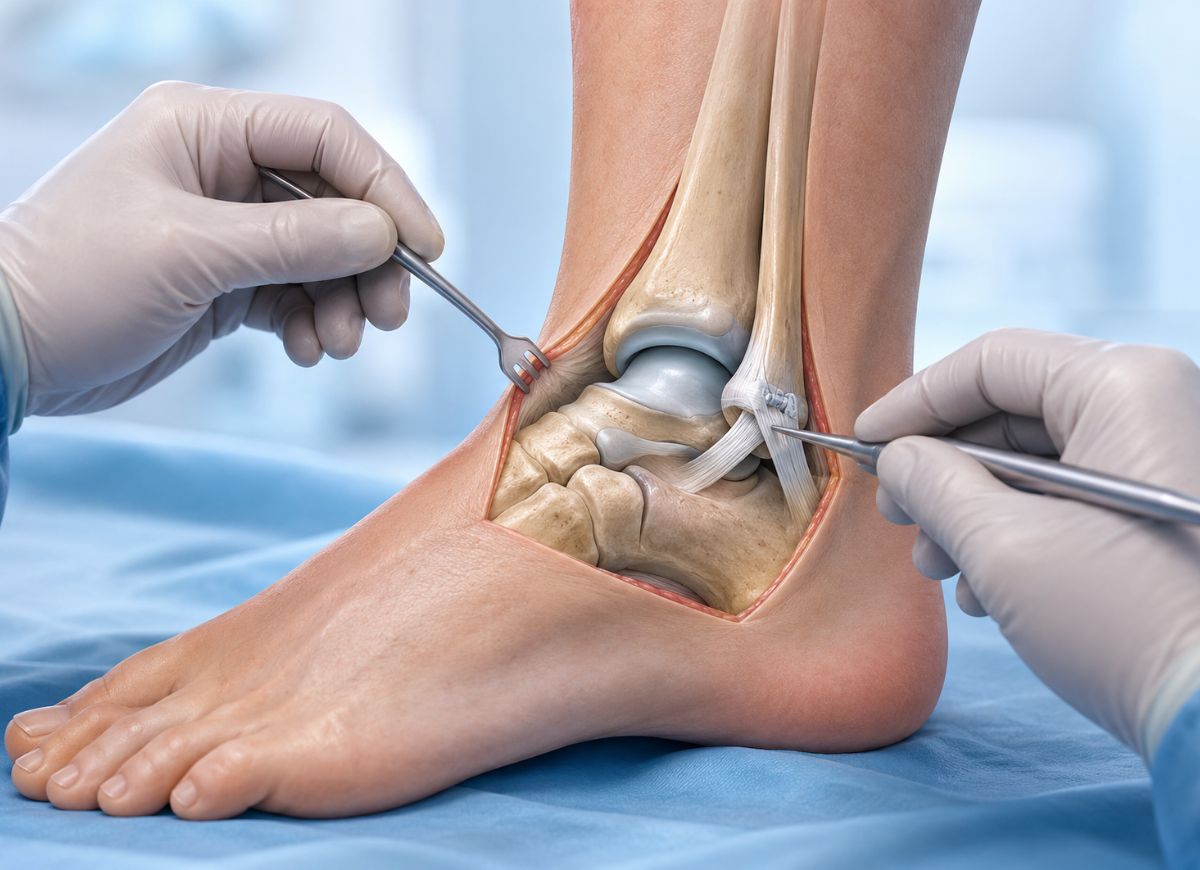
Because the joint no longer moves, the source of arthritic pain is removed. The surgeon opens the ankle, clears away any remaining damaged cartilage from both bones, and may add bone graft to encourage fusion. The bones are then lined up and pressed together with large screws, sometimes with plates, and held still while they heal into one.
Fusion gives excellent pain relief and a stable base for walking. The trade-off is that the ankle can no longer move up and down (dorsiflexion and plantarflexion).
To make up for this, nearby foot joints such as the subtalar and talonavicular joints may become slightly more mobile over time. That extra load can lead to arthritis in those joints years later. Most people walk fairly normally on flat ground, with a slightly altered gait, but may struggle with slopes, stairs, and running.
Total Ankle Replacement (Arthroplasty)?
Total ankle replacement (TAA) removes the damaged bone and cartilage and replaces them with an implant designed to move like a natural joint. It’s the main alternative to fusion for people with severe arthritis who want to keep their range of motion.
The implant has three parts: a polished metal piece that caps the bottom of the tibia, another that caps the top of the talus, and a medical-grade plastic (polyethylene) spacer between them that lets the joint glide smoothly.
TAA has two goals: to relieve arthritis pain and to preserve natural ankle motion, which makes walking feel more normal and makes stairs and uneven ground easier.
It is usually recommended for older patients (generally over 60) with lower physical demands, because implants wear over time and may need revision surgery. Good candidates have healthy bone, little deformity, and intact ligaments to support the implant.
Unlike fusion, which is permanent, a replacement is a mechanical device that can wear out, loosen, or fail. This is a key factor when deciding between the two. Success depends heavily on precise surgical technique and committed rehabilitation afterward.
Ankle Fracture surgery (ORIF)
Ankle fracture surgery, most often Open Reduction and Internal Fixation (ORIF), realigns and secures badly broken bones so they heal in the right position. It’s needed when a fracture is displaced (fragments out of line), unstable (the joint is no longer secure), or open (bone has pierced the skin). The operation has two parts.
Open reduction means the surgeon makes an incision over the break to see the bones directly and move the fragments back into their normal position.
Internal fixation comes next. The surgeon uses medical-grade hardware such as plates, screws, wires, or rods to hold the pieces together. This hardware acts like an internal splint while the bone heals.
The main aim is to restore the exact shape of the ankle joint. Even a small misalignment changes how the joint carries load, puts uneven pressure on the cartilage, and raises the risk of post-traumatic arthritis. After surgery, the ankle is placed in a cast or boot, and you’ll usually need to keep weight off the leg for several weeks.
Ankle Ligament Reconstruction Surgery
This surgery repairs or rebuilds the ligaments on the outer side of the ankle to treat chronic instability. It often develops after repeated sprains have stretched or torn the anterior talofibular ligament (ATFL) and calcaneofibular ligament (CFL) beyond their ability to heal.
People with chronic instability feel their ankle repeatedly “give way” and have recurring sprains, pain, and swelling that bracing and physical therapy haven’t fixed.
There are two main approaches. The first is anatomical repair, such as the modified Broström-Gould procedure. Your own stretched ligaments are tightened and stitched back to the fibula, often reinforced with nearby tissue for extra strength.
The second is reconstruction, used when your ligaments are too damaged for repair. The surgeon builds new ligaments from a tendon graft, either an autograft (taken from your own body, such as the hamstring or peroneal tendons) or an allograft (from a donor). The graft is threaded through tunnels drilled in the bone and fixed in place to mimic the original ligaments.
The goal is to restore stability, prevent further sprains, and protect the joint cartilage from long-term wear caused by instability.
Potential Risks and Complications of Ankle Surgery
Risks fall into two groups. Short-term problems include infection, blood clots, and reactions to anesthesia. Long-term problems include nerve damage, bones that fail to heal, and implant trouble. Surgeons take many precautions, but every operation carries some risk, and you should understand them before you consent.
Your personal risk depends on the type of surgery, your general health, and how well you follow aftercare instructions. For example, smoking, diabetes, and obesity raise the risk of poor wound healing and infection.
Immediate Risks During and Right After Surgery
The most pressing early risks are anesthesia reactions, heavy bleeding, infection at the surgical site, and dangerous blood clots. These usually show up within the first days or weeks and need prompt medical attention.
Anesthesia is generally safe, but it carries a small risk of allergic reaction, breathing difficulty, or heart problems, which the anesthesia team monitors closely. Heavy bleeding is rare, but it can occasionally require a transfusion.
Infection is one of the most common worries. A superficial infection affects the skin around the incision, causing redness, pain, and drainage, and can usually be treated with oral antibiotics.
A deep infection is far more serious. It can reach the bone (osteomyelitis) or the hardware, and often means another operation to clean out infected tissue plus a long course of IV antibiotics.
Blood clots, known as deep vein thrombosis (DVT), can form in the leg veins, and the immobility after ankle surgery raises this risk. A DVT may cause calf pain and swelling. The real danger is a piece breaking off and traveling to the lungs, causing a life-threatening pulmonary embolism (PE). To lower the risk, surgeons often prescribe blood thinners and encourage gentle foot and ankle movement.
Long-term Complications Associated with Ankle Procedures
Long-term complications mainly include lasting nerve damage, nonunion or malunion of bones, post-traumatic arthritis, and chronic pain or stiffness. They may not appear for months or even years.
Nerve damage is a real risk because nerves such as the sural and superficial peroneal run close to common surgical sites. They can be stretched, compressed, or accidentally cut, leading to numbness, tingling, or burning in the foot. Sometimes a painful nerve scar called a neuroma forms.
Nonunion means a fracture or fusion doesn’t heal completely, leaving a gap between the bone ends. It causes ongoing pain and instability and almost always requires revision surgery with bone grafting.
Malunion means the bones heal in the wrong position. This can change how the ankle and foot work, causing an abnormal gait, chronic pain, and faster cartilage wear.
Then there’s post-traumatic arthritis. Even with flawless surgery, the original injury may have damaged the joint cartilage, so arthritis can develop years later. Finally, some people have lasting stiffness or limited motion despite successful surgery and diligent rehab.
Implant Failure
Implant failure is a well-recognized risk, especially with hardware-based procedures such as total ankle replacement and ORIF. What goes wrong depends on the implant.
In ORIF, plates and screws bear enormous mechanical stress. If you put weight on the leg too early, or the bone fails to heal, the hardware can loosen, bend, or break. This usually needs revision surgery to replace the implant and deal with the healing problem. Screws can also work their way out over time and irritate the tissue above them, sometimes requiring a minor procedure to remove them once the bone has healed.
With total ankle replacement, the concern is long-term durability. The plastic component can wear down over decades, much like a tire tread. This creates tiny particles that trigger inflammation, leading to bone loss around the implant (osteolysis) and loosening of the metal parts (aseptic loosening).
When a replacement wears out or loosens, pain and instability return, and a complex revision surgery is needed. Because the lifespan of a replacement is limited, implant failure is an important consideration, particularly for younger, more active patients.
Healing Timeline for Ankle Surgery
Ankle healing is a slow, multi-stage process, usually lasting six months to over a year. It starts with a strict no-weight period, moves to gradual weight-bearing with physical therapy, and ends with a return to full activity. The exact timing depends on the type of surgery, your age, general health, and your commitment to rehab.
In the First Two Weeks After Ankle Surgery
The first two weeks are about controlling pain and swelling, protecting the surgical site, and strictly staying off the foot. This phase sets the stage for healing. Right after surgery, your ankle goes into a padded splint or temporary cast to keep the joint still and protect the repair.
The most important instruction is elevation. Keep your leg above heart level as much as possible, ideally almost all day, so gravity helps drain fluid. Too much swelling increases pain, slows wound healing, and raises infection risk.
Pain is managed with prescribed medication, either narcotic or non-narcotic, and ice packs over the splint. Keep the incision clean and dry at all times, which means covering your leg with a waterproof bag when you shower. You must not put any pressure on the foot.
Getting around requires crutches, a walker, or a knee scooter. A follow-up visit around 10 to 14 days after surgery is typical, when the stitches or staples come out, the wound is checked, and the first post-surgery X-rays are often taken.
When to Start Bearing Weight After Surgery?
Most people can begin putting weight on the ankle between 6 and 12 weeks after surgery. The change is gradual, and your surgeon decides based on X-ray evidence of bone healing. A simple fracture repair may allow earlier weight-bearing, while a complex fracture, fusion, or replacement needs longer protection.
The move away from non-weight-bearing is carefully managed. It usually starts with a removable walking boot, also called a CAM (controlled ankle motion) boot. First comes touch-down weight-bearing, where you lightly rest your foot on the floor for balance without supporting body weight.
Over the next several weeks you progress to partial weight-bearing, for example 25%, then 50%, 75%, and finally 100% of your body weight. Your surgeon and physical therapist guide each step to keep it safe and pain-free.
Crutches or a walker are essential during this phase to control how much weight you put down. Rushing can cause the fixation to fail or delay healing. You can only walk without the boot once the bone has healed enough and your strength and stability have returned.
How Long Does Physical Therapy for Ankle Recovery Last?
Formal physical therapy is essential and typically lasts three to six months. For athletes or people with complex reconstructions, it can continue for a year or longer.
Therapy usually begins once you’re cleared to put some weight on the foot. It matters enormously: surgery fixes the structure, but rehab restores the function. Length and intensity are tailored to your progress and goals.
The first stage uses gentle range-of-motion work to reduce stiffness. Therapists use hands-on techniques and targeted exercises to help you regain upward and downward ankle motion. As healing advances and you can bear more weight, the focus shifts to strengthening the ankle, calf, and whole leg, since these muscles weaken from disuse.
Later stages add balance and proprioception training, which retrains your sense of joint position and helps prevent falls and re-injury. Your therapist will also work on your gait so you can walk without a limp.
Therapy sessions may happen two to three times a week, and you’ll also be expected to do a daily home exercise program. Full recovery, meaning a return to all your desired activities including running and high-impact sports, can take a full year.
Other Factors to Consider Before and After Ankle Surgery
Beyond the operation itself, it helps to think about preparing your home and lifestyle, comparing surgical techniques, looking at non-surgical options, and talking openly with your surgeon. Understanding these areas lets you make informed choices that fit your circumstances and recovery goals. Each one shapes your experience from the first consultation through the final stage of rehab.
How to Prepare Your Home and Lifestyle for Recovery
Getting your home and routines ready makes recovery safer and more comfortable. Since mobility will be very limited in the early weeks, an accessible space prevents complications and reduces stress.
The main goal is to avoid stairs and obstacles. If possible, set up a temporary living area on the ground floor with a comfortable bed or recliner and keep essentials within reach: phone, medications, water, snacks, TV remote, and reading material.
Clear walkways by removing rugs, cords, and clutter that could trip you. In the bathroom, a shower chair, handheld shower head, and non-slip mats make hygiene safer. Cooking and freezing meals ahead, or arranging meal delivery, also takes pressure off.
A good support system matters just as much. You’ll need rides to the hospital and follow-up visits. Ask family, friends, or neighbors to help with groceries, chores, and looking after pets or children.
Talk with your surgeon and employer about the expected recovery time so you can arrange enough time off. If your job is physically demanding, you may need a longer leave or temporary changes to your duties.
Finally, stock up on loose clothing like sweatpants or shorts that slip easily over a cast or boot without disturbing the incision.
Is Minimally Invasive Ankle Surgery Better Than Traditional Open Surgery?
Whether minimally invasive surgery is better depends on your specific condition, how much damage there is, and your surgeon’s expertise.
Minimally invasive surgery, usually arthroscopy, uses a few small incisions through which a tiny camera (arthroscope) and specialized tools are inserted. It’s often preferred for cartilage repair, removing loose fragments, and cleaning out inflamed tissue.
Traditional open surgery uses a larger incision that gives the surgeon a direct, wide view of the joint. It’s typically needed for complex procedures such as total ankle replacement, major fracture repair with plates and screws, or severe ligament reconstruction requiring broad access.
Neither approach is universally better. The right one is whichever gives the best result for your diagnosis. The main differences affect recovery and complications:
- Scarring and tissue damage: Arthroscopy leaves smaller, less noticeable scars and disturbs less soft tissue. Open surgery leaves a larger scar and causes more tissue disruption.
- Pain and recovery: Minimally invasive procedures often mean less pain, lower infection risk, and a faster early recovery, which can mean returning to daily activities sooner.
- Suitability: Arthroscopy works very well for many problems inside the joint, but not all conditions. Open surgery gives the access and visibility needed for complex reconstructions and implants that can’t be done through small portals.
Effective Non-surgical Alternatives to Ankle Surgery
For many ankle problems, non-surgical treatment is the first step before an operation is considered. These conservative options aim to reduce pain and inflammation, improve function, and let the body heal without invasive procedures.
The usual starting point is the RICE protocol: Rest, Ice, Compression, and Elevation. It’s simple but effective for controlling swelling and pain right after an injury. Beyond that, physical therapy is the cornerstone of non-operative care.
A skilled therapist builds a customized program to restore motion, strengthen the supporting muscles, and improve balance and proprioception. This aids recovery and helps prevent future injuries. Depending on your diagnosis, your doctor may also recommend a brace or custom orthotics to support the joint and correct mechanical problems behind your pain.
Medical treatments can also help delay or avoid surgery. For persistent inflammation, corticosteroid injections deliver a strong anti-inflammatory directly to the area, giving temporary but often significant relief. Biologic injections such as platelet-rich plasma (PRP) are also used to promote healing in some soft-tissue injuries.
Simple lifestyle changes can make a big difference too: losing weight to reduce joint stress, avoiding aggravating activities, and wearing supportive shoes.
Specific Questions to Ask your Orthopedic Surgeon
A detailed conversation with your surgeon helps you set realistic expectations and make a well-informed decision. Coming prepared with questions makes sure your concerns are covered and builds trust between you and your doctor.
Your questions should cover the surgeon’s background, the details of the proposed procedure, recovery, and likely outcomes. If you don’t understand a medical term, ask. A good surgeon will welcome your questions and answer clearly.
For example, asking about the surgeon’s experience with your procedure can give you peace of mind, and understanding the technique helps you picture what will happen. Ask about the type of anesthesia and the pain-management plan so you’re ready for the first days afterward.
You should leave the consultation feeling confident about what’s ahead. Here are questions grouped by topic:
About the Surgeon and Procedure
- How many of these ankle surgeries do you perform each year?
- Which technique (arthroscopic or open) do you recommend for me, and why?
- Will screws or plates be used, and will they need to be removed later?
Risks and Outcomes
- What are the most common complications of this surgery?
- What is the success rate for patients with a condition like mine?
- What is the best-case outcome for my recovery, and what is a more realistic one?
Recovery and Rehabilitation
- What will my recovery timeline look like?
- How long will I be non-weight-bearing?
- When will physical therapy start, and how long will it last?
- When can I realistically return to work, driving, and recreational activities?
FAQs
1. How painful is foot surgery?
Pain after foot or ankle surgery is common, especially in the first few days. How much you feel depends on the procedure, the injury, swelling, nerve sensitivity, and your own pain tolerance.
Most patients get pain medication, icing and elevation instructions, and sometimes a nerve block. Pain should gradually ease as you heal. Tell your doctor right away if pain gets worse, or if you notice sudden numbness, blue toes, fever, or a bandage that feels too tight.
2. How long does it take to walk after ankle surgery?
It depends on the surgery. Some people start partial weight-bearing within a few weeks, while others must keep weight off the ankle for 6 to 12 weeks.
Complex fractures, ligament repairs, fusions, and joint replacements can need a longer plan. Doctors decide when walking is safe based on X-rays, wound healing, pain, swelling, and stability. You may need a boot, crutches, a walker, or physical therapy during the transition.
3. What to expect after ankle surgery?
Expect swelling, bruising, soreness, and limited movement. Your ankle will likely be in a splint, cast, or boot to protect the repair. Most patients are told to elevate the leg, keep the incision dry, avoid weight-bearing, and attend follow-up checks.
Stitches or staples are usually removed once the wound starts to heal, and physical therapy begins later to rebuild motion, strength, and balance. Recovery can feel slow, but steady progress is a good sign.
4. Is ankle surgery a big surgery?
It can be, depending on what’s being repaired. Removing a small piece of damaged tissue is very different from treating a displaced fracture, fusing the joint, reconstructing ligaments, or replacing the ankle.
Even with a small incision, the ankle bears your weight, so healing needs careful protection. Take ankle surgery seriously and follow your surgeon’s instructions closely.
5. How long to stay in bed after ankle surgery?
Most people shouldn’t stay in bed all day unless their doctor says so. Rest matters, especially in the first few days, but safe movement helps reduce stiffness and lowers the risk of blood clots. Many patients are told to elevate the leg often while swelling is high.
Short trips to the bathroom or around the house may be allowed with crutches, a walker, or someone’s help. The exact activity level depends on the surgery and your medical condition.
6. Do I need a wheelchair after ankle surgery?
Some people do, but not everyone. A wheelchair can help if you can’t safely use crutches, have poor balance, must avoid weight-bearing for several weeks, or have surgery on both legs.
Others manage with crutches, a knee scooter, a walker, or a walking boot once the surgeon clears them. The safest choice depends on your strength, home layout, pain level, and weight-bearing restrictions.
Conclusion
Ankle surgery can repair damage, reduce pain, and restore stability when injury or disease affects the joint. Recovery, however, takes time. Your ankle supports your weight with every step, so healing needs protection, patience, and careful follow-up.
Pain, swelling, limited movement, and temporary walking restrictions are normal in the early stages. Some people are moving again within weeks, while others need several months before they feel steady. Your timeline depends on the procedure, the severity of the problem, your overall health, and how well you follow aftercare instructions.
Before surgery, ask clear questions about pain control, weight-bearing limits, mobility aids, physical therapy, wound care, and warning signs. A well-prepared patient usually feels calmer and more confident during recovery. With the right care plan and regular medical guidance, ankle surgery can be the first step toward safer movement and everyday comfort.