
What Does Scabies Look Like? A Guide to Its Stages, Symptoms, and Treatment
If you are wondering what scabies looks like, you are not alone. Scabies is a contagious skin condition that can cause severe itching, irritation, and noticeable changes to the skin. Learning how scabies appears during its different stages can make it easier to recognize the condition and seek appropriate medical care.
Scabies may begin with tiny bumps, subtle lines, or mild irritation before developing into a more noticeable rash. In more serious cases, the skin can become severely inflamed, crusted, or damaged from repeated scratching. Knowing these signs can help you understand when a skin problem may need professional attention.
In this guide, we will explain what scabies can look like from the earliest symptoms through more advanced stages. We will also discuss its common locations, how it differs from other rashes, diagnosis, treatment, and what the skin may look like after treatment.
What Does Scabies Look Like at Different Stages?
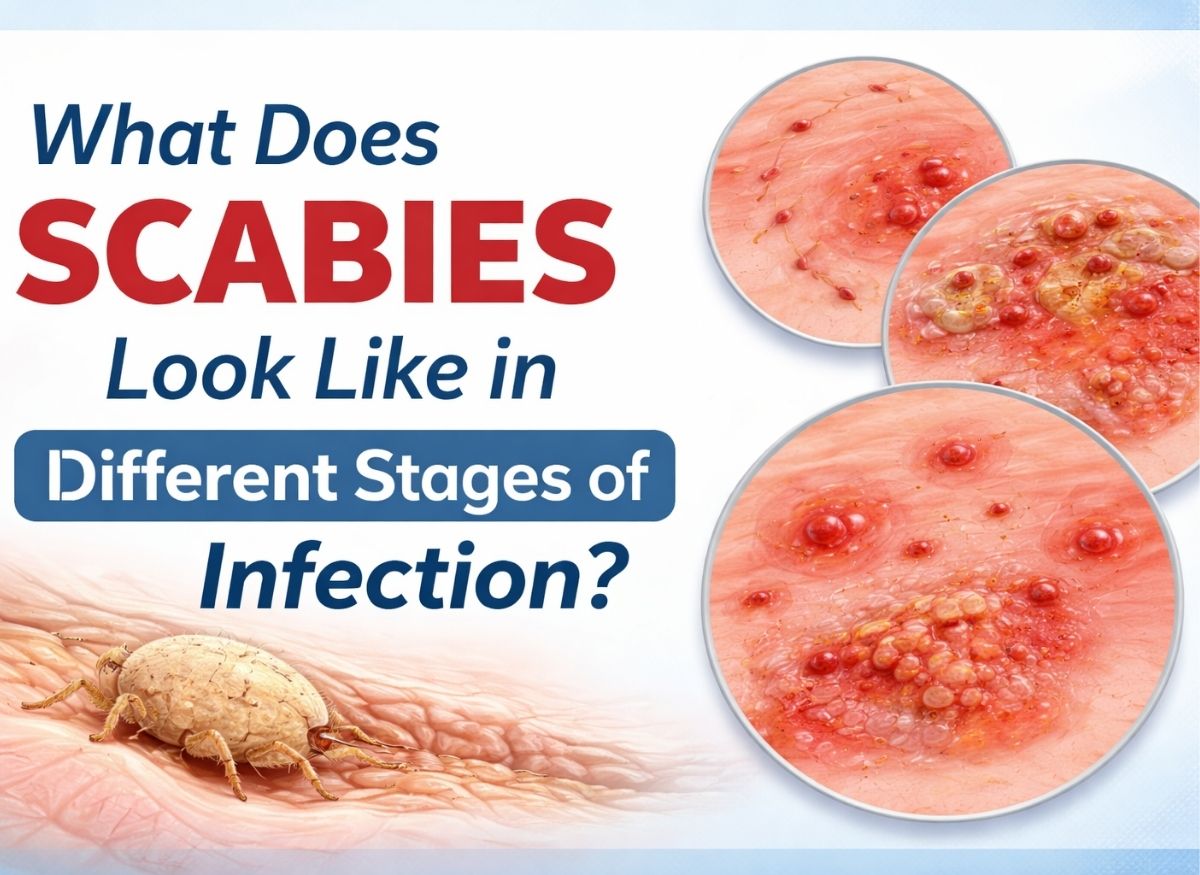
The appearance of scabies can change as the infestation develops. Early signs may be difficult to notice, while a more established infestation can produce obvious bumps, burrows, redness, and intense itching.
Scabies is caused by the microscopic mite Sarcoptes scabiei, which burrows into the upper layer of the skin. The body’s immune response to the mites and their products contributes to the itching and rash.
Early symptoms can sometimes resemble eczema, an allergic reaction, heat rash, or insect bites. As the condition progresses, however, the combination of severe itching and characteristic skin findings can make scabies easier to suspect.
Early-Stage Scabies: Recognizing the First Signs
During the early stage, scabies can be surprisingly difficult to identify. The rash may be limited to a few small bumps or barely noticeable burrows.
One of the characteristic signs is a scabies burrow. A burrow is a thin, slightly raised line created when a female mite moves beneath the surface of the skin. These marks may look gray, skin-colored, or slightly darker than the surrounding skin.
Common early findings include:
- Small raised lines: Burrows are usually short and may appear as thin, thread-like marks.
- Curved or irregular tracks: The lines may have a slightly winding appearance rather than being perfectly straight.
- Small red bumps: Papules can develop around areas where mites have burrowed.
- Tiny blisters: Some people develop small fluid-filled spots alongside the rash.
Burrows are commonly found between the fingers, around the wrists, and in skin folds. Other frequently affected areas include the elbows, armpits, waist, buttocks, and genital region.
In babies and young children, scabies may affect areas that are less typical in adults, including the scalp, face, palms, and soles.
When someone has never had scabies before, symptoms may take several weeks to appear after the initial infestation. During this period, the person may still be able to spread the condition to close contacts.
The Fully Developed Scabies Rash
As the infestation continues, the skin reaction can become much more noticeable. Instead of only a few isolated marks, a person may develop numerous itchy bumps, redness, scratches, and irritated patches.
The itching is often particularly intense at night. Repeated scratching can significantly change the appearance of the original rash.
Common changes include:
- Scratch marks: Repeated scratching can leave linear scratches and areas of broken skin.
- Crusted or irritated sores: Damaged skin may develop crusts or scabs.
- Secondary infections: Bacteria can enter scratched or broken skin and cause infection.
- Scabies nodules: Some people develop firm, reddish-brown itchy lumps, especially around the groin or armpits.
Because scratching can destroy or hide the original burrows, identifying scabies visually may become more difficult as the condition progresses. A healthcare professional may need to examine the skin closely or perform additional testing.
Crusted or Norwegian Scabies
Crusted scabies is a severe form of the condition that occurs when extremely large numbers of mites are present in the skin. It is more likely to occur in people with weakened immune systems, older adults, or individuals with certain medical conditions.
Unlike ordinary scabies, crusted scabies can produce:
- Thick gray, yellow, or whitish crusts
- Extensive scaling
- Cracked or fissured skin
- Widespread skin involvement
- Changes around the nails or scalp
The crusts can contain very large numbers of mites and eggs, making this form particularly contagious.
Crusted scabies requires prompt medical treatment. Anyone who suspects this severe form should seek professional care rather than attempting to manage it with home remedies alone.
What Does Scabies Look Like? Common Symptoms to Watch For
The most recognizable symptom of scabies is persistent itching, often accompanied by a distinctive rash and, in some cases, visible burrows.
These symptoms can sometimes resemble other skin conditions, so the overall pattern and distribution are important.
Severe Itching, Especially at Night
One of the classic features of scabies is itching that becomes worse at night. The discomfort can interfere with sleep and may lead to repeated scratching.
The itching occurs largely because the immune system reacts to the mites and material associated with them inside the skin. People experiencing scabies for the first time may not develop noticeable symptoms immediately. Those who have previously had scabies can develop symptoms much sooner after another exposure.
Nighttime itching by itself does not prove that someone has scabies, but when it occurs together with characteristic bumps or burrows, it can be an important clue.
Where Does the Scabies Rash Usually Appear?
Scabies often affects areas where the skin is relatively thin or where skin folds create a warm environment.
Common locations include:
- Between the fingers
- Wrists
- Elbows
- Armpits
- Around the waist
- Buttocks
- Groin
- Genital area
- Around the nipples
In men, itchy nodules can sometimes develop around the penis or scrotum.
The distribution can help a healthcare professional distinguish scabies from other itchy skin conditions.
How Scabies Can Look Different in Babies and Older Adults
Scabies does not always look the same in every person.
Scabies in Babies and Young Children
Infants and young children can develop scabies in areas that are less commonly affected in adults. The rash may involve:
- Face
- Scalp
- Neck
- Palms
- Soles
- Hands
Children may also develop small blisters and may become unusually irritable because of the itching.
Because these symptoms can resemble other childhood skin conditions, professional evaluation is especially important when scabies is suspected.
Scabies in Older Adults and People With Weakened Immunity
Older adults and people with weakened immune systems may develop unusual or more severe forms of scabies.
In some cases, the typical intense itching may be less obvious. Instead, the skin can become extensively scaly or crusted. This can make the condition harder to recognize and may delay treatment.
Crusted scabies is particularly contagious and requires medical attention.
Key Features That Can Help Identify Scabies
The combination of intense itching, especially at night, characteristic body locations, and possible burrows can raise suspicion of scabies.
For example, a very itchy rash between the fingers or around the wrists is more suggestive of scabies than a rash appearing randomly over the body. However, symptoms can overlap with many other skin conditions, so appearance alone should not be considered a definitive diagnosis.
If you have persistent itching or an unexplained rash, a healthcare professional can help determine the cause.
How Is a Scabies Rash Different From Other Rashes?
Several skin conditions can cause itching, redness, bumps, or irritation. Scabies can be confused with eczema, insect bites, allergic reactions, and other rashes.
One of its characteristic features is the presence of burrows combined with a typical distribution and intense itching.
Scabies vs. Eczema
Both scabies and eczema can cause red, itchy, irritated skin, but they often have different patterns.
Scabies commonly produces small papules and possible burrows, particularly around the finger webs, wrists, waist, armpits, and groin.
Eczema more often causes larger areas of dry, inflamed, scaly, or thickened skin. Depending on the type and severity, eczema may also become cracked, weepy, or crusted.
The two conditions can sometimes overlap. Extensive scratching from scabies may cause an eczema-like appearance, making diagnosis more challenging.
A healthcare professional may therefore look carefully for burrows and consider the patient’s symptoms, exposure history, and rash distribution.
Scabies vs. Bed Bug Bites
Scabies and bed bug bites can both cause itchy red bumps, but their patterns are often different.
Bed bug bites commonly appear as individual raised welts or groups of bites on exposed skin. They may occur in clusters or lines.
Scabies usually causes a broader itchy eruption and may include burrows, especially between the fingers, around the wrists, or in other characteristic areas.
Another important distinction is that bed bugs bite exposed skin while feeding, whereas scabies mites live within the outer layer of the skin.
Because appearances can overlap, a rash should not be diagnosed solely by looking at photographs or the arrangement of bumps.
What Should You Do If You Suspect Scabies?
If you notice a persistent itchy rash that resembles scabies, particularly when itching becomes worse at night, it is important to seek medical advice.
A healthcare professional can assess the rash and determine whether scabies is likely or whether another skin condition may be responsible.
Early diagnosis and appropriate treatment can help reduce symptoms and limit transmission to household members and other close contacts.
How Doctors Diagnose Scabies
Doctors often diagnose scabies by combining the person’s symptoms, medical history, exposure history, and physical examination.
A clinician may look closely for characteristic burrows and examine common locations such as the hands, wrists, waist, and genital region.
In some cases, a skin scraping may be performed. A small sample from a suspected area can be examined under a microscope for mites, eggs, or mite waste.
A negative scraping does not always completely exclude scabies because the sample may not contain a mite even when an infestation is present.
Another method sometimes used to identify burrows is the ink test, in which ink is placed over a suspected burrow. The ink may enter the tunnel and make its path easier to see.
Dermatoscopy can also help healthcare professionals examine suspicious areas at greater magnification.
Scabies in Infants and Older Adults
The appearance of scabies can vary according to age and health status.
In infants, the rash may be more widespread and may involve the scalp, face, palms, and soles. Small blisters can also occur.
Older adults and people with weakened immune systems can sometimes develop extensive or crusted scabies. In these cases, the skin may appear thick, flaky, or crusted rather than showing only the small bumps commonly associated with ordinary scabies.
Because severe cases can be highly contagious, medical evaluation is particularly important.
Preventing Reinfection and Managing the Home
Treating the person with scabies is important, but preventing reinfection also involves following medical advice about close contacts and household items.
Clothing, bedding, and towels that have been used recently may need to be washed and dried according to healthcare guidance. Items that cannot be washed may sometimes be placed in a sealed bag for an appropriate period.
Vacuuming carpets, furniture, and other frequently used areas can also be part of environmental control.
The exact cleaning approach depends on the situation and the form of scabies involved. Crusted scabies may require particularly thorough environmental precautions because of the much larger number of mites present.
What Does Scabies Look Like After Treatment?
The skin does not necessarily return to normal immediately after successful treatment.
Itching can continue for several weeks even after the mites have been eliminated. This is commonly called post-scabetic itch.
The continuing symptoms happen because the immune system can remain sensitive to material left behind by the mites even after the infestation has been treated.
Therefore, continued itching does not automatically mean that treatment has failed.
However, new burrows, new bumps, worsening symptoms, or persistent symptoms should be discussed with a healthcare professional because they may indicate reinfestation, an incomplete response to treatment, or another skin problem.
How to Soothe the Skin During Recovery
After treatment, the main goal is often to calm irritation and allow the skin barrier to recover.
Helpful measures may include:
- Applying cool compresses
- Taking soothing oatmeal baths
- Using gentle, fragrance-free moisturizers
- Avoiding unnecessary scratching
- Following any medications recommended by a healthcare professional
A doctor may recommend additional treatment for persistent inflammation or itching when appropriate.
Repeatedly applying scabies medication without medical guidance can irritate already damaged skin, so treatment should be used according to professional instructions.
Secondary Infection and Changes to the Rash
Scratching can break the skin and create an opportunity for bacteria to enter.
A secondary bacterial infection may cause the skin to look different from the original scabies rash. Warning signs can include:
- Increasing redness
- Swelling
- Warmth
- Pain or tenderness
- Pus or drainage
- Yellow or honey-colored crusting
- Fever in more serious cases
Impetigo is one possible complication and can produce characteristic crusting. Deeper infections such as cellulitis can cause spreading redness, swelling, warmth, and pain.
If these symptoms develop, prompt medical attention is important because bacterial infections may require antibiotics.
Treatment and Symptom Management
Treatment for scabies is designed to eliminate the mites and prevent further transmission.
A commonly prescribed treatment is permethrin 5% cream, although the exact treatment plan depends on the individual’s age, health, severity of infestation, and local medical guidance.
Oral ivermectin may also be prescribed in certain situations, including some widespread or difficult-to-treat cases. It is not appropriate for everyone, so it should only be used according to medical advice.
If a bacterial infection has developed from scratching, antibiotics may also be needed.
Managing Itching During Recovery
Itching may continue after the infestation has been treated. To make the recovery period more comfortable, people may use cool compresses, gentle moisturizers, or oatmeal baths.
Depending on the person’s circumstances, a healthcare professional may recommend an antihistamine or another medication to control persistent itching.
Avoiding excessive scratching is important because damaged skin is more vulnerable to bacterial infection.
Conclusion
Knowing what scabies looks like can help you recognize possible warning signs and seek appropriate medical attention. The condition may begin with subtle bumps or burrows and later develop into a more widespread, intensely itchy rash.
Typical areas include the finger webs, wrists, waist, armpits, groin, and other skin folds. Babies, older adults, and people with weakened immune systems may have different or more extensive symptoms.
Because scabies can resemble eczema, insect bites, and other skin conditions, appearance alone cannot always provide a definite diagnosis. If you have persistent nighttime itching, unexplained bumps, visible burrows, or a rash that is spreading, consult a healthcare professional for proper evaluation and treatment.
Read more: 7 Common Symptoms of Kidney Cysts and How to Identify Them
FAQ: What Does Scabies Look Like?
1. How long does scabies take to heal after treatment?
The mites can be eliminated relatively quickly when appropriate treatment is used, but the skin may take longer to recover. Itching can continue for several weeks because the immune system may remain irritated by material left behind by the mites.
If symptoms continue, become worse, or new burrows appear, contact a healthcare professional for further evaluation.
2. Can scabies come back after treatment?
Yes. A person can develop scabies again after a new exposure. Reinfection can also occur if close contacts are not treated when necessary.
Following medical instructions for treating household members and managing recently used clothing, bedding, and towels can help reduce the risk of reinfection.
3. Can scabies spread to other parts of the body after treatment?
Once the mites have been successfully eliminated, they do not continue spreading to new areas. However, itching and skin irritation can remain for some time.
Scratching can also damage the skin and allow bacteria to cause a secondary infection, which may make redness or irritation appear to spread.
4. Is scabies contagious after treatment?
Scabies is generally considered contagious while an active infestation remains. After appropriate treatment has successfully eliminated the mites, the risk of transmission decreases substantially.
Because treatment recommendations can vary, follow the instructions provided by your healthcare professional and make sure close contacts are managed when advised.
5. What can I do to soothe my skin after scabies treatment?
Cool compresses, oatmeal baths, and gentle fragrance-free moisturizers may help calm irritated skin. Avoiding scratching can also reduce additional skin damage.
If itching remains severe or continues beyond the expected recovery period, speak with a healthcare professional. They can determine whether you are experiencing normal post-treatment irritation or whether additional treatment is needed.