7 Uric Acid Symptoms That May Signal Gout or Kidney Problems
Uric acid symptoms can be difficult to recognize because elevated uric acid may not cause noticeable problems in the beginning. Uric acid is a waste product produced when the body breaks down purines, substances found naturally in the body and in certain foods.
The kidneys normally remove most uric acid through urine. However, when levels become too high, urate crystals can develop in the joints or urinary tract. These crystals may contribute to painful gout attacks, kidney stones, and other kidney-related problems.
Recognizing possible uric acid symptoms can help people understand when joint or urinary changes may need medical attention. Sudden pain in the big toe, swollen or warm joints, redness, stiffness, pain in the lower back or side, painful urination, and blood in the urine can occur with gout or uric acid stones.
However, these symptoms can also have other causes, including infections, different types of arthritis, injuries, or other kidney conditions. This article explains seven uric acid symptoms that may occur with gout or kidney problems and why medical testing may be necessary.
7 key high uric acid symptoms
The seven key symptoms associated with high uric acid include intense joint pain, ongoing joint discomfort, swelling and redness, reduced joint movement, tophi or lumps under the skin, kidney stone pain, and urinary changes. These symptoms can develop when excess urate accumulates and forms crystals in different parts of the body.
These symptoms can generally be grouped according to the areas they affect, including the joints, skin, and urinary system. Each group can reflect a different complication associated with elevated uric acid.
Articular Manifestations: Acute and Lingering Joint Distress
Some of the most noticeable uric acid symptoms involve the joints. When urate levels become high enough, monosodium urate crystals can form inside or around a joint. The immune system recognizes these crystals and responds with inflammation, which can cause sudden and severe discomfort.
Sudden, Severe Joint Pain (Podagra)
One of the classic signs of gout is a sudden flare of intense joint pain. An attack can begin unexpectedly, sometimes during the night, and may become severe within several hours. The joint at the base of the big toe is a particularly common location. Gout affecting this joint is known as podagra.
Although the big toe is often affected, gout can also occur in the ankles, knees, wrists, elbows, and other joints.
Residual Inflammation and Restricted Mobility
- Lingering Joint Discomfort: After the worst part of a gout attack improves, the affected joint may remain sore or tender for several days. Some people may continue to experience discomfort for longer.
- Inflammation and Redness: A gout-affected joint can become swollen, warm, red, and extremely sensitive. The skin around the joint may look stretched or shiny. Because these symptoms can resemble other conditions, including joint infections, proper medical evaluation is important. Repeated gout attacks can also affect joint movement over time.
Dermal Complications: Chronic Tophaceous Formations
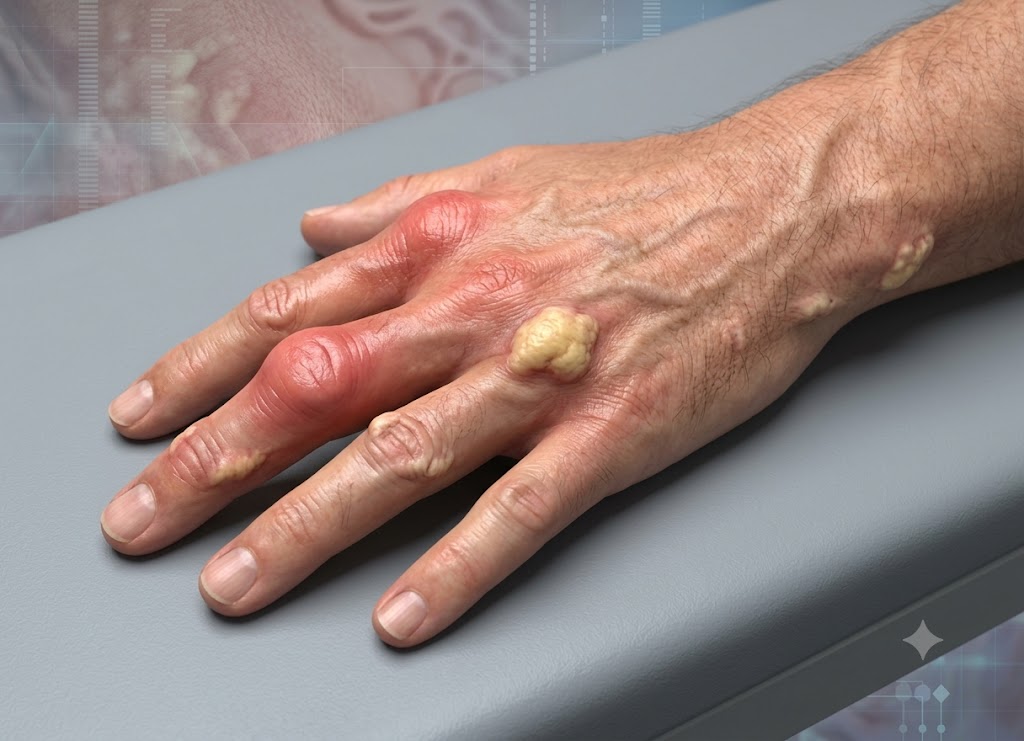
When urate remains elevated for a long period, crystals can accumulate in soft tissues as well as joints. In advanced gout, these deposits can form firm lumps called tophi.
Tophi are collections of urate crystals surrounded by inflammatory tissue. They commonly develop in cooler areas of the body, including the fingers, hands, elbows, feet, Achilles tendon, and outer ear.
Tophi may not cause pain at first, but larger deposits can interfere with joint movement and contribute to ongoing inflammation and joint damage. In some cases, the skin over a tophus can become irritated or break down, allowing the chalky material inside to become exposed and increasing the risk of infection.
Renal and Urinary Complications: Nephrolithiasis
High uric acid can also affect the urinary system. When uric acid becomes concentrated in the urine, crystals may form and eventually develop into kidney stones.
[Acidic Urine + High Urate Concentration] ──► Crystal Formation ──► Kidney Stone Development
Renal Colic and Hematuria
Kidney stones can cause severe pain, particularly when a stone moves from the kidney into the ureter. This pain, known as renal colic, may begin in the side or back below the ribs and travel toward the lower abdomen or groin.
A stone can also irritate the urinary tract and cause blood to appear in the urine. The urine may look pink, red, or brown. Other possible symptoms include nausea, vomiting, or pain while urinating.
Understanding the Lithogenic Environment
When considering what causes uric acid kidney stones, two important factors are concentrated urine and low urine pH. Uric acid is less soluble in acidic urine, making it easier for crystals to form.
When urine remains highly acidic and concentrated, uric acid can crystallize and eventually contribute to stone formation. Dehydration and diets containing large amounts of animal protein may increase the risk in some people.
                     [Renal Pathological Matrix]
                                  │
     ┌────────────────────────────┴────────────────────────────┐
     ▼                                                         ▼
[Stone-Related Symptoms]                              [Possible UTI Symptoms]
 ├── Severe flank or back pain                           ├── Cloudy urine
 ├── Pain that moves toward the groin                    ├── Strong-smelling urine
 └── Blood in the urine                                  └── Burning or frequent urination
Obstruction and Secondary Infections
A kidney stone can sometimes block the normal flow of urine. When urine becomes trapped behind an obstruction, bacteria may have an easier environment in which to multiply.
Signs of a possible urinary tract infection can include cloudy or strong-smelling urine, frequent or urgent urination, and burning during urination. Fever or chills can be more concerning, particularly when they occur along with severe pain or a known urinary obstruction, and require prompt medical evaluation.
How do high uric acid symptoms signal gout or kidney problems?
High uric acid symptoms can occur when excess urate contributes to crystal formation in different tissues. In gout, these crystals can accumulate in and around joints and trigger inflammation. In the urinary system, uric acid crystals can contribute to kidney stone formation.
The connection between elevated uric acid and these conditions depends on how much urate is present, how well the kidneys remove it, and the environment in which crystals form.
Pathological Transition: Hyperuricemia to Gouty Arthritis
Hyperuricemia means that the level of urate in the blood is higher than normal. When urate concentrations become high enough, the blood can reach a point at which urate is more likely to crystallize.
At approximately 6.8 mg/dL under typical physiological conditions, urate reaches its saturation point. Above this level, the likelihood of monosodium urate crystal formation increases.
[Elevated Serum Urate] ──► MSU Crystal Formation ──► Joint Deposition ──► Immune Activation ──► Inflammation
These crystals can remain in a joint without immediately causing symptoms. When the immune system responds to them, however, an inflammatory reaction can develop and produce the characteristic symptoms of a gout flare.
- Immune Recognition: Immune cells can identify monosodium urate crystals as abnormal material within the joint.
- Cellular Response: Immune cells respond to the crystals and release inflammatory substances.
- Inflammatory Cascade: The resulting inflammation causes increased blood flow and fluid accumulation around the joint. This produces swelling, warmth, redness, tenderness, and pain.
Renal Mechanisms: Urate Nephrolithiasis vs. Urate Nephropathy
Elevated uric acid can be associated with kidney problems in more than one way. Uric acid can contribute to kidney stone formation, while certain forms of severe or prolonged urate accumulation can affect kidney tissue.
                                [Renal Pathways]
                                      │
     ┌────────────────────────────────┴────────────────────────────────┐
     ▼                                                                 ▼
[Urate Nephrolithiasis]                                  [Urate-Related Kidney Damage]
 ├── Crystals contribute to stone formation                ├── Urate can accumulate in kidney tissue
 ├── Stones may enter the ureter                            ├── May trigger inflammation
 └── Can obstruct urine flow                                └── Can contribute to kidney dysfunction
Urate Nephrolithiasis (Acute Stone Formation)
Uric acid kidney stones can develop when urine contains a high concentration of uric acid and remains acidic. Under these conditions, uric acid is less soluble and can form crystals.
The crystals may combine and grow into stones. If a stone moves into the ureter, it can interfere with urine flow and cause severe, wave-like pain. Larger or obstructing stones may also increase the risk of infection or kidney injury.
Urate Nephropathy (Chronic Structural Damage)
Long-term, severe urate accumulation can sometimes be associated with deposits within kidney tissue. These deposits may cause inflammation and damage to structures involved in kidney function.
Over time, ongoing inflammation and tissue injury can contribute to scarring and loss of functioning kidney tissue. However, chronic kidney disease has many possible causes, and high uric acid does not automatically mean that urate crystals are directly causing kidney damage.
Structural Comparison of Systemic Impacts
| Clinical Characteristic | Gouty Arthritis (Joints) | Urate Nephrolithiasis (Stones) | Urate-Related Kidney Damage |
|---|---|---|---|
| Primary Target Site | Joints and surrounding tissues | Kidneys and ureters | Kidney tissue |
| Main Problem | Urate crystal-triggered inflammation | Uric acid stone formation | Possible inflammation and tissue injury |
| Typical Trigger | Elevated urate leading to crystal formation | Concentrated, acidic urine | Severe or prolonged urate accumulation |
| Common Symptoms | Pain, swelling, warmth, redness | Flank pain, blood in urine, nausea | May be silent until kidney function is affected |
| Potential Complications | Recurrent attacks and joint damage | Urinary obstruction and infection | Reduced kidney function in severe cases |
The main causes of high uric acid
The main causes of high uric acid, or hyperuricemia, include producing too much uric acid or not removing enough of it through the kidneys. Reduced kidney excretion is a common contributor.
Diet, genetics, certain medications, medical conditions, and changes in hydration or body weight can all influence uric acid levels.
Dietary Substrates of Hyperuricemia
Diet can influence uric acid because the body converts purines into uric acid. Eating large amounts of certain high-purine foods may increase urate levels, particularly in people who are already prone to hyperuricemia.
[High-Purine Foods / High Fructose Intake] ──► Increased Uric Acid Production ──► Higher Urate Levels
Several dietary factors can contribute:
High-Purine Organ and Red Meats: Organ meats such as liver and kidneys contain particularly high amounts of purines. Red meats, including beef, lamb, and pork, also contain purines and may contribute to higher uric acid levels when eaten frequently or in large amounts.
Purine-Dense Seafood: Some seafood is relatively high in purines. Examples include anchovies, sardines, herring, mussels, and other shellfish. People with gout may be advised to limit certain high-purine foods depending on their individual treatment plan.
Alcoholic Beverages: Alcohol can affect uric acid levels and may increase the risk of gout attacks. Beer is relatively high in purines, while alcohol itself can also interfere with uric acid removal by the kidneys.
High-Fructose Corn Syrup (HFCS): Large amounts of fructose can increase uric acid production. Sugary drinks and foods containing high-fructose sweeteners may therefore contribute to elevated uric acid levels, especially when consumed frequently.
Metabolic and Pathological Drivers
Diet is only one part of the picture. Several medical conditions can change how the body produces or removes uric acid.
                         [Systemic Pathological Matrix]
                                       │
     ┌─────────────────────────────────┴─────────────────────────────────┐
     ▼                                                                   ▼
[Reduced Renal Excretion]                                  [Increased Uric Acid Production]
 ├── Chronic kidney disease                                ├── Increased cell breakdown
 ├── Metabolic conditions                                  ├── Certain inherited conditions
 └── Some medications                                      └── Certain medical treatments
Chronic Medical Conditions
- Obesity and Metabolic Syndrome: Obesity and insulin resistance are associated with higher uric acid levels. Changes in kidney handling of urate can make it more difficult for the body to remove it.
- Hypertension and Diabetes: High blood pressure and diabetes can affect kidney health. Because the kidneys play a major role in removing uric acid, reduced kidney function can contribute to elevated levels.
- Pre-existing Kidney Disease: Chronic kidney disease can reduce the kidneys’ ability to excrete uric acid. This can cause urate to accumulate in the blood.
Iatrogenic, Genetic, and Lifestyle Influences
Certain medications, inherited factors, and lifestyle changes can also affect uric acid levels:
- Diuretic and Aspirin Medications: Some diuretics, including thiazide and loop diuretics, can raise uric acid levels by reducing urate excretion. Low-dose aspirin can also affect uric acid handling. People should not stop prescribed medications without discussing the decision with their healthcare provider.
- Genetic Predispositions: Genetics can influence how efficiently the kidneys transport and eliminate uric acid. Some people are therefore more likely to develop hyperuricemia even without a diet particularly high in purines.
- Dehydration and Concentrated Serum: Dehydration reduces the amount of water available for urine production and can make uric acid more concentrated. Maintaining adequate hydration is particularly important for people prone to kidney stones.
- Rapid Weight Loss and Crash Dieting: Rapid weight loss and extreme dieting can temporarily increase uric acid levels. Gradual, sustainable weight management is generally preferable to crash diets.
Mechanisms of Complication Formation
Understanding the different causes of high uric acid helps explain why certain people develop gout or kidney stones while others do not.
[Dehydration + Acidic Urine + High Urate] ──► Crystal Formation ──► Increased Risk of Uric Acid Stones
Uric acid kidney stones are usually influenced by more than one factor. Low urine pH, concentrated urine, and high uric acid levels can work together to make crystal formation more likely.
This helps explain what causes uric acid kidney stones and why hydration, dietary changes, and management of underlying health conditions may all play a role in prevention.
How are high uric acid levels diagnosed and managed?
High uric acid can be evaluated with blood and urine tests, while gout may require joint fluid testing or imaging when the diagnosis is uncertain. Treatment depends on whether someone has asymptomatic hyperuricemia, an acute gout attack, recurrent gout, kidney stones, or another complication.
Management can include medication, lifestyle changes, and treatment of underlying conditions.
Diagnostic Protocols for Hyperuricemia and Gout
Doctors may use several types of testing to determine whether elevated uric acid is contributing to symptoms.
A blood uric acid test measures the amount of urate in the bloodstream. However, a uric acid blood test alone cannot confirm gout because urate levels can fluctuate and may even be normal during an acute attack.
The Clinical Gold Standard: Arthrocentesis
When gout needs to be confirmed, a healthcare professional may perform arthrocentesis, also known as joint aspiration. A small amount of fluid is removed from the affected joint and examined under a microscope.
Finding monosodium urate crystals in the joint fluid provides strong evidence that the inflammation is caused by gout.
Advanced Diagnostic Imaging
When joint fluid cannot be obtained or the diagnosis remains uncertain, imaging may help identify urate deposits:
- Musculoskeletal Ultrasound: Ultrasound can identify urate deposits around joints and may show a finding called the “double contour sign.” It can also help identify tophi.
- Dual-Energy Computed Tomography (DECT): DECT can detect and distinguish urate deposits from other materials in certain joints and soft tissues.
- Standard Radiography (X-rays): X-rays may not show early gout, but they can help identify bone and joint changes associated with longstanding disease.
Clinical Thresholds and Therapeutic Targets
Uric acid is commonly measured in milligrams per deciliter (mg/dL). Laboratory reference ranges can vary, and treatment targets are different from the ranges used to describe typical blood levels.
| Clinical Situation | Uric Acid Level / Target | Purpose |
|---|---|---|
| Typical adult reference range | Varies by laboratory and individual | Used to interpret blood test results |
| Approximate urate saturation point | Around 6.8 mg/dL | Above this level, crystal formation becomes more likely |
| Common gout treatment target | Below 6.0 mg/dL | Helps dissolve urate crystals and prevent future flares |
| Severe tophaceous gout | Sometimes below 5.0 mg/dL | May be considered to help dissolve substantial crystal deposits |
The approximate saturation point of urate is around 6.8 mg/dL under typical physiological conditions. However, a person can have a uric acid level above this without developing gout.
For people receiving urate-lowering treatment for gout, healthcare professionals commonly aim for a serum urate level below 6.0 mg/dL. A lower target may sometimes be considered for people with severe or tophaceous gout.
Acute Flare Intervention vs. Long-Term Management
Treating a gout attack and preventing future attacks are two different goals. Medicines used during an acute flare reduce inflammation and pain, while long-term urate-lowering medicines reduce uric acid levels over time.
                      [Hyperuricemia Treatment Paradigm]
                                      │
     ┌────────────────────────────────┴────────────────────────────────┐
     ▼                                                                 ▼
[Acute Flare Treatment]                                  [Long-Term Urate Lowering]
 ├── Reduce inflammation                                  ├── Lower serum urate
 ├── NSAIDs                                                ├── Allopurinol
 ├── Colchicine                                             ├── Febuxostat
 └── Corticosteroids                                        └── Other urate-lowering options
Acute Flare Response
Treatment during an acute gout attack focuses on controlling inflammation and pain.
- Nonsteroidal Anti-Inflammatory Drugs (NSAIDs): Medicines such as naproxen or other NSAIDs may be prescribed to reduce inflammation and pain when appropriate.
- Colchicine: Colchicine can reduce the inflammatory response to urate crystals and is often most effective when started early in an attack.
- Corticosteroids: Steroids such as prednisone may be used when NSAIDs or colchicine are unsuitable or when additional anti-inflammatory treatment is needed.
Long-Term Management
Long-term urate-lowering therapy may be recommended for people with recurrent gout, tophi, certain gout-related complications, or other specific indications.
Xanthine oxidase inhibitors, including allopurinol and febuxostat, reduce the production of uric acid. Other medicines, such as probenecid, can increase uric acid excretion in selected patients.
Pegloticase is an intravenous treatment reserved for certain people with severe gout that has not responded adequately to standard urate-lowering therapies.
Managing Asymptomatic Hyperuricemia
Some people have elevated uric acid without experiencing gout attacks, kidney stones, or other symptoms. This is known as asymptomatic hyperuricemia.
Having a high uric acid level does not automatically mean that medication is necessary. For many people without gout or another related complication, doctors may focus on managing contributing conditions, maintaining healthy habits, and monitoring the situation.
Lifestyle measures may include staying adequately hydrated, limiting excessive alcohol and high-fructose drinks, moderating certain high-purine foods when appropriate, and maintaining a healthy weight through gradual changes.
People with very high uric acid levels or additional health concerns may need individualized medical evaluation. Treatment decisions should be based on the person’s symptoms, medical history, kidney function, and overall risk rather than the uric acid number alone.
Conclusion
Uric acid symptoms can develop when excess urate contributes to crystal formation in the joints or urinary tract. Gout may cause sudden joint pain, swelling, warmth, redness, and stiffness, while uric acid kidney stones can cause severe pain in the back or side, blood in the urine, nausea, vomiting, or painful urination.
However, high uric acid can also occur without any symptoms. Because similar symptoms can have many causes, medical testing may be needed to determine whether uric acid, gout, kidney stones, an infection, or another condition is responsible. Severe pain, fever or chills, vomiting, difficulty passing urine, or other concerning symptoms should be evaluated promptly.
Frequently Asked Questions
1. What are common uric acid symptoms?
Common symptoms associated with uric acid problems include sudden joint pain, swelling, redness, warmth, stiffness, and tenderness. Gout often affects the big toe but can also involve the ankles, knees, wrists, and other joints. Uric acid kidney stones may cause severe side or back pain, blood in the urine, nausea, or painful urination. Some people with elevated uric acid have no symptoms at all.
2. How does high uric acid cause gout?
High uric acid can contribute to gout when urate crystals form in or around a joint. The immune system responds to these crystals by triggering inflammation. This can result in sudden and intense pain, swelling, redness, warmth, and tenderness. The big toe is a common site, but other joints can also be affected.
3. Can high uric acid affect the kidneys?
Yes. High uric acid can contribute to uric acid kidney stones, particularly when the urine is acidic and concentrated. Kidney stones can cause sharp pain in the back or side, blood in the urine, nausea, vomiting, or painful urination. Repeated stones or urinary blockage should be evaluated by a healthcare professional.
4. Does high uric acid always cause symptoms?
No. Many people have elevated uric acid without experiencing gout or kidney stones. High uric acid may be discovered during blood testing performed for another reason. Whether treatment is appropriate depends on the individual’s symptoms, medical history, kidney health, and other risk factors.
5. How are uric acid problems diagnosed?
Doctors may use blood tests, urine tests, joint fluid analysis, imaging, and sometimes analysis of a passed or removed kidney stone. A blood uric acid test can identify elevated levels but cannot confirm gout on its own. Joint fluid analysis can identify urate crystals, while imaging may help detect crystal deposits or kidney stones.