
8 Peripheral Vascular Disease Symptoms That Signal Poor Leg Circulation
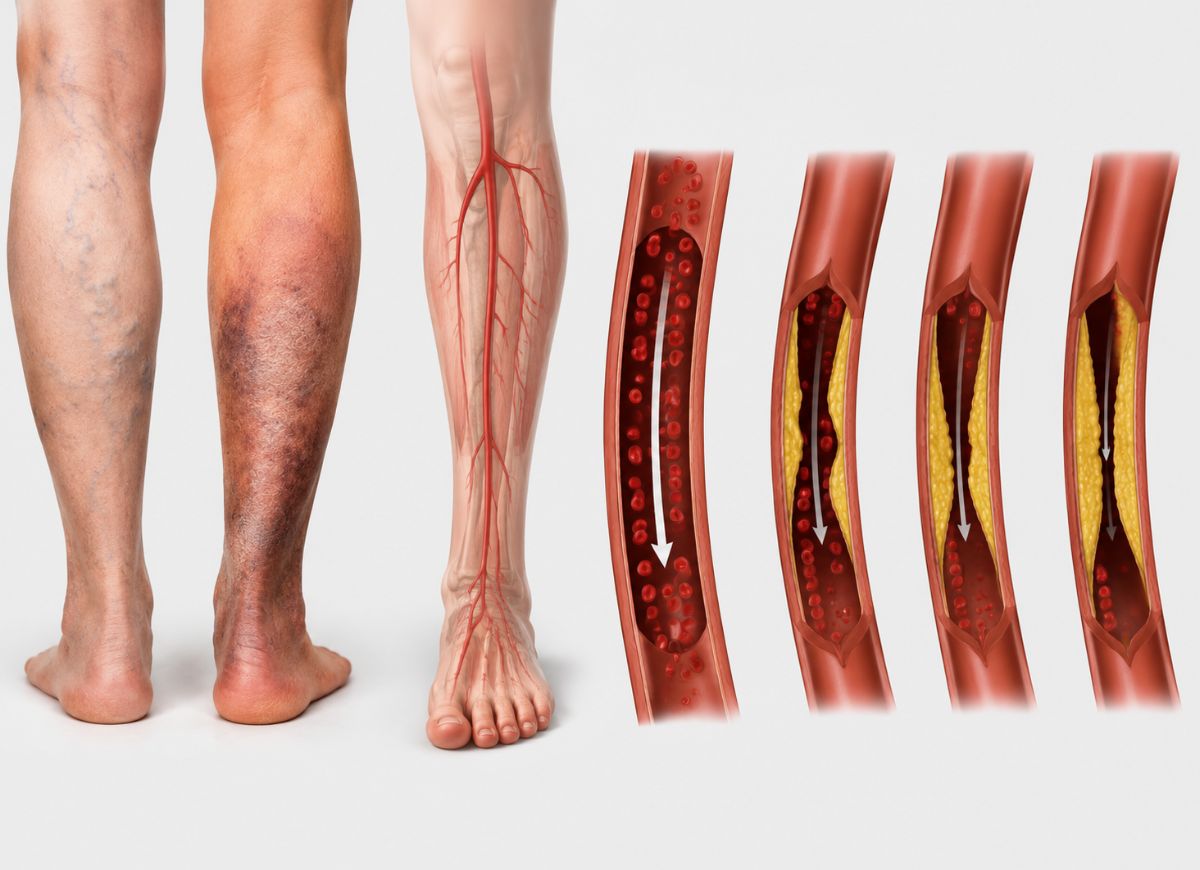
Poor circulation in the legs rarely announces itself loudly. It usually creeps in tired legs after a short walk, occasional numbness, feet that always feel cold. Most people brush these off as signs of aging or being out of shape. But sometimes these small clues point to something mo re significant: peripheral vascular disease (PVD), a condition where the blood vessels supplying the legs narrow or become blocked, cutting down blood flow.
PVD is far from rare. In the U.S. alone, roughly 8.5 million people over 40 live with it, and the numbers climb higher among older adults, diabetics, smokers, and those with high blood pressure or cholesterol. Millions more worldwide are affected, many without realizing it. Left untreated, PVD can progress to wounds that won’t heal, infections, gangrene, and even limb loss.
Because PVD tends to develop slowly, its early symptoms are easy to dismiss achy legs after a walk, tingling feet, a sense of heaviness. Some people notice their lower legs feel cold, their skin changes color, cuts take forever to heal, or leg hair starts thinning and ignore all of it until it gets worse. Since healthy tissue depends on steady blood flow, even a modest drop can cause lasting damage over time.
This guide walks through 8 warning signs of poor leg circulation caused by PVD. Catching these symptoms early means you can get evaluated sooner, take preventive action, and protect both your mobility and your long-term health. Your legs are worth paying attention to not just when they hurt, but when something about how they feel, look, or move quietly changes.
What is Peripheral Vascular Disease?
Peripheral Vascular Disease is a circulation problem in which blood vessels outside the heart and brain most often in the legs become narrowed or blocked, cutting off the normal supply of oxygen-rich blood to the lower limbs. It’s an umbrella term, but in practice it almost always refers to Peripheral Artery Disease (PAD), which develops from atherosclerosis.
Picture your circulatory system as a highway network. With PVD, the “roads” leading to your legs the arteries get clogged and narrow, creating a bottleneck that keeps blood from reaching its destination. That shortage, called ischemia, starves leg muscles and tissue of the oxygen and nutrients they need, which is where most PVD symptoms come from.
The Medical Definition of Peripheral Vascular Disease (PVD)?
Clinically, PVD is a broad label for any disease of the circulatory system in the arms or legs but in everyday medical use, it’s shorthand for PAD, driven by atherosclerosis. Technically the term could also cover vein problems like deep vein thrombosis, but doctors and patients almost always mean PAD when they say PVD.
Atherosclerosis is behind nearly every case. It’s a gradual process where plaque a mix of fat, cholesterol, calcium, and other blood-borne substances builds up along artery walls. Over time, this hardens and narrows the arteries, a process called stenosis.
When this happens in the arteries feeding the legs (the iliac, femoral, popliteal, or tibial arteries), blood flow takes a direct hit. How bad the symptoms get usually tracks with how much the artery has narrowed mild narrowing might cause nothing noticeable, while a severe blockage can bring intense pain, tissue damage, or amputation if it goes untreated. Less commonly, PVD can also stem from blood vessel inflammation, limb injuries, unusual muscle or ligament anatomy, or past radiation exposure.
PVD Leading to Symptoms in the Legs
The root cause of PVD symptoms is a supply-and-demand mismatch known as ischemia. When you’re resting, your leg muscles don’t need much oxygen, so even a partially blocked artery can usually keep up.
That changes the moment you start moving walking, taking stairs, exercising. Oxygen demand in the leg muscles spikes. Normally, healthy arteries would simply widen to let more blood through and meet that demand. But in PVD, stiffened, narrowed arteries can’t expand enough to keep up.
The result is an oxygen shortfall. Muscle tissue starts producing waste products like lactic acid, which trigger pain signals this is exactly what causes intermittent claudication, PVD’s signature symptom: cramping pain during activity that eases with rest.
As blockages worsen, blood flow can eventually fall short even when you’re not moving. That stage, called critical limb ischemia, brings on more constant symptoms pain at rest, ulcers that won’t heal, and gangrene because tissue is essentially being starved around the clock.
8 Key Symptoms of Peripheral Vascular Disease
Leg Pain or Cramping During Activity (Claudication)
Cramping or pain in the legs during activity intermittent claudication is the hallmark symptom of PVD. It shows up as a deep, cramp-like ache or heaviness in the calves, thighs, or buttocks after a consistent amount of walking or exertion, forcing you to stop.
The pain typically fades within a few minutes of rest, letting you continue only to return after a similar stretch of activity. That predictable pattern is what sets claudication apart. Where the pain shows up can hint at the blockage’s location: calf pain often points to the femoral or popliteal artery, while thigh or buttock pain suggests a problem higher up, in the iliac arteries or aorta.
It happens because working muscles aren’t getting enough oxygen, triggering ischemia and a buildup of waste byproducts that cause pain. Because it’s easy to mistake for arthritis or ordinary aging, many people put off getting checked.
Numbness, Weakness, or a “Pins and Needles” Sensation
Unexplained numbness, weakness, or tingling in the legs or feet can also point to poor circulation. Just like muscles, the nerves in your lower limbs need a steady blood supply to work properly.
When that supply is badly restricted, nerves can start malfunctioning a condition called ischemic neuropathy. This might feel like a numb or “dead” sensation in the foot that makes it hard to feel the ground, or a persistent tingling similar to a limb “falling asleep.” Muscle weakness is common too legs that feel heavy or hard to lift, even without cramping pain.
These sensations can occur during activity or at rest, and they usually signal that blood flow is poor enough to be damaging the nerves themselves often a sign of more advanced disease.
Noticeable Coldness in One Leg or Foot
A leg or foot that feels distinctly colder than the other is a classic PVD warning sign. Your circulation works like an internal heating system, carrying warm blood from your core out to your extremities.
A significant blockage in one leg means less warm blood reaches that limb, creating a temperature difference you or someone else might notice. Unlike claudication, this coldness doesn’t need exertion to show up it can be present even at rest, showing that circulation is compromised enough to affect the limb’s baseline temperature. Doctors often check for exactly this asymmetry during a physical exam.
Sores or Ulcers on Toes, Feet, or Legs That Don’t Heal
Wounds or ulcers on the toes, feet, or lower legs that heal slowly, won’t heal, or keep coming back are a serious red flag for advanced PVD. Healing depends heavily on blood supply it delivers the oxygen, nutrients, and immune cells needed to repair tissue and fight infection.
When PVD chokes off that supply, even small injuries a blister, a minor cut, a pressure sore can fail to close and turn into open, ischemic ulcers. These typically form on the toes, heels, or other bony parts of the foot, often with sharply defined edges, a pale or blackened base, and significant pain.
A non-healing ulcer usually signals critical limb ischemia a severe stage carrying real risk of infection, gangrene, and amputation if blood flow isn’t restored quickly.
Change in Leg Color (Pale, Bluish) or Shiny Skin
Skin color and texture changes in the legs and feet are common signs of long-term poor circulation. When blood supply is inadequate, skin can’t maintain its normal look and health.
One notable pattern is elevational pallor and dependent rubor. Lifting the affected leg above heart level makes it look pale or white, since gravity works against already weak blood flow. Lowering the leg lets blood flow back in, but damaged vessels can’t regulate it properly blood pools, becomes deoxygenated, and the foot turns deep red or purplish-blue.
Skin can also become thin, tight, fragile, and shiny or waxy-looking over time a form of skin atrophy caused by chronic malnourishment of the tissue.
Hair Loss or Slower Hair Growth on the Legs and Feet
Losing hair or noticing much slower hair growth on the shins, feet, and toes is a subtler but telling sign of PVD. Hair follicles need a reliable blood supply to keep growing, and when leg circulation is chronically restricted, follicles can go dormant or die off.
This shows up as patchy hair loss on the lower legs. Men may find their shin hair has thinned or vanished; both men and women may notice the small toe hairs are gone. Some people who used to shave their legs regularly find they barely need to anymore.
Hair loss has plenty of other causes, but paired with other PVD symptoms, it adds meaningful evidence of an underlying circulation problem.
Brittle or Slow-Growing Toenails
Toenails that turn brittle, thick, or grow very slowly can also reflect poor leg circulation. Nail beds, like skin and hair follicles, rely on a steady flow of nutrient-rich blood to grow healthy nail tissue.
When that supply falls short, the nail matrix can’t function well, leading to nails that are thickened, opaque, brittle, prone to cracking, or ridged. A common giveaway is needing to trim toenails far less often than before.
Fungal infections can cause similar changes, but combined with slow growth, cold feet, or leg pain, brittle nails point strongly toward a circulation issue.
Weak or Absent Pulse in the Legs or Feet
A weak or missing pulse in the feet or legs is one of the most direct clinical signs doctors use to diagnose PVD. In healthy people, pulses can be easily felt where arteries run close to the skin’s surface most commonly the dorsalis pedis artery on top of the foot and the posterior tibial artery just behind the inner ankle.
A pulse is simply the pressure wave from each heartbeat traveling through the arteries. A significant blockage higher up the leg dampens that wave by the time it reaches the foot, making the pulse faint, thready, or undetectable.
Doctors typically compare pulses in both feet a noticeable difference between them strongly suggests a blockage on one side. An absent pulse is considered one of the most reliable signs of severe arterial disease found during a physical exam.
What Are the Primary Risk Factors for Developing PVD?
PVD risk factors generally fall into three groups: lifestyle habits you can change, related health conditions, and factors like age or genetics that you can’t.
Smoking is the single biggest risk factor. Chemicals in tobacco smoke damage artery linings directly, speed up plaque buildup, and constrict blood vessels a triple hit to circulation.
Uncontrolled diabetes and the high blood sugar that comes with it damage arteries throughout the body, including in the legs, raising the risk of PVD and complications like non-healing ulcers and amputation.
High blood pressure puts constant extra strain on artery walls, weakening them and making plaque buildup more likely. High LDL (“bad”) cholesterol directly feeds the atherosclerotic plaques responsible for most PVD cases.
Risk also climbs noticeably after age 50, and having a personal or family history of PVD, heart disease, or stroke points to a genetic predisposition that raises your overall risk.
When to Seek Medical Help?
Any new, persistent, or worsening leg circulation symptom deserves a doctor’s attention these signs are rarely nothing, and they usually point to an underlying vascular issue. Even something as minor-seeming as mild cramping during walks shouldn’t be written off as normal aging.
These symptoms are your body’s early alarm system, warning not just of leg complications but of a higher risk for heart attack and stroke. Seeing your primary care provider is the right first step.
They’ll likely check your foot pulses and run a quick, painless test called the Ankle-Brachial Index (ABI), comparing blood pressure at your ankle to your arm. From there, they can confirm a diagnosis or refer you to a vascular specialist for further testing and treatment planning. How urgently you should be seen depends on your specific symptoms.
Are These Leg Symptoms Always a Sign of a Serious Problem?
Not every symptom is a limb-threatening emergency, but all of them point to a real underlying issue worth checking out. That’s because PVD is a local expression of a much bigger problem: systemic atherosclerosis. The same plaque narrowing your leg arteries is very likely building up in the coronary arteries feeding your heart and the carotid arteries feeding your brain.
That’s why a PVD diagnosis is such a strong predictor of future cardiovascular trouble people with PVD face a three-to-six-times higher risk of dying from a heart attack or stroke compared to those without it. Ignoring leg symptoms, in other words, means ignoring a major warning sign for your whole cardiovascular system.
Getting evaluated early isn’t just about easing leg pain it opens the door to critical steps like quitting smoking, managing blood pressure and cholesterol, controlling diabetes, and starting medications like statins or antiplatelet drugs to protect your heart, brain, and long-term survival.
Specific Symptoms Requiring Immediate Medical Attention
Some symptoms signal Acute Limb Ischemia (ALI) a sudden, severe blockage that’s a true vascular emergency. If any of the “6 P’s” appear suddenly, get to an emergency room immediately:
- Pain sudden, severe, unrelenting pain in the leg or foot
- Pallor the limb turns pale, white, or mottled
- Pulselessness no detectable pulse in the foot
- Paresthesia numbness or intense pins-and-needles
- Paralysis inability to move the toes, foot, or leg
- Poikilothermia the limb becomes extremely cold
With ALI, the window to save the limb is often just a few hours before permanent muscle and nerve damage sets in.
Similarly, if an existing ulcer suddenly shows signs of spreading infection rapid redness, warmth, swelling, pus, foul odor, or fever treat it as an emergency and seek care right away rather than waiting to see if it improves.
Peripheral Vascular Disease Diagnosis
Diagnosing PVD starts with a conversation your symptoms, medical history, and risk factors followed by a physical exam of the legs and feet. Doctors check for weak or absent pulses (at the dorsalis pedis and posterior tibial points), assess skin color and temperature, look at any wounds, and note hair loss patterns.
The Ankle-Brachial Index (ABI) is the most common first test a simple, non-invasive comparison of blood pressure at the ankle versus the arm. A low ABI (generally under 0.90) suggests a likely blockage restricting blood flow to the legs.
If the ABI is unclear or more detail is needed, a Doppler ultrasound uses sound waves to map blood flow and pinpoint narrowing or blockages. For more complex cases, especially when surgery is being considered, a CT angiogram or catheter-based angiogram provides a detailed picture of the arterial system.
Peripheral Vascular Disease (PVD) vs. Deep Vein Thrombosis (DVT)
PVD and DVT both affect the leg’s blood vessels and can cause pain, but they’re fundamentally different conditions. PVD is an arterial disease arteries carrying oxygen-rich blood from the heart to the legs gradually narrow, usually due to atherosclerosis, over many years.
DVT, on the other hand, is a venous disease a blood clot forms in a deep leg vein, blocking the return of deoxygenated blood to the heart.
PVD typically shows up as intermittent claudication (cramping with activity that eases with rest), cool skin, weak or absent pulses, and pale or bluish discoloration. DVT usually appears suddenly with one-sided swelling, warmth, redness, and constant tenderness not just pain during exertion.
PVD’s most feared outcome is critical limb ischemia leading to non-healing wounds, gangrene, or amputation. DVT’s biggest danger is a pulmonary embolism, where part of the clot breaks loose and blocks blood flow to the lungs. In short: PVD develops gradually and worsens with activity, while DVT strikes suddenly.
How to Manage Poor Leg Circulation in Peripheral Vascular Disease
Managing PVD takes a layered approach relieving symptoms, improving function, and slowing atherosclerosis to lower heart attack and stroke risk. Treatment usually starts conservative and escalates only as needed.
Lifestyle changes come first. Quitting smoking matters most, since tobacco is a major driver of arterial damage. Supervised walking programs walking until it hurts, then resting can encourage the body to build collateral circulation, small new vessels that bypass blockages. Cutting back on saturated fat, cholesterol, and sodium helps manage related conditions like high blood pressure and cholesterol.
Medications come next when lifestyle changes aren’t enough. Antiplatelet drugs like aspirin or clopidogrel help prevent clots from forming on plaques. Statins lower LDL cholesterol and help stabilize plaque. Blood pressure and diabetes medications address related risk factors, and drugs like cilostazol can help extend walking distance for people with significant claudication.
Procedures are reserved for severe symptoms or critical limb ischemia. Angioplasty uses a balloon to widen a narrowed artery, often followed by a stent to keep it open. For longer or more extensive blockages, bypass surgery reroutes blood flow around the blockage using a graft either a vein from elsewhere in the body or a synthetic tube.
FAQs
1. Is serious peripheral vascular disease bad?
Yes. Severe PVD (or PAD) can lead to serious problems if untreated pain, numbness, tingling, slow-healing wounds, and even tissue death (gangrene), with amputation possible in extreme cases. It also signals that arteries elsewhere, including in the heart and brain, may be affected, raising heart attack and stroke risk. Early detection and treatment matter a lot here.
2. How do I know if I have PAD or PVD?
Early symptoms are easy to miss leg cramps or fatigue while walking, cold or numb feet, tingling or burning, slow-healing cuts, skin discoloration, or leg hair loss, often improving with rest and returning with activity. A doctor can confirm a diagnosis through physical exams, an ABI test, ultrasound, CT angiography, or MRI.
3. Can you live a long life with peripheral vascular disease?
Yes many people with PVD live long, active lives when it’s caught early and managed well. Quitting smoking, eating heart-healthy, exercising, and controlling blood sugar, cholesterol, and blood pressure all help slow progression, alongside medications and, when needed, procedures.
4. How to make PVD better?
A mix of lifestyle changes and medical care works best regular activity like walking, a balanced diet, weight and diabetes management, blood pressure control, and medications to lower cholesterol or prevent clots. In advanced cases, angioplasty, stents, or bypass surgery can restore blood flow.
5. What is the end stage of peripheral vascular disease?
End-stage PVD involves severe blockages causing constant leg pain, tissue damage, non-healing ulcers, or gangrene, sometimes requiring amputation if circulation can’t be restored. It also sharply raises heart attack and stroke risk, making aggressive treatment important.
6. What to avoid with peripheral vascular disease?
Avoid smoking, long periods of inactivity, high-sodium or heavily processed foods, excess saturated and trans fats, and cold exposure (which constricts blood vessels). Also avoid overexertion without medical guidance, since it can strain both the heart and leg circulation.
7. What foods should you avoid if you have PVD?
Limit saturated fats, trans fats, refined sugar, and processed meats, since these speed up plaque buildup. Cut back on fried food, sugary drinks, and packaged snacks. Favor vegetables, fruits, whole grains, lean protein, nuts, seeds, and healthy fats like olive oil or fatty fish.
8. Can PVD be reversed?
Not fully, but its progression can be slowed or partly improved through consistent lifestyle changes and treatment exercise, diet, managing diabetes or blood pressure, and medication. Early action makes a real difference, since untreated PVD tends to worsen over time.
9. Does PVD only affect the legs?
Mainly the legs and feet, but PVD often signals atherosclerosis elsewhere in the body too, including the heart and brain part of why PVD patients face higher heart attack and stroke risk, and why full cardiovascular evaluation matters.
10. How does exercise help PVD?
Exercise boosts blood flow and oxygen delivery to leg muscles, easing pain and fatigue over time. Walking, cycling, swimming, and other low-impact aerobic activity work well, especially through structured programs that gradually build walking distance and endurance.
11. When should I see a doctor for PVD?
See a doctor for persistent leg pain, numbness, coldness, color changes, swelling, non-healing wounds, or cramping during walks. Catching it early opens up options like lifestyle changes, medication, or procedures before things get more serious.
12. Can PVD lead to amputation?
Yes if blood flow drops critically low and tissue dies, amputation may become necessary to prevent infection and further complications. This is exactly why early recognition and treatment matter so much.
13. Is PVD hereditary?
Genetics play a role a family history of heart disease, stroke, or diabetes raises your risk. But lifestyle factors like smoking, diet, and activity level still heavily influence whether PVD develops and how severe it becomes.
Conclusion
Peripheral vascular disease disrupts blood flow to the legs, and its effects can range from mild cramping and fatigue to non-healing wounds and, in severe cases, amputation. Catching early symptoms leg cramps, tingling, cold feet, skin changes is key to avoiding complications down the line.
The encouraging part: PVD can be managed, and its progression slowed, through lifestyle changes, regular exercise, heart-healthy eating, and consistent medical care. Staying aware, getting diagnosed early, and sticking with treatment are what protect your mobility, your leg health, and your heart in the long run. Paying attention to your legs today can make a real difference in how you feel tomorrow.