
Pyloric Stenosis in Babies: Warning Signs Every Parent Should Know
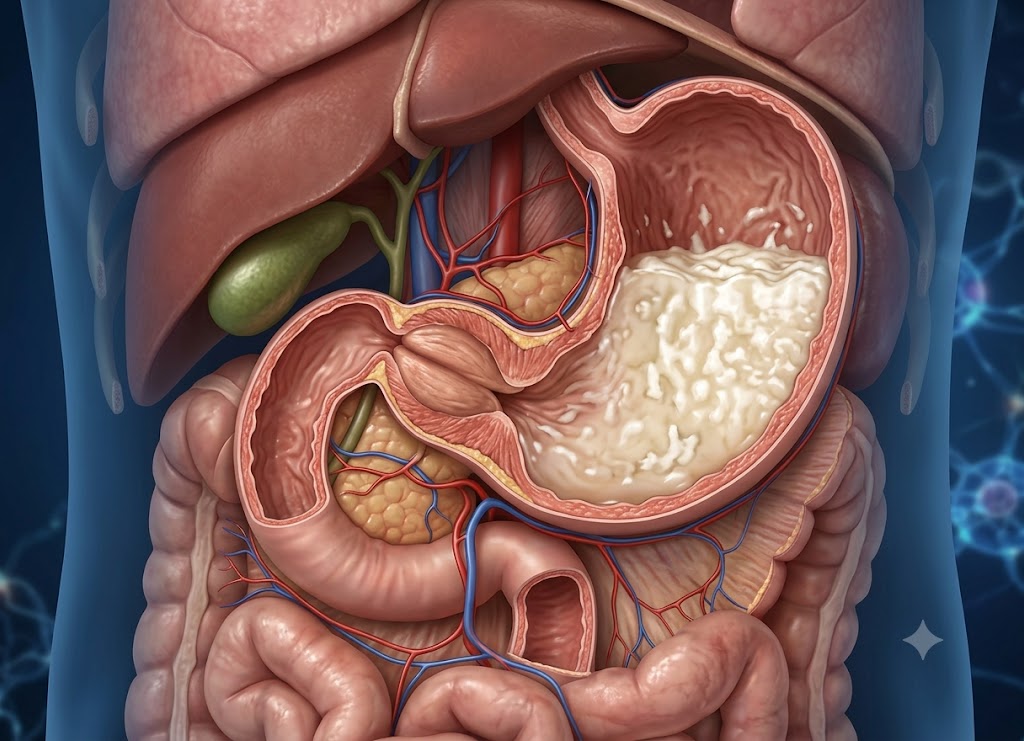
Pyloric stenosis happens when the muscle at the bottom of a baby’s stomach the one that controls the exit into the small intestine grows too thick and blocks food from moving through. That muscular gate is called the pylorus, and once it narrows too much, milk or formula simply can’t get past it. The result is usually forceful vomiting, trouble feeding, and, if it isn’t caught in time, dehydration. It tends to show up in the first weeks of life and needs medical treatment to fix the blockage.
Catching the early signs matters because things can go downhill fast in a newborn. This isn’t ordinary spit-up the vomiting is sudden and strong, often coming right after a feed. Babies may act starving right after throwing up, drop weight, or start going through fewer wet diapers as they lose fluids. Below, we’ll walk through the signs to watch for, how doctors confirm the diagnosis, and what treatment looks like.
What is Pyloric Stenosis and What Causes It?
Doctors call this condition infantile hypertrophic pyloric stenosis, or IHPS for short. It’s a fairly rare digestive problem in young babies, caused by the pylorus the muscular passage linking the stomach to the duodenum, the first stretch of small intestine thickening and lengthening far beyond normal.
It isn’t something a baby is born with; instead, it builds up over time, usually showing up somewhere between two and eight weeks of age.
Physiological Impact on the Infant’s Body
Normally, the pylorus works like a gate that opens and closes on cue. It holds milk in the stomach long enough for early digestion, then relaxes to let it move into the intestines.
With pyloric stenosis, the muscle cells around that gate grow larger and thicker. That thickening squeezes the channel closed until almost nothing can pass. Once that happens, a chain reaction follows:
Stomach stretching and projectile vomiting: Milk builds up with no way out. The stomach stretches, gets irritated, and starts contracting hard to try to force its contents through. Since the exit is essentially sealed, that pressure sends everything back up and out sometimes shooting several feet, which is the telltale sign of this condition.
A cycle of hunger and dehydration: Because almost nothing reaches the intestines, the baby absorbs very little food or fluid. This pushes them quickly toward dehydration and malnourishment.
A dangerous chemical imbalance: Stomach fluid is rich in acid, and losing so much of it through vomiting throws off the body’s chemistry a condition called hypochloremic metabolic alkalosis (low chloride, blood pH too alkaline). If it isn’t corrected, it can start to affect muscles and brain function, making it a genuine emergency.
Evaluating the Primary Risk Factors
There’s no single known cause, but research points to a combination of genetics and early-life factors. Doctors tend to watch more closely for pyloric stenosis when a baby fits certain patterns:
| Risk Factor | Details |
|---|---|
| Being male | Boys are affected about 4–5 times more often than girls, and firstborn boys seem to carry the highest risk. |
| Family history | Risk rises to around 5% if the father had it, and as high as 20% if the mother needed surgery for it as a baby. |
| Ethnic background | Seen most often in Caucasian babies of Northern European descent, and less often in babies of Asian or African descent. |
| Antibiotic exposure | Early use of macrolide antibiotics (like erythromycin or azithromycin) whether given to the baby directly or taken by the mother late in pregnancy or while nursing has been linked to a higher risk. |
Keep in mind these are just statistical patterns, not guarantees. A baby can develop pyloric stenosis with none of these risk factors present, which is exactly why spotting the shift from normal spit-up to forceful vomiting is the most reliable clue parents have.
Early Symptoms of Pyloric Stenosis Parents Should Not Ignore
Because the muscle keeps thickening over time, symptoms tend to escalate quickly going from what looks like a minor feeding hiccup to something alarming within just a few days. Knowing what to look for can help parents get medical help before things become serious.
Projectile Vomiting vs. Normal Spit-Up
The clearest sign of this condition is projectile vomiting. Nearly every newborn spits up now and then, but there’s a real difference between that and what happens with pyloric stenosis:
How forceful it is: Ordinary spit-up just dribbles out, usually during a burp or a change in position. Projectile vomiting is nothing like that it’s a forceful, active event, where the stomach contracts hard against the blocked valve and sends its contents flying.
No bile in the vomit: It’ll look like curdled milk or formula, but it won’t have any greenish-yellow bile in it. Bile enters the digestive tract further down, past the pylorus so if bile shows up, it usually points to a different kind of blockage entirely.
The “Hungry Vomiter” Paradox
Most stomach illnesses that cause vomiting also kill a baby’s appetite. Pyloric stenosis is the opposite right after vomiting, the baby wants to eat again immediately.
Since so little food gets absorbed, the baby’s body is essentially running on empty, which keeps hunger signals firing nonstop. So you’ll see a pattern: feed, forceful vomit, then instant rooting and demanding another feed. That repeating loop is a strong clue that something structural is going on, rather than a simple formula issue or stomach bug.
Subtle Signs of Infant Dehydration
Babies dehydrate fast because their bodies are small and rely on a steady intake of fluids. Watch for these gradual warning signs:
- Fewer wet diapers a healthy baby usually soaks 6–8 diapers a day; dropping below that, especially with dark or strong-smelling urine, is worth noting.
- A sunken soft spot the fontanelle on top of the head should feel flat; if it looks sunken, that signals low fluid levels.
- Low energy a dehydrated baby may seem unusually floppy, sleep more than usual, be hard to wake for feeds, or cry without producing tears.
Visual and Palpable Physical Signs
As the stomach keeps fighting the blocked valve, a couple of physical clues can appear on the baby’s belly:
Peristaltic Waves
Undress the baby in good light during or right after a feed, and you might spot wave-like ripples moving across the upper belly the stomach muscles straining against the blockage. These often move left to right and can be a sign that vomiting is about to happen.
The “Olive” Mass
The most telling physical sign is a small, firm, movable lump felt in the upper right area of the belly, just under the ribs this is the thickened pyloric muscle itself. Doctors call it the “olive” because of its size and shape. It can be tricky to feel if the baby is upset or tensing up, but finding it strongly points to pyloric stenosis.
Call your pediatrician if: spit-up turns into forceful vomiting, or your baby shows the hungry-right-after-vomiting pattern along with fewer wet diapers. A simple ultrasound can check the thickness of the pylorus and confirm what’s going on.
When Should You See a Doctor and How is Pyloric Stenosis Diagnosed?
If feeding problems are escalating from mild spit-up to forceful vomiting, don’t wait it out this is a physical blockage, and getting it checked quickly matters.
Red Flag Symptoms Requiring Immediate Evaluation
Seek medical care right away if you notice:
- Vomiting that’s getting more forceful, happens after nearly every feed, has no green bile in it, and shoots out rather than dribbling.
- Fewer than 6 wet diapers in 24 hours, a dry mouth, a sunken soft spot, or crying with no tears.
- A shift from fussy hunger to real lethargy weak, floppy, unusually sleepy, or hard to wake for feeds.
- Weight loss or a stalled growth curve, even though the baby seems constantly hungry.
Confirming the Diagnosis
Once a doctor suspects a blockage, they’ll usually run two kinds of tests one to look at the physical narrowing, and one to check how it’s affected the baby’s body chemistry.
Abdominal ultrasound (the standard test): This is quick, painless, and doesn’t involve radiation. A sonographer runs a probe over the baby’s belly with some gel, and the radiologist measures the thickness and length of the pyloric muscle. If the muscle is 3 mm thick or more, or the channel is 14 mm long or more, that confirms the diagnosis.
Blood tests: A blood sample checks for the chemical fallout from repeated vomiting specifically low chloride (hypochloremia), low potassium (hypokalemia), and elevated bicarbonate causing alkalosis.
Less common tests: If the ultrasound results aren’t clear enough, doctors might order an upper GI series, where the baby swallows a small amount of contrast liquid (barium) and X-rays capture how it moves. A very narrow, thread-like channel called the “string sign” confirms the blockage this way.
One important rule: Diagnosis is only step one. Surgery can’t happen until the baby’s blood chemistry is back to normal, so the first priority is IV fluids to correct dehydration and rebalance electrolytes.
Treatment Options for Pyloric Stenosis
Since this is a physical blockage caused by overgrown muscle, there’s no medication, therapy, or formula change that will fix it. The only real fix is a routine surgery called a pyloromyotomy, which cuts through the thickened muscle to open the passage permanently.
Step 1: Getting the Baby Ready for Surgery
Even though the situation needs quick action, doctors don’t rush straight into surgery. Vomiting has likely left the baby dehydrated with off-balance blood chemistry, and operating under those conditions raises the risk under anesthesia.
So the first day or two in the hospital go toward stabilizing the baby an IV line delivers fluids along with chloride and potassium, and the team keeps checking blood levels until everything’s back within a safe range before clearing the baby for surgery.
Step 2: The Pyloromyotomy Surgery
Done under general anesthesia, this procedure usually takes under an hour. The goal is to cut through the tight outer muscle layer without touching the delicate inner lining underneath. Surgeons typically use one of two approaches:
Laparoscopic surgery (minimally invasive): This is the more common option today. The surgeon makes two or three tiny incisions, then uses a small camera and thin instruments to make a precise cut along the thickened muscle, letting the inner lining bulge outward and open the channel. It usually means less pain, smaller scars, and a quicker recovery.
Open surgery: When laparoscopic surgery isn’t the right fit, the surgeon makes one small cut often near the belly button to hide the scar and works directly on the muscle, cutting and spreading it until the blockage is cleared.
Step 3: Feeding and Recovery After Surgery
Recovery tends to be quick and follows a fairly predictable path:
- First few hours: The stomach gets a short break after anesthesia wears off.
- Early feeds: Small amounts of an electrolyte solution, breast milk, or formula are offered to see how the baby tolerates it.
- Building back up (12–24 hours): Feeding amounts are gradually increased as the baby shows they can keep things down.
- Going home (24–48 hours): Once the baby is handling full feeds without trouble, they’re cleared to go home.
What’s normal at home: A little mild spit-up during the first day or two is expected as things settle but the forceful, projectile vomiting should be gone for good. The muscle doesn’t grow back together, so this surgery is a lasting fix with no lingering effect on digestion down the road.
What Happens After a Pyloric Stenosis Diagnosis and Treatment?
Recovery after a pyloromyotomy tends to go smoothly, since the surgery directly fixes the physical blockage. For parents who’ve just been through a stressful diagnosis, it helps to know what recovery looks like and that there’s usually nothing to worry about long-term.
Recovering at Home
Babies are usually discharged within 24–48 hours once they can hold down full feeds. Once home, care mostly comes down to a few basics:
Caring for the incision: With laparoscopic surgery, the small cuts are usually closed with skin glue or thin strips. Keep the area clean and dry sponge baths instead of full baths until it’s healed and watch for redness, swelling, warmth, drainage, or fever, which could point to infection.
Managing discomfort: Pain afterward is usually mild and manageable with infant-appropriate doses of acetaminophen if needed. Most babies are back to their normal selves within 3–4 days.
Settling the stomach: A little spit-up in the first couple of days at home is normal it’s just the stomach lining adjusting after surgery and anesthesia, not a sign that something’s wrong.
Long-Term Outlook: A Permanent Cure
One of the more reassuring parts of this condition is that surgery cures it completely. Once the muscle is cut and spread apart, it heals in an open position for good.
Zero Lasting Gastrointestinal Deficits
Kids who’ve had this surgery don’t go on to have ongoing digestive problems, nutrient issues, or developmental delays. Their digestive system works just like anyone else’s, and they move on to solids and grow normally without restrictions.
Cosmetic Outcomes
Since laparoscopic surgery is the standard now, scars are usually minimal often tucked into the belly button or fading into faint lines as the child grows.
Differentiating Pyloric Stenosis from Infant GERD
Because spitting up and vomiting are both common in babies, pyloric stenosis is sometimes mistaken for reflux at first. Here’s how to tell them apart:
| Pyloric Stenosis | Infant Reflux (GERD) | |
|---|---|---|
| What’s happening | A physical blockage from muscle overgrowth | A temporary, functional issue with the valve at the top of the stomach |
| Vomiting style | Forceful, projectile, gets worse over time | Gentle spilling or dribbling, often during burping |
| Appetite | Ravenous wants to feed again right away | May cry, arch, or refuse feeds due to discomfort |
| Growth | Weight loss, failure to thrive, dehydration | Usually still gains weight normally (“happy spitter”) |
Addressing Concerns About Recurrence
A true return of pyloric stenosis after surgery is extremely rare once the muscle ring is cut, it can’t grow back together to cause another blockage.
If projectile vomiting continues days after surgery, it’s almost never a recurrence it’s more likely that the initial cut didn’t fully release the muscle. A follow-up ultrasound can confirm this, and a quick revision surgery resolves it completely.
Conclusion
Pyloric stenosis is very treatable, but catching it early makes all the difference in avoiding dehydration and nutrition problems. If a baby has ongoing forceful vomiting, isn’t gaining weight, has fewer wet diapers, seems unusually fussy, or shows signs of dehydration, it’s worth getting checked by a doctor right away. The standard fix is a surgery called pyloromyotomy, which opens up the narrowed passage so food can move through normally again. With early diagnosis and the right care, most babies bounce back and go on to grow and develop just fine.
Frequently Asked Questions
1. What is pyloric stenosis?
It’s a condition where the pylorus the muscular valve between the stomach and small intestine thickens and blocks food from moving through, causing vomiting and feeding trouble. It typically shows up between 2 and 8 weeks of age and responds well to treatment.
2. What are the warning signs of pyloric stenosis?
The biggest sign is forceful, projectile vomiting shortly after feeding. Other clues include being hungry right after vomiting, poor weight gain, dehydration, fewer wet diapers, fussiness, and changes in bowel habits. Some babies show visible stomach contractions as their body tries to push food through. Persistent or worsening vomiting should be checked by a doctor.
3. What causes pyloric stenosis in babies?
There’s no single known cause it likely comes from a mix of genetics and early environmental factors. A family history raises the risk, and it’s more common in boys, especially firstborn boys. Researchers are still studying exactly why the muscle overgrows.
4. How is pyloric stenosis diagnosed?
Doctors combine a physical exam with imaging usually an abdominal ultrasound, which can clearly show if the pyloric muscle is thickened. Blood tests may also check for dehydration or electrolyte imbalance from ongoing vomiting. Catching it early means treatment can start before complications set in.
5. How is pyloric stenosis treated?
The standard treatment is a surgery called pyloromyotomy, where a surgeon makes a small cut in the thickened muscle to widen the passage. Before surgery, doctors typically correct any dehydration or electrolyte issues with IV fluids. Most babies return to normal feeding quickly afterward.
6. Can pyloric stenosis come back after treatment?
It’s very unlikely to return after successful surgery, since the muscle is permanently opened. Some babies have mild spit-up for a short time afterward as their system adjusts, but long-term complications are rare, and most go on to grow and develop normally.