
PRK Eye Surgery Recovery: 7 Things to Know About Results
PRK eye surgery, or photorefractive keratectomy, is a type of laser vision correction that reshapes the cornea to improve nearsightedness, farsightedness, and astigmatism. Unlike LASIK, PRK does not involve creating a corneal flap.
Instead, the surgeon removes the thin outer layer of the cornea, known as the epithelium, and uses a laser to reshape the tissue underneath. The surface layer naturally grows back as the eye heals, but recovery generally takes longer than it does with LASIK.
Knowing what to expect after PRK eye surgery can make the recovery process easier to manage. During the early stages, blurry vision, light sensitivity, dryness, and discomfort are common while the cornea heals.
Vision usually improves gradually over the next several weeks and can continue becoming sharper for several months. This guide covers seven important things to know about PRK recovery and results, including healing time, possible side effects, expected outcomes, and factors that can affect long-term vision.
What is the PRK Eye Surgery Procedure?
PRK eye surgery, or Photorefractive Keratectomy, is an established laser vision correction procedure that reshapes the surface of the cornea with an excimer laser. Before the laser treatment, the surgeon carefully removes the thin outer epithelial layer.
PRK can be an effective alternative to LASIK, particularly for people with thinner corneas or those involved in activities where an eye injury could be a concern. Since PRK does not create a corneal flap, it avoids complications associated with having a flap.
The main goal of PRK is to change the shape of the cornea so incoming light can focus properly on the retina. This can provide clearer vision without relying on glasses or contact lenses. Before surgery, the patient undergoes a detailed eye examination, including scans that map the cornea and measurements of the existing refractive error.
How PRK Eye Surgery Corrects Vision
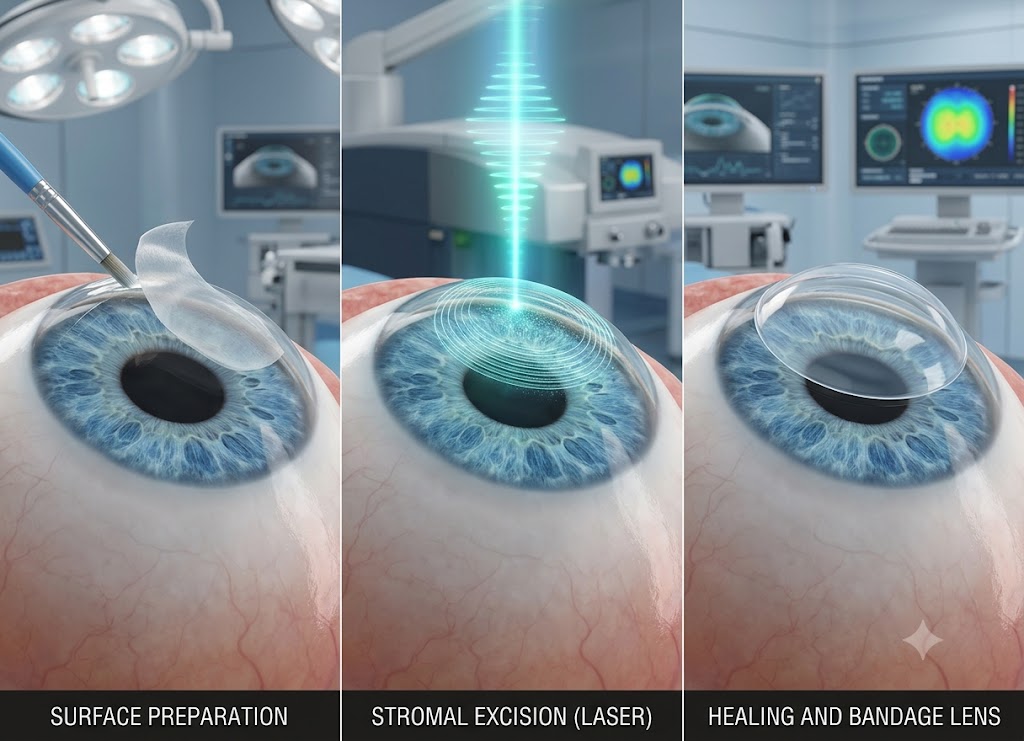
PRK uses a process called photoablation. A computer-guided excimer laser uses cool ultraviolet light to remove extremely small amounts of corneal tissue with a high degree of precision. The procedure generally involves several important stages.
Anesthesia and Epithelial Removal: Numbing eye drops are applied so the procedure can be performed comfortably. Once the eye is fully numb, the surgeon removes the central portion of the epithelium. Depending on the technique used, a diluted alcohol solution may be applied briefly to loosen the cells, or the surgeon may use a specialized instrument or rotating brush. This exposes the corneal stroma, which is the middle layer that will be reshaped.
Laser Reshaping: The excimer laser is programmed using the patient’s prescription and corneal measurements. The laser is carefully positioned over the eye while the patient focuses on a target light. An eye-tracking system monitors movement and adjusts the treatment as needed. The laser then removes tiny amounts of tissue to reshape the cornea. For myopia, the central cornea is flattened. For hyperopia, peripheral tissue is treated to create a steeper central shape. For astigmatism, the cornea is reshaped to create a more regular surface. The laser treatment itself generally takes less than a minute per eye.
Surface Protection: After the laser treatment is complete, the surgeon places a clear bandage contact lens over the treated area. This lens does not correct vision. Instead, it protects the healing surface, reduces friction from blinking, and gives the epithelial cells a smoother environment in which to regenerate.
Steps on the Day of Surgery
The entire visit to the clinic may take a couple of hours, although the actual procedure usually takes only about 10 to 15 minutes for both eyes. PRK is performed as an outpatient procedure, so an overnight hospital stay is not normally required.
Pre-Operative Preparation: When you arrive, you may complete any remaining paperwork and consent forms. A technician may take final measurements to confirm the accuracy of the treatment plan. The surgeon will review the procedure and answer any remaining questions. Numbing eye drops are applied several times, and some patients may be offered a mild oral sedative to help them relax.
Inside the Laser Suite: You will lie comfortably in a reclining chair beneath the excimer laser. An eyelid holder, called a speculum, is used to keep the eye open. The surgeon removes the epithelial layer and begins the laser treatment. You will be asked to focus on a blinking target light. While the laser is operating, you may hear a clicking or ticking sound and notice a faint odor. These sensations can be normal during the procedure.
Post-Operative Routine: Once the cornea has been reshaped, the surgeon rinses the eye with sterile saline and places the protective bandage contact lens over the treated area. The same process is then performed on the other eye. After a short recovery period, the medical team checks the eyes and provides protective sunglasses. You will also receive instructions for using prescribed antibiotic, steroid, and lubricating eye drops. Because your vision will be temporarily impaired, you should arrange for someone to drive you home.
Week-by-Week Recovery Timeline for PRK Eye Surgery
The recovery timeline after PRK is gradual and follows several stages of healing. Unlike LASIK, which often provides rapid visual improvement, PRK requires more time because the surface layer of the cornea must regenerate. Recovery generally moves through three main phases: epithelial regrowth, improvement toward functional vision, and gradual visual refinement.
The First 24–72 Hours: Epithelial Regeneration
The first 24 to 72 hours after PRK are often the most uncomfortable part of recovery. During this period, the main priorities are protecting the eyes and managing discomfort while the epithelial layer begins to grow back.
Sensation and Comfort: As the corneal surface heals, you may experience significant discomfort. It can feel gritty, scratchy, burning, or as though something is stuck in the eye. Some people also experience aching or soreness.
Vision Quality: Vision is usually very blurry, hazy, or foggy during these first few days. Some people describe the experience as looking through water or a dirty window. Excessive tearing is also common as the eyes respond to the procedure.
Light Sensitivity: Strong sensitivity to light, known as photophobia, is common during the early recovery period. Sunglasses can make bright indoor and outdoor environments more comfortable.
The Role of the Bandage Lens: A clear bandage contact lens is placed over the eye after PRK to protect the healing surface. It reduces friction caused by blinking, shields exposed nerve endings, and provides a smooth surface where new epithelial cells can grow.
Clinical Action Plan: Resting with your eyes closed in a dim, quiet environment can make the first few days easier. Follow your surgeon’s instructions carefully and use prescribed antibiotic and anti-inflammatory eye drops according to the recommended schedule.
Days 4–7 (The First Week): Achieving Functional Vision
Between days 4 and 7, the surface of the cornea usually begins to heal significantly. This period often represents an important improvement in comfort and vision.
The Follow-Up Milestone: Around the fifth day, you will typically return to your surgeon for an examination. Once the doctor confirms that the epithelial layer has adequately regenerated, the bandage contact lens can be removed.
Comfort Levels: As the surface layer heals and the protective lens is removed, discomfort and sensitivity to light generally begin to decrease.
Visual Status: Vision usually becomes more functional during this stage, but it may still be hazy, foggy, and inconsistent. You may be able to move around comfortably and handle simple activities at home, but vision may not yet be clear enough for driving or returning to work.
Ongoing Drops: Your doctor may continue steroid and antibiotic eye drops and recommend frequent use of preservative-free artificial tears. Keeping the eyes well lubricated can support comfort during this stage of recovery.
Weeks 2–4: Gradual Clearing and Activity Resumption
Weeks 2 through 4 usually bring noticeable improvement as the initial visual haze begins to lift. Many patients can gradually return to more of their normal activities during this period.
- Return to Routine: Depending on your individual healing progress, your doctor may clear you to return to work and resume driving.
- Daily Fluctuations: Vision can become noticeably clearer but may still change throughout the day. Your eyes might feel sharper in the morning and become somewhat blurrier later because of dryness or eye fatigue. Regular use of lubricating drops can help manage these fluctuations.
- Night Vision Aberrations: Halos and starbursts can occur in low-light conditions while the corneal surface continues to heal. These effects can make headlights and other bright lights appear different from normal.
- Microscopic Haze: Some patients develop a mild cloudiness called corneal haze during the healing process. It may only be visible during an eye examination. Following your prescribed steroid treatment can help control the healing response and support a clear result.
Month 1 to Month 3 and Beyond: Visual Sharpening and Stabilization
This stage focuses on the gradual refinement and stabilization of vision. The cornea continues to remodel as the healing process progresses.
Reaching Peak Acuity: Between the first and third months, the corneal surface generally becomes smoother and more regular. As this happens, visual clarity and sharpness can improve significantly. Many patients reach or approach their best vision during this period, although individual results vary.
Resolution of Side Effects: Visual fluctuations often become less noticeable over time. Night vision effects such as halos and starbursts may also gradually decrease as the cornea continues to heal.
Tapering Medications: Your surgeon will monitor your progress during follow-up appointments. As healing advances and the risk of an excessive healing response decreases, steroid eye drops may be gradually reduced according to your doctor’s instructions.
Long-Term Outlook: Vision may continue to stabilize for several months after surgery. A stable baseline is often assessed around six months, although some patients, particularly those with stronger prescriptions, may continue to experience subtle improvements for up to a year. If an enhancement is needed, your surgeon will generally wait until the vision has stabilized before considering it.
Expected Results and Visual Outcomes of PRK Eye Surgery
The main purpose of PRK eye surgery is to permanently reshape the cornea so incoming light can focus more accurately on the retina. This can provide long-term correction for refractive errors such as nearsightedness, farsightedness, and astigmatism. Many patients experience a major reduction in their dependence on glasses or contact lenses after completing the healing process.
Long-term visual outcomes with modern PRK can be comparable to those achieved with LASIK, even though the recovery process is slower. Advanced excimer laser technology allows surgeons to perform highly precise treatments on the corneal surface.
Once the cornea has completed its healing and remodeling process, the correction is generally stable. However, PRK does not stop normal age-related changes in vision. Conditions such as presbyopia or cataracts can still develop later in life.
Quantifying the Success Rate: What Level of Vision is Attainable?
Clinical studies and real-world outcomes show that PRK can provide strong visual results for many appropriately selected patients.
The 20/20 Standard: Reported outcomes indicate that approximately 92% to 98% of patients with mild to moderate myopia or astigmatism may achieve 20/20 vision or better without corrective lenses.
The Driving Standard: More than 99% of patients may achieve uncorrected vision of 20/40 or better. This level is commonly used as a legal driving standard in many regions, although requirements vary by location.
Overall Patient Satisfaction: PRK has a high level of patient satisfaction, with many patients reporting significant improvement in their vision after recovery.
Low Retreatment Rates: Some patients may have a small amount of residual refractive error after surgery. In certain cases, a later enhancement may be considered once the prescription has remained stable.
High-Prescription Expectations: People with stronger prescriptions may have a somewhat lower chance of achieving exactly 20/20 vision. Even so, many can achieve useful functional vision and substantially reduce their dependence on glasses.
Are Common Low-Light Side Effects Permanent?
Night vision symptoms such as halos, glare, and starbursts are a common concern for people considering PRK. For many patients, these effects are temporary and become less noticeable as the cornea heals.
Several factors help explain why these symptoms occur and why they can improve.
The Mechanism of Light Scatter: During the early healing period, the corneal surface can be uneven at a microscopic level. Instead of focusing light perfectly, these irregularities can scatter incoming light. This may create halos or streaks around bright lights.
The Role of the Pupil: These symptoms can be more noticeable at night because the pupil becomes larger in low-light conditions. More light then passes through the peripheral areas of the treated cornea, which may still be undergoing healing and remodeling.
The Remodeling Timeline: As the epithelial cells mature and the corneal surface becomes smoother over the following months, light scatter can decrease. As a result, halos, glare, and starbursts may gradually become less noticeable.
Technological Advances: Modern wavefront-guided and topography-guided laser systems can create customized treatment profiles based on the shape of an individual’s cornea. These technologies, along with improvements in treatment zones, have helped reduce certain visual disturbances compared with earlier laser platforms.
The Long-Term Baseline: Most patients experience improvement in night vision symptoms as recovery progresses. However, some people can continue to notice mild visual effects after healing. Your surgeon can discuss your individual risk based on your eye measurements and treatment plan.
Other Important Considerations for PRK Surgery
Choosing a vision correction procedure requires more than looking at the recovery schedule. Your eye health, prescription, lifestyle, expectations, and financial situation should all be considered before deciding whether PRK is appropriate.
How PRK Compares to LASIK
PRK and LASIK are both established laser vision correction procedures, but they differ in how the surgeon reaches the corneal tissue that needs to be reshaped.
Surgical Technique: LASIK involves creating a thin flap in the cornea, lifting it, reshaping the tissue underneath, and then repositioning the flap. PRK does not create a flap. Instead, the outer epithelial layer is removed so the laser can reshape the cornea directly. The epithelial layer then grows back naturally.
Recovery Experience: LASIK usually provides faster visual recovery, with many patients noticing clear vision within a day or so. PRK takes longer because the epithelial layer needs several days to regenerate. During the early phase, PRK patients commonly experience more discomfort, light sensitivity, and blurry vision.
Ideal Candidate Variations: Because PRK does not require a corneal flap, it can be an option for people with thinner corneas who may not be suitable candidates for LASIK. It can also be useful for people whose occupations or activities involve a higher risk of direct eye trauma, including some military personnel, law enforcement officers, and contact sports athletes.
Long-Term Stability: PRK does not have the long-term flap-related complications associated with LASIK. Both procedures can provide stable and effective vision correction when patients are appropriately selected and treated.
Candidacy Requirements for PRK
A comprehensive eye examination is necessary to determine whether you are a suitable candidate for PRK. Your ophthalmologist will evaluate several factors before recommending surgery.
Age and Stability: Patients generally need to be at least 18 years old, although some surgeons prefer patients to be in their early 20s. Your prescription should also remain stable for a sufficient period before surgery so the treatment is based on a consistent level of refractive error.
Corneal and Eye Health: Healthy corneas are essential for safe PRK. Conditions such as keratoconus, active infections, significant scarring, and certain other eye diseases may affect eligibility. You also need enough corneal tissue for safe reshaping. Other conditions, including uncontrolled glaucoma, advanced cataracts, certain retinal problems, or severe dry eye, may also affect candidacy.
Systemic Health: Certain medical conditions can interfere with healing. Autoimmune disorders and uncontrolled diabetes, for example, may affect whether PRK is appropriate. Your surgeon will consider your overall health before recommending the procedure.
Lifestyle Factors: PRK may be especially appealing to people involved in activities where eye trauma is possible because there is no corneal flap. This can include military personnel, pilots, martial artists, and people involved in contact sports or other active pursuits.
Potential Risks and Complications
PRK is widely regarded as a safe and effective procedure for properly selected patients, but no surgery is completely free of risk. Most complications can be managed with appropriate follow-up care.
Corneal Haze: Corneal haze is a cloudy appearance that can develop as the cornea heals. Mild haze may resolve as healing progresses, while more significant haze can affect visual clarity. In some cases, surgeons use medications such as Mitomycin-C during surgery to reduce the risk of significant haze.
Infection and Delayed Healing: Removing the epithelial layer temporarily leaves the surface of the eye more vulnerable to infection. Using prescribed antibiotic drops exactly as instructed is important. In some cases, epithelial healing can take longer than expected, extending the period of discomfort and blurry vision.
Under-correction or Over-correction: The treatment may occasionally leave a small amount of residual refractive error. Some patients may still need glasses for specific activities. If a remaining prescription is significant and remains stable, an enhancement may sometimes be considered.
Visual Aberrations: Glare, halos, starbursts, and other visual changes can occur during recovery, particularly in low-light conditions. These symptoms often become less noticeable as the cornea continues to smooth and heal.
Financial Investment and Insurance Options
PRK is a significant one-time investment in vision correction. In the United States, the average cost can range from about $1,500 to more than $3,000 per eye.
What Influences the Cost: The final price depends on factors such as the surgeon’s experience, the clinic’s location, and the technology used. Customized treatments, including wavefront-guided and topography-guided procedures, may cost more. Before scheduling surgery, ask for a detailed quote that explains what is included, such as consultations, surgery, medications, and follow-up care.
Insurance Coverage: PRK is commonly considered an elective procedure, so standard health insurance and vision plans often do not cover the full cost. Some insurance plans may provide discounts through participating laser vision centers, so it is worth checking your benefits.
Using Pre-Tax Accounts: Depending on your eligibility and plan rules, Flexible Spending Accounts and Health Savings Accounts may allow you to use pre-tax funds toward qualifying vision correction expenses.
Financing Options: Many clinics offer financing programs that allow patients to spread the cost of surgery across monthly payments. Some programs may include promotional financing periods, but terms and interest rates vary, so review the agreement carefully before choosing a plan.
Conclusion
PRK eye surgery can provide long-lasting vision correction for many people who want to reduce their reliance on glasses or contact lenses. Although recovery is generally slower than LASIK, PRK offers important advantages for certain patients, including those with thinner corneas or people who may not be ideal candidates for a corneal flap.
Following your surgeon’s post-operative instructions, using prescribed eye drops, protecting your eyes, and attending scheduled follow-up appointments are important parts of a successful recovery. Results differ from person to person, but many patients experience substantial improvements in vision once the healing process is complete.
Frequently Asked Questions
1. What is PRK eye surgery?
PRK reshapes the cornea with an excimer laser to improve vision. Unlike LASIK, it does not create a corneal flap.
2. How long does recovery take after PRK eye surgery?
PRK recovery takes longer than LASIK. Blurry vision and discomfort are common at first, while vision gradually improves over several weeks and months.
3. What symptoms are normal after PRK eye surgery?
Common symptoms include discomfort, light sensitivity, tearing, dryness, and blurry vision. Severe pain or sudden vision loss should be reported to an eye doctor.
4. How successful is PRK eye surgery?
PRK has a high success rate for correcting nearsightedness, farsightedness, and astigmatism. Many patients achieve 20/20 vision or close to it after healing.
5. What are the risks of PRK eye surgery?
Possible risks include dry eyes, glare, halos, infection, delayed healing, corneal haze, and changes in visual quality.
6. Who is a good candidate for PRK eye surgery?
People with healthy eyes, a stable prescription, and realistic expectations may be good candidates. PRK can also suit some people with thinner corneas.
7. Are PRK eye surgery results permanent?
PRK provides long-lasting vision correction, but it cannot prevent natural age-related changes such as presbyopia. Regular eye exams remain important.