
Estimated Glomerular Filtration Rate (eGFR): The Key to Kidney Health
Have you ever wondered how well your kidneys are actually working? Many people do not think about kidney health until a problem develops. Your kidneys perform several essential functions, including removing waste from the blood, balancing fluids and electrolytes, and helping regulate blood pressure. One of the most useful tools doctors use to understand how well the kidneys are working is the Estimated Glomerular Filtration Rate (eGFR).
The eGFR is a calculated measurement based primarily on a blood test. It estimates how effectively your kidneys are filtering waste products from your bloodstream. Because kidney disease can develop without obvious symptoms during its early stages, eGFR testing can help identify reduced kidney function before noticeable problems occur.
Monitoring eGFR is especially important for people who have risk factors for chronic kidney disease (CKD), including diabetes, high blood pressure, cardiovascular disease, obesity, or a family history of kidney problems. Understanding what your eGFR means can help you have more informed conversations with your healthcare provider and take appropriate steps to protect kidney function.
In this guide, we will explain what eGFR means, how it is calculated, how results are interpreted, what can cause eGFR levels to change, and how it relates to other kidney tests.
Understanding Estimated Glomerular Filtration Rate (eGFR)
An eGFR test is a calculation based on a blood sample that estimates the glomerular filtration rate, one of the main indicators of kidney filtration. Rather than looking at creatinine levels alone, the eGFR calculation uses creatinine along with other patient information to provide a broader estimate of kidney function.
What Is eGFR?
eGFR stands for estimated Glomerular Filtration Rate. It describes how much blood the kidneys are expected to filter in one minute, standardized to a body surface area of 1.73 square meters. Results are usually reported as mL/min/1.73m².
Inside each kidney are approximately one million microscopic filtering units called glomeruli. These structures help remove waste products and excess substances from the blood so they can eventually leave the body through urine.
Creatinine is one of the main substances used to estimate GFR. It is produced naturally as muscles use energy. Healthy kidneys remove creatinine from the bloodstream and eliminate it through urine. When kidney filtration decreases, creatinine may build up in the blood.
The word “estimated” is important because eGFR is not a direct measurement of filtration. Instead, laboratories use mathematical equations to estimate kidney function from blood test results and other characteristics.
Common equations have included the MDRD equation and the CKD-EPI equations. Current clinical practice increasingly uses race-free equations, including the 2021 CKD-EPI creatinine equation. Depending on the situation, healthcare professionals may also use cystatin C to improve the estimate.
Why Is the eGFR Test Performed?
Doctors use eGFR testing for several reasons. It can help identify possible kidney disease, monitor people who already have CKD, and support decisions about medications whose doses depend on kidney function.
Kidney disease can remain unnoticed for a long time because early CKD often causes few or no symptoms. Regular testing can therefore help identify changes before kidney function becomes severely impaired.
eGFR monitoring is particularly important for people who have conditions associated with kidney disease, such as:
- Diabetes
- High blood pressure
- Cardiovascular disease
- Obesity
- A family history of kidney failure
- Previous kidney disease or injury
If kidney function begins to decline, a healthcare professional may adjust treatment for the underlying condition. For example, improving blood sugar control in diabetes or managing high blood pressure may help protect kidney function.
eGFR can also be useful when determining medication doses. Some medicines are primarily removed from the body through the kidneys. When kidney function decreases, those medicines may remain in the body longer, so the dose may need to be adjusted.
Cystatin C and More Advanced Kidney Testing
Creatinine-based eGFR is widely used, but creatinine can be influenced by factors such as muscle mass, diet, and certain medications. In some situations, doctors may order a cystatin C test.
Cystatin C is another blood marker that can be used to estimate kidney filtration. Because it is less dependent on muscle mass than creatinine, combining creatinine and cystatin C may provide a more reliable estimate for certain individuals.
The cost of cystatin C testing can vary depending on the laboratory, location, insurance coverage, and whether it is ordered as part of a broader kidney-function assessment.
Modern eGFR equations have also moved away from older race-based adjustments. Current approaches are designed to provide kidney-function estimates without using race as a variable.
How to Interpret eGFR Test Results
An eGFR result should not be interpreted by looking at the number alone. Age, other kidney tests, medical conditions, medications, hydration, and whether the result remains abnormal over time all matter.
Normal eGFR Ranges by Age
An eGFR of 90 or higher is generally considered within the normal or high range. However, kidney filtration naturally tends to decrease as people get older.
Approximate average eGFR values often cited by age group include:
- 20–29 years: 116 mL/min/1.73m²
- 30–39 years: 107 mL/min/1.73m²
- 40–49 years: 99 mL/min/1.73m²
- 50–59 years: 93 mL/min/1.73m²
- 60–69 years: 85 mL/min/1.73m²
- 70+ years: 75 mL/min/1.73m²
These numbers are general averages rather than individual targets. A particular eGFR result must be considered alongside the person’s age and other evidence of kidney health.
For example, an eGFR of 80 may have a different clinical significance in a younger adult than in an older person. Evidence of kidney damage, such as persistent albumin in the urine, is also important.
CKD Stages Based on eGFR
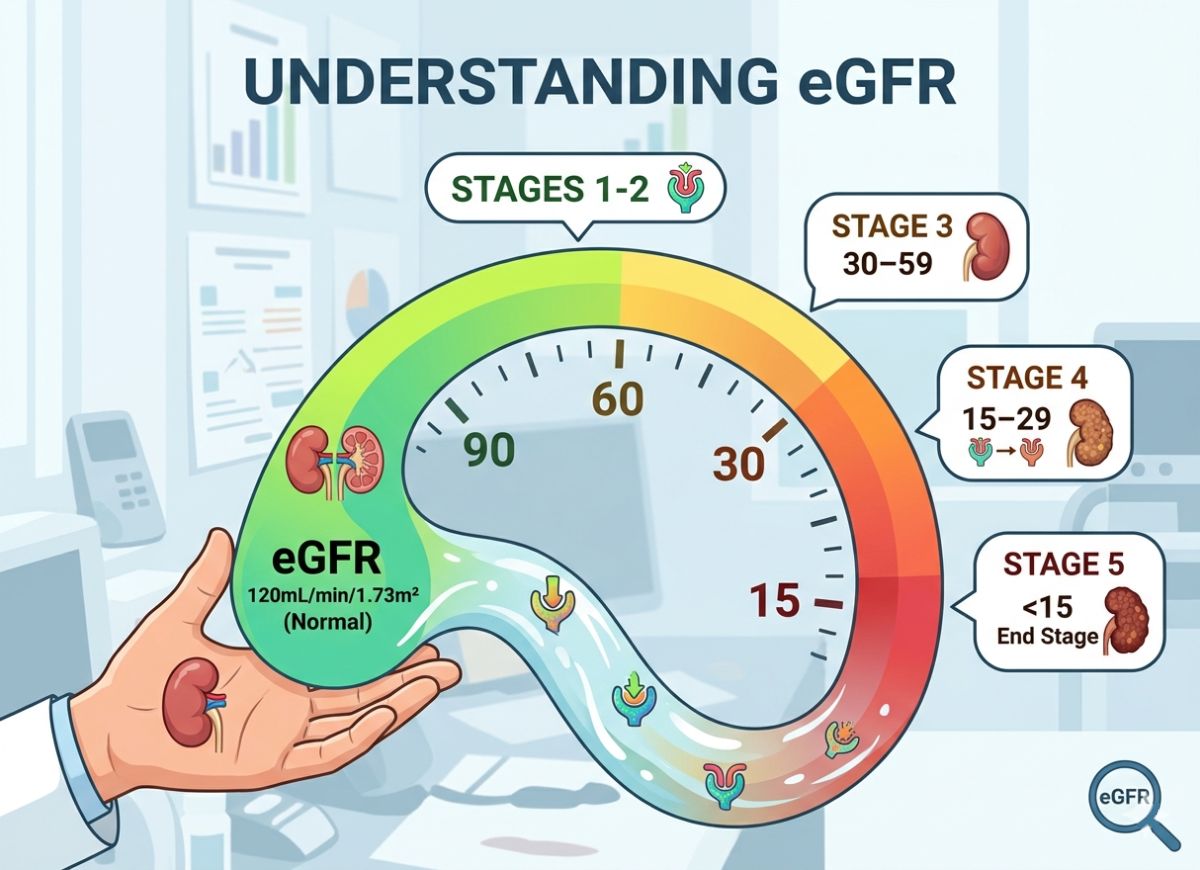
Chronic kidney disease is commonly categorized according to eGFR. However, an eGFR between 60 and 89 does not automatically mean CKD. For stages 1 and 2, there generally needs to be additional evidence of kidney damage that persists over time.
| CKD Stage | eGFR (mL/min/1.73m²) | General Description |
|---|---|---|
| Stage 1 | 90 or higher | Normal or high filtration with evidence of kidney damage |
| Stage 2 | 60–89 | Mildly decreased filtration with evidence of kidney damage |
| Stage 3a | 45–59 | Mild to moderately decreased kidney function |
| Stage 3b | 30–44 | Moderately to severely decreased kidney function |
| Stage 4 | 15–29 | Severely decreased kidney function |
| Stage 5 | Below 15 | Kidney failure |
In the earlier stages, people may have few or no symptoms. As kidney function declines, complications can include high blood pressure, anemia, changes in mineral and bone metabolism, swelling, fatigue, nausea, and changes in urination.
Stage 5 kidney failure may require kidney replacement therapy, such as dialysis or kidney transplantation, depending on the individual’s condition.
What Causes eGFR Levels to Change?
Several conditions can affect eGFR. Some cause long-term kidney damage, while others can temporarily alter creatinine levels and therefore change the calculated eGFR.
Diabetes and High Blood Pressure
Diabetes and high blood pressure are major causes of chronic kidney disease.
Persistently elevated blood sugar can damage the kidney’s filtering structures over time. High blood pressure can also damage the blood vessels within the kidneys, reducing their ability to function properly.
Managing these conditions is therefore an important part of protecting kidney health.
Other Kidney Conditions
Other conditions that may affect kidney function include:
- Glomerulonephritis
- Polycystic kidney disease
- Autoimmune diseases such as lupus
- Kidney infections
- Urinary tract obstruction
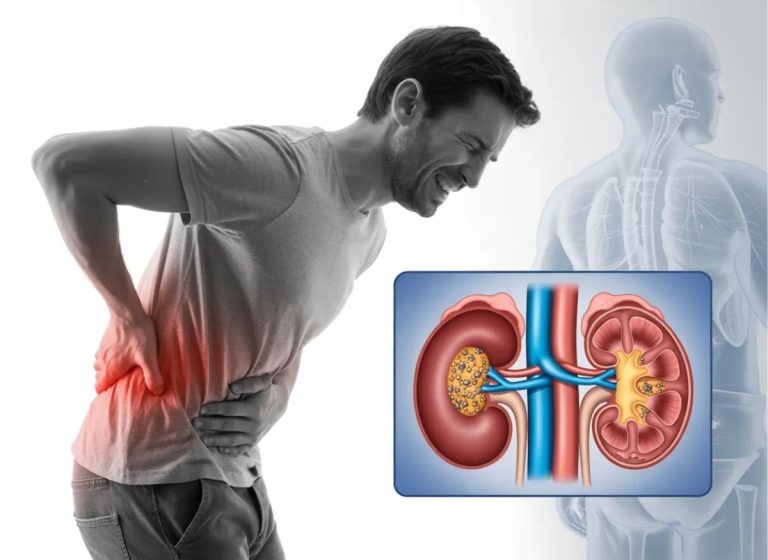
- Kidney stones
- Certain tumors
- Acute kidney injury
Glomerulonephritis involves inflammation of the kidney’s filtering structures and may occur because of infections, autoimmune conditions, or other causes.
Polycystic kidney disease is a genetic disorder in which numerous cysts develop in the kidneys. Over time, these cysts can interfere with normal kidney tissue and reduce kidney function.
Urinary Tract Blockages
A blockage can interfere with the normal flow of urine and eventually place pressure on the kidneys. Possible causes include kidney stones, an enlarged prostate, or tumors affecting the urinary system.
Acute Kidney Injury
Acute kidney injury (AKI) is a sudden decline in kidney function. It can result from severe dehydration, infection, major surgery, reduced blood flow to the kidneys, certain medications, toxins, or urinary obstruction.
AKI can sometimes be reversed, but repeated or severe episodes may increase the risk of developing chronic kidney disease.
Dehydration, Diet, and Creatine
Temporary changes in hydration can influence creatinine levels and eGFR results. Dehydration can reduce blood flow to the kidneys and may cause the calculated eGFR to decrease.
A very high-protein diet or recent use of creatine supplements can also increase creatinine levels in some people. Because creatinine is used to calculate eGFR, this can make the estimated value appear lower without necessarily indicating permanent kidney damage.
Medications
Certain medicines can affect kidney function or influence creatinine levels. Examples include some NSAIDs, particular antibiotics, diuretics, ACE inhibitors, and ARBs.
This does not mean these medications are necessarily unsafe. Many are important treatments and may be appropriate for people with kidney disease. However, kidney function and medication doses should be monitored by a healthcare professional when necessary.
If an unexpectedly low eGFR appears, a doctor may repeat the test and investigate possible temporary causes before determining whether there is a long-term decline.
How to Maintain Healthy Kidney Function
Protecting kidney health involves managing the conditions and lifestyle factors that can place additional stress on the kidneys.
Manage Blood Pressure
High blood pressure can contribute to kidney damage. Work with your healthcare provider to determine an appropriate blood-pressure target for you.
Reducing sodium intake may also help with blood pressure management. For many adults, limiting sodium to less than 2,300 mg per day is recommended, although individual needs can differ.
People with CKD may also need individualized advice about protein, potassium, phosphorus, and fluid intake.
Control Blood Sugar
For people with diabetes, keeping blood glucose within the recommended range is an important way to reduce the risk of kidney complications.
Following the treatment plan provided by your healthcare team, taking prescribed medication, eating a balanced diet, staying physically active, and monitoring blood glucose can all contribute to better diabetes management.
Maintain a Healthy Weight
Excess body weight can increase the risk of diabetes and high blood pressure, both of which can affect kidney health. A balanced diet and regular physical activity can support healthy weight management and overall cardiovascular health.
Avoid Smoking
Smoking damages blood vessels and can negatively affect blood flow throughout the body, including the kidneys. Quitting smoking can support overall cardiovascular and kidney health.
Be Careful With Certain Pain Medicines
Regular or high-dose use of NSAIDs such as ibuprofen can potentially harm the kidneys, particularly in people who already have kidney disease or other risk factors.
Do not stop prescribed medications without medical advice, and discuss over-the-counter pain medicines and supplements with your healthcare provider if you have concerns about kidney function.
When Should You Seek Medical Advice?
You should discuss your eGFR results with a healthcare professional if your result is below 60 mL/min/1.73m², if it has decreased significantly compared with previous results, or if you have risk factors for kidney disease.
One abnormal eGFR result does not necessarily mean you have permanent kidney disease. Temporary conditions can affect creatinine and the calculated eGFR. Your healthcare provider may repeat the test and consider other kidney markers to determine whether the change is persistent.
A nephrologist, or kidney specialist, may become involved when kidney function is significantly reduced, particularly when eGFR is consistently below 30 mL/min/1.73m². Earlier specialist assessment may also be appropriate when kidney function is declining quickly, significant albumin or protein is present in the urine, or the cause of kidney disease is uncertain.
Seek prompt medical attention if you develop concerning symptoms such as persistent swelling, significant changes in urination, severe fatigue, nausea, or other symptoms that your healthcare provider has advised you to watch for.
The Specifics and Limitations of the eGFR Test
Although eGFR is one of the most useful measures of kidney function, it is still an estimate. The result can be affected by the equation used and by individual factors that influence creatinine.
Understanding these limitations helps explain why doctors may use several tests rather than relying on a single eGFR value.
eGFR vs. Measured GFR (mGFR)
The main difference between eGFR and measured GFR is how kidney filtration is assessed.
eGFR is calculated from a blood test using mathematical equations. It is inexpensive, convenient, and widely available, making it the standard approach for routine kidney-function assessment.
Measured GFR (mGFR) directly evaluates how quickly the kidneys clear a specific filtration marker from the bloodstream. Depending on the method, substances such as iohexol or iothalamate may be used. Multiple blood samples may be required.
Because mGFR is more complicated and time-consuming, it is generally reserved for specific clinical situations where a more precise measurement is needed.
CKD-EPI and MDRD Equations
The MDRD and CKD-EPI equations have both been used to estimate GFR from serum creatinine.
The MDRD equation was widely adopted for many years but has limitations, particularly at higher levels of kidney function.
The CKD-EPI equation was developed to improve estimation, especially among people with normal or mildly reduced kidney function. Modern clinical practice commonly uses the 2021 CKD-EPI equation, which does not include a race coefficient.
Some newer approaches combine creatinine with cystatin C. Because cystatin C is less affected by muscle mass, using both markers can improve the estimate in certain situations.
Is eGFR Accurate for Everyone?
eGFR is useful for most people, but it may be less reliable when an individual’s muscle mass or physiology differs substantially from the populations used to develop the equations.
For example, people with unusually high muscle mass may produce more creatinine, potentially resulting in a lower calculated eGFR. On the other hand, people with very low muscle mass may have lower creatinine levels, which can make the calculated eGFR appear higher than their actual kidney function.
Other situations that can complicate interpretation include:
- Very high-protein diets
- Creatine supplementation
- Pregnancy
- Acute kidney injury
- Rapidly changing kidney function
- Certain medications
- Significant muscle loss
- Extremes of body composition
During pregnancy, normal physiological changes can make standard eGFR equations unreliable because these formulas were not developed for routine use during pregnancy.
Some medications, including trimethoprim and cimetidine, can also raise serum creatinine by affecting its secretion without necessarily causing an equivalent reduction in actual filtration.
For these reasons, healthcare professionals may use additional tests when the eGFR result does not fit the overall clinical picture.
eGFR Compared With BUN and Urinalysis
eGFR is only one part of a complete kidney assessment. Other tests, including Blood Urea Nitrogen (BUN) and urinalysis, provide different information.
The eGFR estimates how effectively the kidneys filter blood. BUN measures the amount of urea nitrogen in the bloodstream. Because urea is produced when the body processes protein, BUN can be influenced by factors other than kidney function.
For example, BUN can increase because of dehydration, a high-protein diet, gastrointestinal bleeding, or certain medical conditions.
A urinalysis examines urine for abnormalities such as blood, protein, or other substances. Albumin or protein in the urine can be an important sign of kidney damage, even when eGFR is still within a relatively normal range.
Using these tests together gives doctors a more complete view of kidney health.
For instance, someone may have a normal eGFR but elevated BUN because of dehydration. Another person may have an eGFR within a relatively preserved range but have persistent albumin in the urine, indicating kidney damage.
This is why kidney health should not be assessed using eGFR alone.
FAQs
1. What Formula Is Used to Calculate eGFR?
Several equations have been developed to estimate GFR. Historically, common examples include the MDRD equation and CKD-EPI equation. Modern practice commonly uses the 2021 CKD-EPI equation for creatinine-based eGFR.
The equation uses serum creatinine along with factors such as age and sex to estimate filtration. Some assessments also use cystatin C.
2. How Is eGFR Calculated From Creatinine?
Creatinine is measured through a blood test and entered into an eGFR equation. The calculation also considers other patient characteristics, such as age and sex.
The resulting number is an estimate of kidney filtration rather than a direct measurement of GFR.
3. How Much Does a Cystatin C Test Cost?
The cost of a cystatin C test varies according to the laboratory, country, insurance coverage, and whether it is combined with other testing. A previously quoted range of approximately $50 to $150 may apply in some settings, but actual prices can differ substantially.
Cystatin C may be useful when a creatinine-based eGFR does not provide enough confidence about kidney function.
4. What Does a Low eGFR Mean?
A persistently low eGFR can indicate reduced kidney function. An eGFR below 60 mL/min/1.73m² may be associated with CKD when the reduction persists for at least three months.
An eGFR below 15 is generally associated with kidney failure, although treatment decisions depend on the individual’s overall medical condition and symptoms.
A single low result should be interpreted in context rather than automatically being treated as proof of permanent kidney disease.
5. What Does an eGFR of 90 Mean?
An eGFR of 90 mL/min/1.73m² is generally within the normal or high range. However, kidney disease can still be present if other evidence of kidney damage exists, such as persistent albumin in the urine.
The complete clinical picture is more important than the eGFR number by itself.
6. How Accurate Is an eGFR Test?
eGFR is a useful and widely accepted estimate of kidney function, but it is not a direct measurement. Its accuracy can vary depending on the equation and individual factors such as muscle mass, diet, medications, and rapidly changing kidney function.
When greater accuracy is needed, healthcare professionals may use cystatin C, combined creatinine-cystatin C equations, or measured GFR.
7. What Is GFR and Why Is It Important?
Glomerular filtration rate describes how much blood the kidneys filter over a given period. It is one of the most important indicators of kidney function.
Because directly measuring GFR is complicated, eGFR is commonly used as a practical estimate in routine healthcare.
8. What Are CKD-EPI Equations Used For?
CKD-EPI equations estimate GFR using blood markers and patient characteristics. They are used to evaluate kidney function, monitor CKD, assess changes over time, and support certain medication-dosing decisions.
The modern 2021 CKD-EPI creatinine equation does not use race as a variable.
9. What Does an eGFR of 60 or 70 Mean?
An eGFR of 60 or 70 indicates that estimated filtration is below the level generally considered normal for younger adults. However, these numbers alone do not establish CKD.
An eGFR in the 60–89 range is categorized as G2 in the CKD staging system, but CKD requires additional evidence of kidney damage or another qualifying finding that persists over time.
Age and urine findings should therefore be considered when interpreting these results.
10. What Do eGFR Values of 79, 84, or 89 Mean?
Values such as 79, 84, and 89 mL/min/1.73m² fall within the G2 eGFR category. However, having a G2 value does not automatically mean that a person has Stage 2 CKD.
For CKD to be diagnosed at this level, there generally needs to be evidence of kidney damage, such as persistent albuminuria, structural abnormalities, or another marker of kidney disease.
The meaning of the result depends on age, medical history, urine findings, previous eGFR results, and whether the value remains stable over time.
Conclusion
Understanding your Estimated Glomerular Filtration Rate (eGFR) can provide valuable information about kidney function. Because kidney disease may develop without obvious symptoms, regular testing can help identify changes early and give healthcare professionals an opportunity to investigate potential causes.
Conditions such as diabetes and high blood pressure can have a major impact on kidney health, making their proper management an important part of protecting kidney function. Healthy lifestyle habits, appropriate medication use, regular medical checkups, and monitoring kidney-related tests can all contribute to long-term kidney care.
Remember that eGFR is an estimate rather than a perfect measurement. A single result should be interpreted alongside urine tests, creatinine levels, medical history, age, medications, and previous results. If you have concerns about your eGFR or notice a significant change in your results, discuss them with your healthcare provider.