
6 Warning Symptoms of Boils and Carbuncles That Demand Attention
Boils and carbuncles are among the most common skin infections seen in everyday medical practice, yet they’re often underestimated. These painful lumps develop when bacteria, most commonly Staphylococcus aureus, enter the skin through tiny breaks or clogged hair follicles.
Because this bacterium lives naturally on the skin, the risk isn’t limited to any one group. It affects people of all ages, especially in settings where heat, friction, or poor hygiene let bacteria multiply more easily. For many people, it becomes a recurring problem rather than a one-time event.
What makes these infections concerning is how easily they blend in with everyday skin issues. At first you might notice a small, red, tender bump that looks almost like a pimple, which leads many people to ignore it or try simple home remedies. But these infections can deepen quickly beneath the surface. Pain intensifies, swelling increases, and the center may fill with pus as the body responds.
Carbuncles take this a step further. Instead of a single boil, multiple infected follicles connect under the skin, forming a larger, more severe lesion. This can cause wider inflammation, skin damage, and even symptoms beyond the skin, like fatigue or mild fever. Despite this, many people delay proper treatment, assuming it will resolve on its own.
Recognizing when a boil is no longer minor is essential. Below are six important symptoms that shouldn’t be overlooked, so you can act before things get worse.
What Are Boils and Carbuncles?
A boil (medically, a furuncle) is a painful, pus-filled skin abscess that develops from a bacterial infection in a single hair follicle. A carbuncle is a larger, more severe cluster of interconnected boils forming a connected area of infection deep under the skin. Both result from the immune system walling off a bacterial invasion, most often by Staphylococcus aureus.
The process starts when bacteria that often live harmlessly on the skin get into deeper layers, typically through a hair follicle or a minor cut or scrape, and multiply rapidly. The body sends white blood cells to fight them, and the resulting battle produces pus: a thick fluid of dead white blood cells, dead skin cells, and bacteria. Pus accumulating in a confined space creates the pressure, swelling, and pain characteristic of a boil.
A carbuncle is a much more formidable lesion: a coalescence of multiple furuncles forming a broad, deep, multichambered abscess extending into the subcutaneous tissue. Because of its size and depth, it’s a more serious infection, often accompanied by fever and malaise, and far more likely to leave significant scarring.
Boil vs. Carbuncle
A boil is a solitary abscess, typically a single tender, red nodule that develops a central pustule or “head.” The infection is confined to one follicle and its immediate surroundings, so a simple boil may resolve with home care and often heals without a major scar. It usually forms a single head from which pus drains.
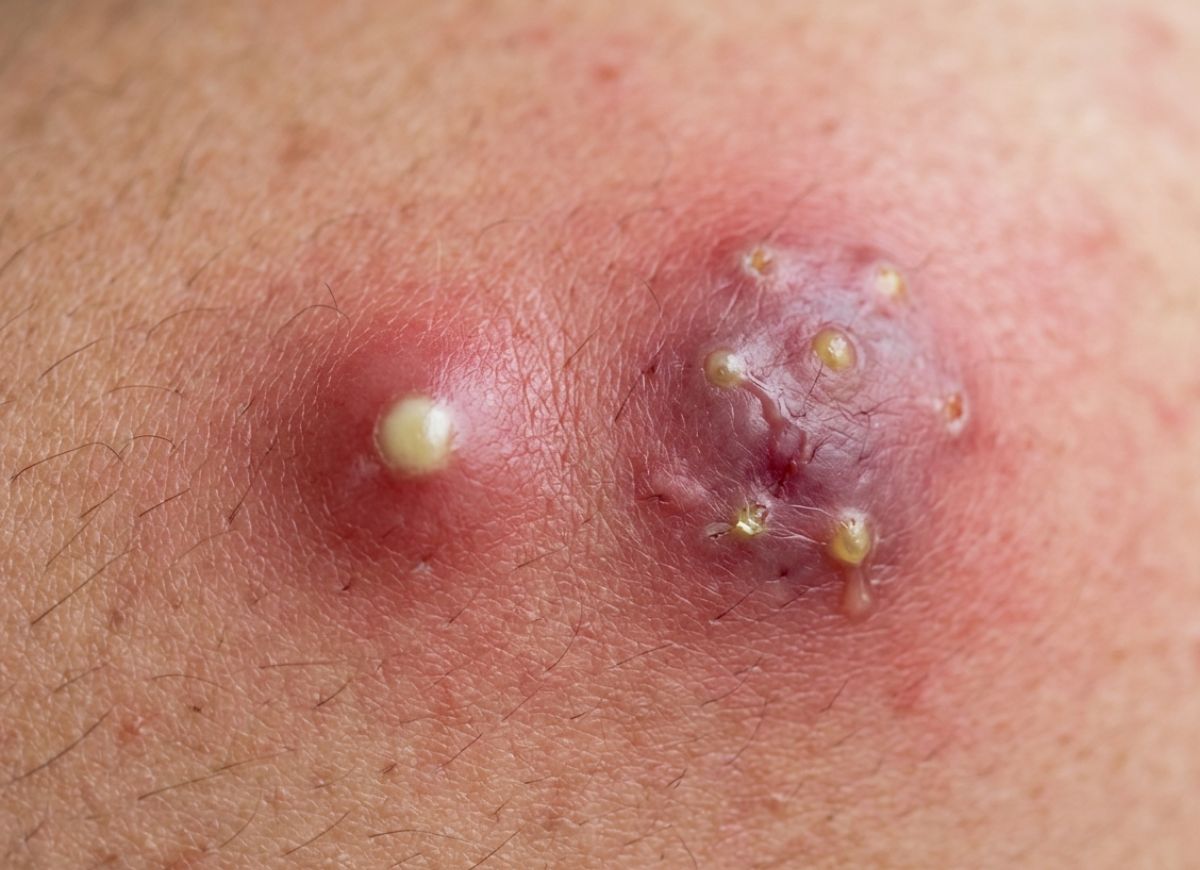
A carbuncle is a consolidated mass with multiple drainage points, appearing as a much larger, swollen, often dome-shaped mass that may have several pustules on its surface. The infection burrows into the fat layer, creating interconnected tunnels of pus. Because of the extensive tissue destruction, significant scarring is almost inevitable, and pus often drains from several openings.
Where They Commonly Appear
Boils and carbuncles favor hairy areas subject to friction, moisture, and sweat: the face, neck, armpits, back, buttocks, and thighs.
- Face and neck: dense in hair follicles and oil glands. Shaving can create microscopic cuts, and collars rubbing the back of the neck add friction.
- Armpits: warm, moist, and subject to friction, with shaving or waxing adding irritation.
- Buttocks and groin: constantly under pressure from sitting and often covered by clothing that traps heat and sweat. Tight clothing can cause folliculitis that progresses to boils, and the buttocks are one of the most common sites.
- Inner thighs: prone to chafing, especially with physical activity or excess weight.
- Back and shoulders: many follicles, plenty of sweating, and clothing that traps moisture against the skin.
6 Key Symptoms
1. A small, red, firm, tender lump. The first sign of a developing boil is usually a pea-sized, red, firm, tender bump. This is the start of the inflammatory process within a single follicle: the immune system detects invading bacteria and sends inflammatory cells and fluid to the site, causing redness, swelling, and tenderness. At this stage the lump is solid because it’s inflamed tissue rather than liquid pus, and it may feel warm or itchy before becoming painful. This early stage, folliculitis, can sometimes resolve on its own, but if the immune response continues it progresses to a full boil. It’s a critical window for intervention, since warm compresses at this point can sometimes help the body fight off the infection before an abscess fully forms.
2. Increasing size and swelling. Over several days, the abscess grows and swells as immune cells and bacteria accumulate into a growing pocket of pus. White blood cells rush in, die, and mix with dead skin cells and multiplying bacteria, while the body walls off the material with a fibrous capsule, forming the abscess cavity. As it fills, it stretches the surrounding skin. A boil that began pea-sized can reach the size of a cherry, walnut, or even a golf ball within days, with taut, shiny, intensely red skin. In a carbuncle, this happens across multiple follicles, producing a much larger, broader, hardened area of swelling. This rapid growth and tension generate the intense, throbbing pain of a maturing abscess.
3. A yellow-white tip forming. As pus builds and pushes toward the surface, a yellow or white “head” (pustule) forms, marking the point where the abscess will eventually rupture and drain. Internal pressure seeks the path of least resistance, usually up through the original follicle toward the skin’s surface, and the skin over the center thins and weakens until the pus shows through. This is called “pointing” or “coming to a head,” and it means the boil is nearing spontaneous rupture. Once it drains, pressure is relieved and pain typically eases significantly. It’s the body’s way of expelling the infection and a sign healing can soon begin, but also a point of high contagion, since the draining pus is teeming with bacteria.
4. A constant, throbbing ache. Pain from boils and carbuncles is typically a constant, throbbing ache that intensifies as pus pressure builds on surrounding nerve endings. Unlike a superficial scratch, it’s deep, persistent, and worsens with movement or pressure. Early on it may feel like tenderness or soreness, but as the abscess fills over several days, internal pressure rises dramatically, and the pain can become debilitating, often peaking just before the boil drains, when the skin is stretched to its limit. Location matters: boils over joints (knee, armpit) or areas under constant pressure (the buttocks when sitting) are exceptionally painful, and even the touch of clothing can be agonizing. With carbuncles, pain is more widespread and severe because of the larger area and deeper tissue involved. It typically subsides dramatically once the abscess ruptures.
5. Fever or general illness. Larger boils and especially carbuncles can cause fever, chills, and malaise (a general sense of being unwell) as the body mounts a significant immune response. This shows the infection is no longer just a local skin problem. A small, simple boil rarely does this, but a large boil or carbuncle is a substantial infectious burden. The immune system releases inflammatory chemicals called cytokines that signal the brain’s hypothalamus to raise body temperature, and chills often accompany a rising fever as the body shivers to generate heat. Malaise includes fatigue, weakness, body aches, and loss of appetite as the body diverts energy toward fighting the infection. Fever, chills, or malaise are red flags that call for medical evaluation, since they raise the risk of bacteria spreading to the bloodstream (bacteremia) or deeper tissues.
6. Swollen lymph nodes nearby. Lymph nodes close to a boil or carbuncle often swell and become tender because they’re actively filtering infectious material and producing more white blood cells. This reactive lymphadenopathy is a tangible sign that the immune system is fully engaged. Bacteria, dead cells, and inflammatory fluid from the abscess travel through lymphatic vessels to the nearest node cluster: a boil on the arm drains to the armpit nodes, an infection on the neck to the cervical nodes. Inside the nodes, immune cells trap and destroy the bacteria, and the nodes enlarge as they ramp up production, often felt as firm, tender lumps under the skin. It’s a good sign the immune system is working to contain the infection, but it also underscores how significant the original infection is.
What Causes Boils and Carbuncles?
They’re primarily caused by bacterial infection of a hair follicle, most commonly Staphylococcus aureus, which enters through small cuts or abrasions or travels down the hair shaft. Staph commonly lives on the skin’s surface and inside the nostrils of many healthy people without causing harm, but when the skin barrier is breached, it can invade a follicle and multiply.
Typically a follicle becomes blocked by dead skin cells and oil (sebum), creating an environment where bacteria thrive. Entry can be a visible cut, scrape, or insect bite, or a microscopic break from friction or shaving. Once inside, the bacteria trigger a strong immune response, white blood cells arrive, and pus forms, producing the painful abscess.
In some cases the cause is MRSA (methicillin-resistant Staphylococcus aureus), a strain resistant to many common antibiotics that makes infection harder to treat. Staph causes the vast majority of cases, though other bacteria are occasionally responsible.
Who Is Most at Risk?
Anyone can get a boil, but some conditions and habits raise susceptibility by weakening defenses or increasing exposure to the bacteria.
- Diabetes, especially poorly controlled: high glucose impairs white blood cell function, and poor circulation and nerve damage make minor skin injuries slower to heal and easier to infect.
- Weakened immune systems, such as HIV/AIDS, chemotherapy, immunosuppressive drugs after organ transplant, or genetic immune disorders, which make it harder to contain bacteria early.
- Chronic skin conditions like eczema, psoriasis, or severe acne, which create many entry points for bacteria.
- Staph carriers. Many people carry staph in their nostrils and can transfer it to their skin via their hands, a process called autoinoculation.
- Obesity, where deeper skin folds trap heat and moisture, and friction and chafing cause irritation and breaks in the skin.
- Close-contact environments like athletic teams (especially wrestling), military barracks, prisons, and shelters, where sharing towels, razors, or gear spreads the bacteria.
- Poor hygiene, which raises risk, though good hygiene doesn’t guarantee protection.
Are Boils Contagious?
The bacteria that cause boils are contagious and can spread from the pus of an active boil to other parts of the body or to other people. The boil itself isn’t contagious like a cold virus, but the infectious agent inside it is easily transmitted, and drainage is teeming with live staph.
- Skin-to-skin contact. The most common route: touching the boil or draining pus, then touching skin with a small cut or abrasion.
- Shared items. Bacteria can survive on towels, washcloths, razors, bed linens, clothing, and athletic equipment, which is how boils spread through households and sports teams.
- Autoinoculation. Touching a boil and then scratching elsewhere can seed a new boil in another follicle, so wash hands thoroughly after touching a boil or changing its dressing.
To limit spread, keep the boil covered with a clean, dry bandage, avoid sharing personal items, wash hands frequently, and launder contaminated clothing, towels, and bedding in hot water.
Treating a Boil at Home Safely
Small, uncomplicated boils can often be treated at home with warm, moist compresses, but you must never squeeze or lance a boil yourself. Home care works best for a minor boil in a low-risk location with no systemic symptoms, aiming to help it mature and drain naturally.
- Apply warm compresses. Soak a clean washcloth in warm (not scalding) water, wring it out, and hold it on the boil for 10 to 15 minutes, three to four times a day. Heat and moisture boost blood flow, bringing more infection-fighting white blood cells, and soften the skin over the pustule to encourage natural drainage.
- Wash your hands with soap and water before and after touching the boil or compress, to avoid introducing new bacteria or spreading existing ones.
- Cover it once it drains. Keep the area clean and cover it with sterile gauze or a bandage to absorb pus and stop bacteria from spreading, changing the dressing frequently, especially if saturated.
- Never squeeze, pop, or cut it. Squeezing can damage tissue and force pus and bacteria deeper, causing cellulitis or even pushing bacteria into the bloodstream. Lancing at home with a needle or pin is very risky, introducing new infection and causing injury and scarring. Let it drain on its own or have a professional drain it in a sterile setting.
When to Seek Medical Help
Many small, single boils can be managed at home, but certain warning signs mean the infection is too severe or spreading:
- Fever, chills, or feeling generally unwell, a strong sign of a significant infection that may be spreading; seek attention right away
- Boils on the face, especially around the nose and mouth (the “danger triangle”), since bacteria from this region can potentially travel to the brain; a boil on or near the spine also needs urgent evaluation, and boils in the groin or deep in the buttock crease are hard to manage
- Excruciating or intensifying pain despite home care, which suggests a severe abscess likely needing professional drainage
- Red streaks spreading from the boil (lymphangitis, infection tracking along lymphatic vessels) or rapidly expanding red, warm, tender skin (cellulitis), both of which need antibiotics
- A very large abscess (bigger than a golf ball) or a cluster of boils (a carbuncle), which are too large and deep to resolve on their own
- No improvement within two weeks of consistent home care, meaning it hasn’t come to a head or begun draining
- Multiple boils over several months, which may point to MRSA carriage or an undiagnosed condition like diabetes
- A compromised immune system, diabetes, or immunosuppressive medication, in which case any boil, regardless of size, warrants a doctor’s visit
Boil vs. Cyst vs. Pimple
Though they look similar, these bumps differ in origin, structure, and treatment.
A boil is a deep bacterial infection of a hair follicle, most commonly from Staphylococcus aureus. It starts as a tender red lump that grows more painful as it fills with pus, eventually forming a white or yellow head. Boils are true abscesses and quite painful due to inflammation and pressure on nerve endings.
A pimple results from a clogged pore, blocked by excess oil, dead skin cells, and bacteria, producing whiteheads or blackheads. Some become inflamed and pus-filled, but they’re typically much smaller, more superficial, and less painful than boils, with infection contained within the pore.
A cyst is a closed, sac-like pocket of tissue that’s typically non-infectious, such as an epidermoid or sebaceous cyst, filled with fluid, semi-solid material, or air. Cysts often feel like a small, smooth pea and grow slowly, and are usually painless unless they rupture, become inflamed, or get infected, at which point they can resemble a boil.
Preventing Boils and Carbuncles
Complete prevention isn’t always possible, particularly with a compromised immune system or chronic skin condition, but strict hygiene and preventive habits can dramatically reduce frequency and severity.
- Practice good personal hygiene. Regular handwashing with soap and water is one of the most effective ways to remove staph from the skin, and daily bathing washes away sweat, oil, and bacteria that contribute to clogged follicles. If you’re prone to boils in friction areas like the inner thighs or underarms, keep them clean and dry.
- Don’t share personal items like towels, razors, clothing, or athletic equipment, which is especially important for preventing spread of antibiotic-resistant MRSA, a common cause of recurrent, severe boils. Each household member should have their own items.
- Care for wounds promptly. Clean any cut, scrape, or insect bite right away with soap and water, apply an over-the-counter antiseptic to reduce infection risk, and cover it with a sterile bandage, changing it daily or when wet or dirty.
- Support your immune system with a balanced diet, regular exercise, and adequate sleep, helping your body fight off bacterial infections before they develop into abscesses.
Complications of Untreated Boils
Ignoring a boil, or draining it improperly by squeezing or lancing with an unsterile object, can cause serious and, rarely, life-threatening complications.
- Permanent scarring, especially with large, deep, or repeatedly squeezed boils that damage the underlying skin.
- Cellulitis. Pressure can force pus deeper into tissue, causing a serious infection of the deeper skin layers and soft tissues, with spreading redness, swelling, warmth, and pain around the boil. It needs prompt antibiotic treatment.
- Sepsis. The most severe complication, occurring when bacteria enter the bloodstream and trigger a system-wide inflammatory response. It’s a medical emergency marked by fever, rapid heart rate, shortness of breath, confusion, and a sharp drop in blood pressure, and without immediate hospital treatment it can lead to organ failure and death.
- Carbuncle formation. An untreated boil can spread sideways under the skin, connecting with other follicles into a larger, deeper, more painful cluster.
- Rare distant infections, as bacteria travel through the bloodstream to cause osteomyelitis (bone infection) or endocarditis (infection of the heart’s inner lining).
- Recurrence. Improperly drained boils are more likely to return, since the underlying bacterial colony may not be fully eliminated.
Medical Treatment
Professional treatment is needed when boils are large, extremely painful, in a sensitive area like the face or spine, or accompanied by signs of spreading infection such as fever.
Incision and drainage (I&D) is the main procedure for a mature boil or carbuncle and should only be done by a healthcare professional in a sterile environment. The doctor numbs the area with local anesthetic, makes a small, precise incision with a sterile scalpel at the tip of the abscess, and lets the pus drain fully, gently pressing nearby to remove all infected material. For larger abscesses, the cavity may be packed with sterile gauze that wicks away remaining pus and helps the wound heal from the inside out, preventing premature closure and recurrence; the packing is usually removed and replaced within a few days. Attempting this at home is extremely dangerous and can cause severe scarring, worsened infection, and cellulitis.
Antibiotics may be prescribed to fully clear the infection. A small boil that drains on its own may not need them, but they’re often necessary for large boils, carbuncles, abscesses with cellulitis, and patients with weakened immune systems. They’re also typically prescribed for facial boils because of the risk of spread to the brain.
Culture testing. A doctor may send a pus sample to a lab to identify the bacteria and determine which antibiotics will work, which is especially important for MRSA.
Finish the full antibiotic course even if the boil looks and feels better. Stopping early can cause recurrence and contribute to antibiotic resistance.
Frequently Asked Questions
Are boils a hygiene issue?
Not necessarily. Boils occur when bacteria, most often Staphylococcus aureus, enter through small cuts, hair follicles, or areas of friction. Poor hygiene can raise risk, but many people who keep clean still get them. Sweating, tight clothing, shaving irritation, or a weakened immune response can also contribute, and recurrent boils may point to an underlying condition rather than simply a hygiene problem.
How do you get rid of carbuncles?
It depends on severity. Small boils may improve with warm compresses several times a day, but carbuncles, being larger and deeper, often need medical attention. A provider may need to drain the infection safely and prescribe antibiotics if it’s spreading or causing systemic symptoms. Squeezing or cutting a boil at home isn’t recommended.
What is the body lacking if you get boils?
Boils aren’t always tied to a specific deficiency, but low immunity, poorly controlled blood sugar, or deficiencies in nutrients like vitamin C, zinc, or iron can make skin more vulnerable. Chronic conditions like diabetes are also associated with recurrent boils because they impair the body’s ability to fight bacteria.
What are the final stages of a boil?
It typically grows larger, softer in the center, and pus-filled, then ruptures and drains, either naturally or with medical help. After draining, the area heals, though a small scar may remain. Proper care at this stage prevents secondary infection and speeds recovery.
What disease is associated with boils?
Boils are commonly linked to bacterial skin infection, but recurrent or severe cases may reflect underlying conditions such as weakened immunity, chronic illness, or skin disorders. Repeated infections may also relate to colonization with antibiotic-resistant bacteria like MRSA, which requires careful medical management.
How long is too long for a boil?
Most begin improving within one to three weeks, softening, forming a pus-filled center, and eventually draining before healing. If a boil lasts longer than two weeks without improvement, keeps growing, or becomes increasingly painful, it may be a deeper or more persistent infection. Delayed healing can also reflect weakened immunity or diabetes, so medical evaluation is important.
Can a boil heal without draining?
Yes, some small boils resolve without noticeable drainage as the immune system gradually breaks down the infection, and warm compresses can support this. Larger or increasingly painful boils often need to drain, naturally or with medical help. Squeezing or puncturing one at home can push bacteria deeper and worsen the infection.
When should you worry about a boil?
When it shows signs of progression or complication: severe pain, rapid growth, spreading redness, fever, or multiple boils forming together. Boils on the face, spine, or other sensitive areas also deserve serious attention because of the risk of deeper infection. If a boil doesn’t improve, becomes unusually large, or comes with systemic symptoms, seek medical care, since early attention can prevent spread and more serious outcomes.
The Bottom Line
Boils and carbuncles may seem like minor skin issues at first, but they’re more common, and potentially more serious, than they appear. Many people experience them at some point, often without recognizing when things begin to worsen. What starts as a small, tender bump can quickly become a painful infection reaching deeper layers of the skin.
The key challenge is early recognition. Mild symptoms are easy to dismiss, which delays proper care, and as the infection progresses the risk of complications grows, including spreading infection and symptoms that affect overall health. Watching for changes in size, pain, and accompanying symptoms can guide better decisions about when to seek help. Simple measures may be enough early on, but more advanced cases often need professional treatment.
Ultimately, awareness and a prompt response are what matter. Boils and carbuncles are common, but they should never be ignored once they show signs of progression, and recognizing when a condition needs attention can make a real difference in both recovery and long-term skin health.