

6 Early Symptoms of Otitis Media with Effusion in Children
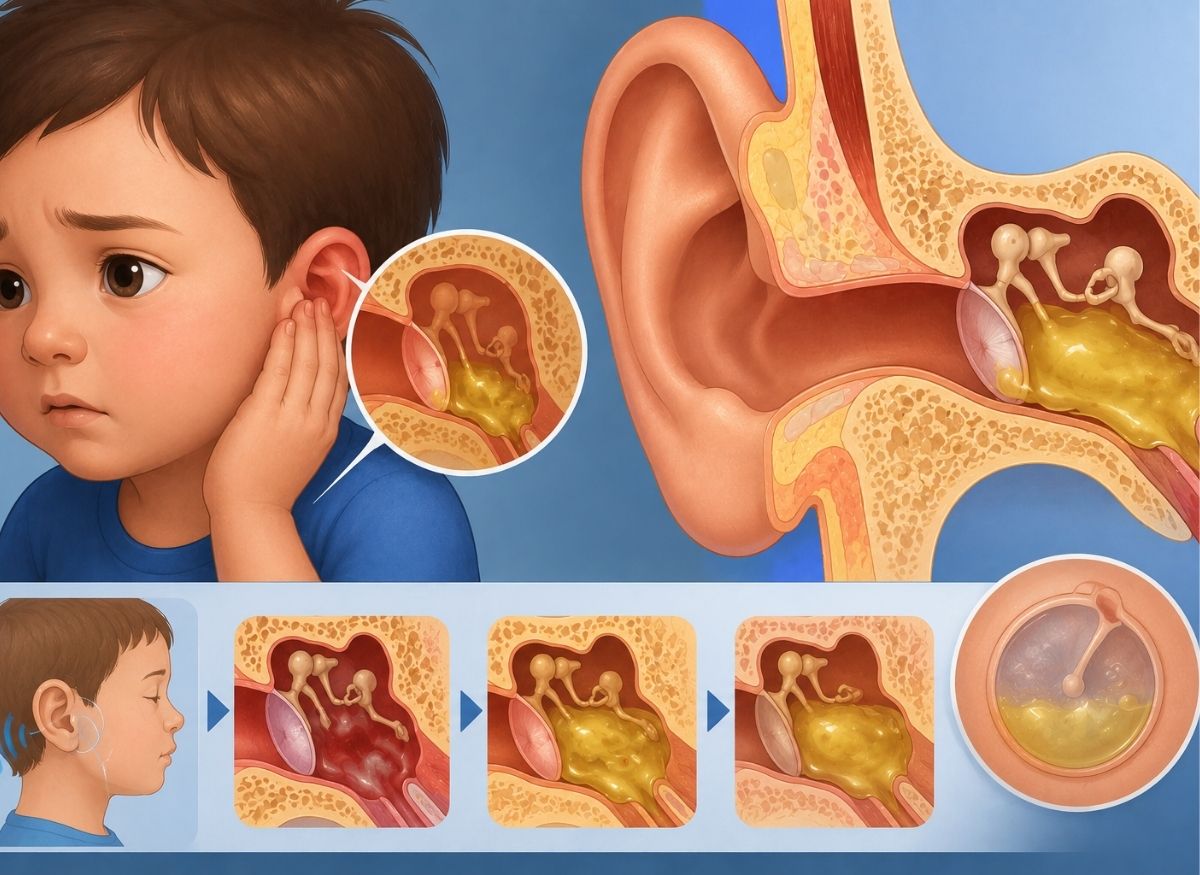
Otitis Media with Effusion (OME) often called “fluid in the middle ear” is a widespread childhood condition where fluid builds up behind the eardrum without any active infection. Unlike a typical ear infection, OME usually doesn’t come with a fever or intense pain, which makes it easy to miss. Still, that trapped fluid can quietly affect a child’s hearing, balance, and speech growth if it sticks around for weeks or months. Catching the signs early makes a real difference in how quickly it’s managed.
Kids are especially prone to this because their Eustachian tubes are shorter and sit more horizontally than an adult’s, so fluid doesn’t drain as easily. Common triggers include a recent cold, allergies, sinus trouble, or secondhand smoke. Below, we walk through six early warning signs, how to spot them, and what parents can do to protect their child’s hearing.
Definition of Otitis Media with Effusion: What Exactly is ‘Glue Ear’ in Children?
Tucked behind the eardrum is a tiny, air-filled space called the middle ear. Normally, this pocket lets sound travel cleanly to the inner ear. But when the ear’s drainage system stops working properly, sterile fluid can start pooling there instead. Doctors call this otitis media with effusion (OME) though most people know it by its nickname, “glue ear.”
The Core Definition of Otitis Media with Effusion
The broader term “otitis media” simply means any inflammation or fluid buildup in the middle ear.
With OME specifically, nothing is actively infected it’s a mechanical problem. Inside the middle ear sit three tiny bones (the ossicles) that need to move freely for sound to register properly. When OME sets in, a thick, sterile fluid surrounds these bones, muffling sound and causing a temporary form of hearing loss.
The “glue ear” nickname fits because, left alone, this fluid gradually thickens into something sticky and gel-like, making it even harder for the eardrum to vibrate.
The Internal Mechanics: What Happens Inside the Ear
Normal ear function depends on the Eustachian tube a narrow passage linking the middle ear to the back of the throat and nose. Think of it as a built-in pressure valve that balances air pressure and clears out natural secretions.
The vacuum effect: When the tube closes off, the tissue inside the middle ear starts absorbing the trapped air, creating negative pressure. That vacuum tugs the eardrum inward, stiffening it and dulling its response to sound.
Fluid buildup: To counter that pressure, the middle ear lining starts producing a thin, sterile fluid sometimes called serous otitis media.
Thickening: If the blockage doesn’t clear, more mucus-producing cells kick in, and the fluid slowly turns into a heavier, glue-like gel. Since this fluid can shift with head movement, a child’s hearing might seem to come and go.
Key Differences: Glue Ear vs. A Typical Ear Infection
Glue ear and a standard ear infection often get lumped together, but they’re two very different stages of the same broader condition.
Acute Otitis Media (AOM)
This is the sudden, painful version most people picture driven by a virus or bacteria, it fills the middle ear with infected fluid or pus almost overnight. It brings sharp pain, high fever, and a clearly unwell, irritable child.
Otitis Media with Effusion (OME)
Glue ear, on the other hand, involves no infection at all. It often shows up after an ear infection clears, once the bacteria are gone but the leftover fluid hasn’t drained. It can also develop on its own from allergies or anatomy alone. Because nothing is actively infected, there’s no fever and no sharp pain a child with OME usually doesn’t look sick at all. The main giveaway is muffled hearing, which is easy to mistake for simple daydreaming.
Recognizing the Subtle Symptoms in Children
Since glue ear skips the obvious red flags of fever or pain, parents need to watch for quieter clues:
- Behavior shifts: Saying “what?” a lot, not responding when called, or cranking up the TV volume.
- Speech delays: Struggling to copy sounds correctly, which can slow speech development during a critical growth window.
- Balance quirks: The extra weight of the fluid can throw off balance, making a child seem clumsier than usual.
Signs of Otitis Media with Effusion: What are the 6 Key Symptoms to Watch For?
Because OME builds up silently without a fever, sharp crying, or draining pus it doesn’t announce itself the way an infection does.
Instead, the fluid acts like a muffler inside the ear, giving sound an “underwater” quality. Since it can shift as a child moves, symptoms may come and go, which makes them trickier to catch. Here are the six key signs worth watching for.
The 6 Key Symptoms of Otitis Media with Effusion
           [THE 6 SIGNS OF FLUID ACCUMULATION]
                                │
       ┌────────────────────────┼────────────────────────┐
       ▼                        ▼                        ▼
 [HEARING DIFFICULTY]    [SPEECH DELAYS]         [BALANCE ISSUES]
 • Asks "What?" often.    • Omits clear consonants.• Unsteady on feet.
 • Turns up device volumes.• Slow vocabulary growth.• Frequent tripping.
       │                        │                        │
       ├────────────────────────┼────────────────────────┤
       ▼                        ▼                        ▼
 [EAR TUGGING/POKING]    [BEHAVIORAL CHANGES]    [INATTENTIVENESS]
 • Relieving ear pressure.• Irritability from clog. • Mistaken for defiance.
 • Annoying popping sound.• Poor sleep when flat.  • "Zoning out" at school.
Because sound vibrations get blocked by the fluid, children with OME experience a mild-to-moderate hearing dip. Watch for frequent “what?” or “huh?” responses, needing things repeated, or not answering when called from another room.
A telltale sign is turning the TV, tablet, or game volume up louder than feels comfortable to everyone else in the room. And because the fluid shifts, hearing can seem to come and go fine one hour, foggy the next.
Muffled or Inconsistent Hearing Difficulty
Kids learn to talk by closely listening to and copying sounds. When OME dulls their hearing, it’s hard for them to pick up on subtle consonants like “s,” “f,” “sh,” and “t.”
This can show up as unclear speech or dropped sounds altogether “poon” instead of “spoon,” for example. In toddlers, look for slower vocabulary growth, delayed milestones, or trouble stringing simple sentences together.
Balance Problems and Clumsiness
The middle ear sits right next to the inner ear’s balance system (the vestibular system). The shifting fluid and pressure changes from OME can throw this off.
A child might suddenly seem more clumsy, trip more than usual, or hesitate on activities that require good balance climbing playground stairs, riding a balance bike, or stepping off a curb.
Ear Tugging, Rubbing, or Poking
Unlike a painful ear infection, OME causes more of a dull pressure or “stuffed” feeling, sometimes with a popping or cracking sound when swallowing.
Since young kids can’t always describe this, they try to fix it physically tugging at their ears, rubbing their head against furniture, or poking a finger into the ear canal, even without complaining of real pain.
Behavioral Changes and Irritability
Living with a constant clogged feeling is tiring and frustrating for a child. That frustration can show up as more tantrums, shorter patience, or sudden meltdowns when they can’t understand what’s being said.
Lying flat can also make the pressure worse, which may disrupt sleep harder bedtime settling or more night wakings.
Apparent Inattentiveness or “Zoning Out”
This is probably the most misread symptom of all. Kids who seem spaced out, don’t follow instructions, or appear disconnected are often assumed to be defiant or dealing with attention issues.
At school, a teacher might flag trouble following directions. In reality, the child often just can’t hear clearly through the fluid they’re not tuning out on purpose.
Distinguishing OME from Active Infections
These six behavioral cues matter because they’re often the only window into what’s happening in a child’s ears. A true infection would look much louder in comparison:
           [The Ear Condition Spectrum]

Acute Otitis Media (AOM) ──────► Severe pain, high fever, red/bulging eardrum, crying.
                                      │
                                      ▼
Otitis Media with Effusion (OME) ──► No fever, no sharp pain, muffled hearing, behavioral changes.
Since OME is fluid without active bacteria, antibiotics won’t fix it. Most cases clear up on their own within about three months. If symptoms linger past twelve weeks, it’s worth seeing an ENT specialist to protect speech, balance, and learning down the line.
Causes of Otitis Media with Effusion: Why Does Fluid Get Trapped in a Child’s Ear?
OME comes down to a mechanical failure in the middle ear’s drainage system the Eustachian tube. When this valve stops working, the middle ear turns from an air-filled space into a stagnant, fluid-filled one. While several everyday triggers can set it off, the root cause traces back to a child’s anatomy.
The Anatomy of a Child’s Eustachian Tube
This narrow channel connects the middle ear to the back of the throat and nose, doing three jobs: keeping germs out, balancing air pressure, and draining fluid. In young kids, it’s still immature the main reason OME is so common at this age.
Because a child’s tube runs more horizontally, gravity doesn’t help drainage the way it does in adults. Its narrow width means even mild swelling can block it entirely, and the soft cartilage lets it collapse easily under pressure. As kids grow, the tube lengthens, widens, and angles more steeply which is why most children eventually outgrow OME altogether.
The Vacuum Effect: How Fluid Fills the Middle Ear
Once the Eustachian tube blocks up, a chain reaction follows:
- Air absorption: With no fresh air getting in, the tissue lining absorbs what’s already trapped inside.
- Vacuum formation: As the air disappears, negative pressure builds, pulling the eardrum inward and stiffening it.
- Fluid secretion: To offset the pressure, the lining releases a clear, sterile fluid but with the tube blocked, it has nowhere to go. It pools and slowly thickens into the sticky, glue-like substance behind the muffled hearing.
Preceding Illnesses: Colds, Sinus Infections, and Allergies
Fluid buildup rarely comes out of nowhere it’s almost always a leftover effect of a cold or allergic reaction.
Viral infections: A cold triggers swelling and mucus production in the nose and throat, which can plug the Eustachian tube’s opening.
Allergies: Exposure to pollen, dust mites, or pet dander triggers histamine release, causing swelling along the same drainage pathway.
Even after the original cold or allergy symptoms fade, this internal swelling can linger for weeks which is why OME often turns up during a routine check-up long after the illness has passed.
Distinguishing OME from Active Bacterial Infections
Acute Otitis Media (AOM): an active, painful infection with fever, sharp pain, and a red, bulging eardrum.
Otitis Media with Effusion (OME): sterile fluid with no infection, no fever, no sharp pain instead, subtle cues like volume creep, inattentiveness, balance quirks, or mild speech delays. Since there’s no bacteria involved, antibiotics don’t help; a few months of observation is the usual approach.
Other Pediatric Risk Factors: Daycares and Enlarged Adenoids
Enlarged adenoids: These immune-tissue pads sit right next to the Eustachian tube openings and are naturally largest in early childhood. If they swell from allergies or infections, they can physically block the tube.
Daycare exposure: Kids in group settings catch more colds simply from constant exposure, leaving little recovery time between bouts of swelling.
How do Doctors Officially Diagnose Otitis Media with Effusion?
Since OME doesn’t announce itself with fever or pain, doctors can’t diagnose it by symptoms alone they rely on a mix of visual exams and objective tests.
Visual Inspection: Standard and Pneumatic Otoscopy
Diagnosis starts with an otoscope a lighted, magnifying tool used to look directly at the eardrum.
What doctors look for:
- A dull, cloudy, or yellowish eardrum instead of the normal shiny, translucent look.
- A visible fluid line or trapped air bubbles behind the membrane.
- A retracted eardrum, pulled inward by the internal vacuum.
Pneumatic otoscopy goes a step further: a small bulb attached to the otoscope seals the canal and sends a gentle puff of air. A healthy eardrum flexes in response; one full of fluid barely moves at all this lack of movement is one of the most reliable signs of OME.
Objective Testing: Tympanometry
To confirm what they see, doctors often run a tympanometry test a quick, painless check of how well the middle ear conducts sound. A soft probe adjusts air pressure in the canal, plays a tone, and measures how much sound bounces back, plotted as a tympanogram:
- Type A (Normal): A sharp peak healthy, air-filled ear.
- Type B (Flat): No peak at all the eardrum is immobilized by fluid, a clear sign of effusion.
- Type C (Negative Pressure): A shifted peak early-stage blockage before fluid fully fills the space.
Assessing the Impact: Audiometry (Formal Hearing Tests)
If OME lasts more than three months, doctors may order audiometry a formal hearing test using headphones in a quiet room to measure exactly how much hearing has been affected. This helps guide decisions like whether ventilation tubes (grommets) are needed.
Differentiating OME from Other Ear Conditions
Acute Otitis Media (AOM): a red, bulging eardrum with fever and pain very different from OME’s dull, retracted look.
Chronic Otitis Media: involves a lasting perforation or ongoing drainage over months.
Spotting a flat Type B tympanogram helps doctors avoid unnecessary antibiotics and instead recommend a safe observation period.
The Potential Long-Term Complications if Otitis Media with Effusion is Not Addressed
Left untreated for months or years, OME stops being a minor, temporary issue. The ongoing pressure and trapped fluid can cause lasting harm to development and to the ear’s physical structures.
Developmental and Cognitive Complications
The first few years of life are a crucial window for language learning, which makes unaddressed OME especially risky then.
- Speech delays: Muffled hearing makes it hard to mimic sounds correctly, which can lead to lasting articulation issues and a smaller vocabulary.
- Academic struggles: Difficulty hearing over classroom noise can affect reading, comprehension, and spelling sometimes mistaken for a learning disability.
- Social and behavioral effects: Communication struggles often bring frustration, anxiety, or withdrawal from peers.
Structural Damage to the Eardrum (Atelectasis)
A persistent vacuum from a blocked Eustachian tube keeps pulling the eardrum inward. Over time it can lose elasticity, thin out, and collapse a condition called atelectasis sometimes draping over the hearing bones and preventing normal vibration.
Erosion of the Middle Ear Bones (Ossicles)
The three tiny bones that transmit sound (malleus, incus, stapes) need to stay suspended in air to work properly. Months spent submerged in thick fluid, combined with constant pressure and inflammation, can wear away the connections between them potentially causing permanent hearing loss.
The Development of a Cholesteatoma
One of the more serious complications is a cholesteatoma a noncancerous skin cyst that forms when chronic vacuum pressure pulls part of the eardrum into a pocket, trapping shed skin cells that can’t escape. Over time, this growth can erode surrounding bone and even reach the inner ear’s balance centers, usually requiring surgery to treat.
Can you prevent Otitis Media with Effusion in your child?
Because a child’s short, horizontal Eustachian tube is simply part of their anatomy, OME can’t always be avoided entirely. Still, there’s plenty parents can do to lower the risk mainly by reducing the illnesses that tend to trigger it.
Eliminate Exposure to Secondhand Smoke
A smoke-free home is one of the most effective steps you can take. Smoke irritates the respiratory tract, causing swelling around the Eustachian tube opening, and it paralyzes the tiny cilia that normally sweep fluid out of the ear letting secretions pool instead.
Encourage Breastfeeding and Practicing Strict Hygiene
Breastfeeding: Exclusive breastfeeding for at least six months passes on maternal antibodies (IgA) that help block infections before they start, and the feeding motion itself supports healthy Eustachian tube function.
Hand hygiene: Regular handwashing especially after coughing, sneezing, or daycare play cuts down on the colds that often lead to OME.
Stay Up-to-Date on Scheduled Vaccinations
Vaccines don’t prevent OME directly, but they do lower the risk of the bacterial and viral infections that often leave fluid behind afterward.
Proactively Manage Environmental Allergies
Allergic rhinitis is a major, often overlooked driver of chronic ear fluid. Managing allergy triggers with antihistamines or prescribed nasal sprays, guided by a pediatrician can keep the Eustachian tube open and draining normally.
Field Screening: What to Watch For
Since OME doesn’t come with the loud warning signs of a typical infection, parents should stay alert after a cold or allergy flare-up. Volume creep on devices, frequent repeats, a stall in speech progress, or unusual inattentiveness at school are all worth a doctor’s evaluation.
Conclusion
Otitis media with effusion is usually mild and tends to resolve on its own, but persistent fluid can still affect a child’s hearing and speech development. Recognizing early signs muffled hearing, trouble following instructions, ear tugging, irritability, balance issues, or speech delays helps parents get timely medical input. Depending on the case, a doctor might recommend simple monitoring, addressing an underlying cause, or, if needed, ear tube placement.
Prevention comes down to managing allergies, avoiding secondhand smoke, and treating respiratory infections promptly. With early awareness and the right care, most children come through OME with healthy hearing and normal speech development.
FAQ
What is otitis media with effusion and how does it differ from an ear infection?
OME is fluid sitting in the middle ear without any active infection no fever, no sharp pain. Unlike a typical ear infection, it can go unnoticed since the child often seems otherwise well. Subtle cues like inattentiveness, slow responses, or mild irritability are usually the biggest tells.
What are the early symptoms of otitis media with effusion in children?
Look for muffled hearing, trouble following conversations, frequent ear tugging, irritability, clumsiness or balance issues, and delayed speech milestones. Some children also sleep more restlessly or seem less focused at school. Since these signs can be subtle and inconsistent, it’s worth getting checked if you notice a pattern.
How is otitis media with effusion diagnosed?
Doctors typically use otoscopy to look at the eardrum, tympanometry to measure how it moves, and sometimes a hearing test. Otoscopy shows fluid behind the eardrum directly, while tympanometry confirms it with objective pressure readings. Catching it early helps avoid unnecessary hearing or developmental setbacks.
How is OME treated?
Most cases are managed with watchful waiting, since fluid often clears on its own within a few weeks. Treating an underlying cause like allergies or sinus issues can help too. If fluid persists or hearing is significantly affected, doctors may recommend ear tube placement, with regular follow-ups to track progress.
Can otitis media with effusion affect my child’s development?
Yes ongoing fluid can interfere with how clearly a child hears, which can slow speech, language, and learning. Catching it early and treating it (including hearing checks or ear tubes if needed) helps keep development on track.
How can otitis media with effusion be prevented?
Not every case is preventable, but avoiding secondhand smoke, managing allergies, practicing good hygiene, and staying current on vaccinations all help lower the risk. Watching for early symptoms means you can act quickly if fluid does build up.