
AC Joint Separation: Symptoms, Grades, and How It’s Treated
An AC joint separation is a common shoulder injury that occurs when the ligaments connecting the collarbone to the shoulder blade are stretched or torn. Often referred to as a shoulder separation, this injury frequently results from falls, contact sports, bicycle accidents, or direct blows to the shoulder.
Symptoms can range from mild pain and swelling to a noticeable bump on top of the shoulder and difficulty moving the arm. The severity of an AC joint separation varies significantly, which is why doctors classify the injury into different grades based on the amount of ligament damage and joint displacement.
While mild cases often heal with rest and physical therapy, more severe injuries may require surgical treatment. Understanding the symptoms, grades, and available treatment options can help you recognize the injury early and make informed decisions about your recovery.
This article covers the signs of AC joint separation, how doctors determine its severity, and the treatments commonly used to restore shoulder function.
What Is an AC Joint Separation?
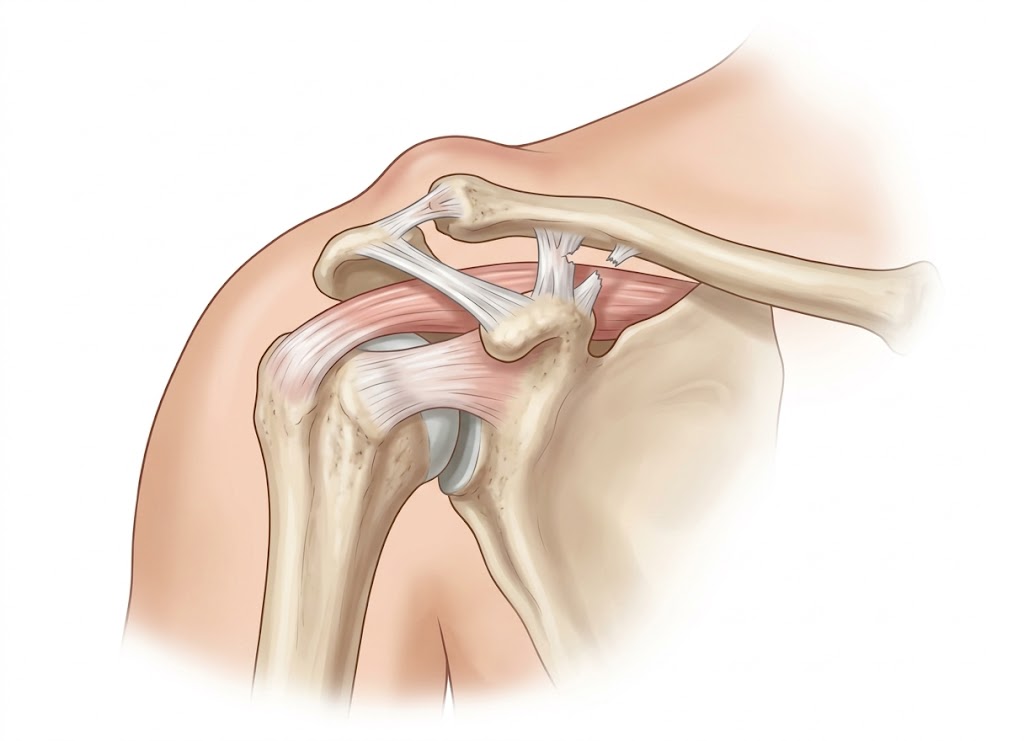
An AC joint separation is a traumatic injury targeting the ligaments that stabilize the connection between the distal end of the clavicle and the acromion, a prominent bony process on the shoulder blade. This injury is fundamentally classified as a sprain, where the supporting ligaments are stretched or torn. This structural failure causes the collarbone to separate from its normal anatomical position relative to the acromion.
It’s important to note that this condition is distinct from a traditional shoulder dislocation, which involves the displacement of the main ball and socket glenohumeral joint. To understand this injury better, it helps to look at the underlying anatomy and the specific mechanisms behind the damage.
What Exactly Happens to the Shoulder Ligaments During an AC Joint Separation?
During a traumatic AC joint separation, physical force applied to the shoulder region causes a progressive structural failure of the stabilizing ligaments. This deterioration starts directly with the acromioclavicular ligaments and, in more severe cases, extends to damage the coracoclavicular ligaments, ultimately allowing the clavicle to displace upward.
The structural integrity of this region relies on two primary ligament complexes. The first is the AC ligament complex, which forms a protective capsule around the joint and is primarily responsible for horizontal stability. The second, sturdier structure is the coracoclavicular ligament complex, made up of two distinct bands known as the trapezoid and conoid ligaments. These ligaments run from the coracoid process up to the underside of the collarbone and act as the primary vertical anchors.
When a direct downward force is applied to the acromion, such as during a fall onto the point of the shoulder, the acromion is driven downward while the clavicle remains fixed in its baseline position. This creates significant mechanical stress on the tissue.
In a mild injury, only the AC ligament is stretched or partially torn. As the impact force increases, the AC ligament tears completely. With even greater force, the strain transfers directly to the stronger coracoclavicular ligaments, causing them to stretch, sprain, or rupture completely.
Once both the AC and CC ligament groups are torn, the collarbone completely loses its ligamentous connection to the shoulder blade. The powerful trapezius muscle then pulls the detached bone upward, creating the characteristic visible bump seen in a severe separated shoulder. This predictable, progressive tissue failure serves as the clinical basis for the grading system used to classify the overall severity of an AC separation.
What Are the Most Common Causes of an AC Joint Injury?
There are three main categories of causes for an AC joint separation: direct impact to the shoulder structure, indirect impact transmitted up through the arm, and high energy trauma associated with athletics. Understanding these mechanisms helps clinicians properly diagnose the severity of the sprain and rule out associated skeletal injuries.
Direct Impact
This is the most frequent cause, accounting for the vast majority of separations. It occurs when someone falls and lands directly on the top point of their shoulder. The resulting force drives the acromion downward and inward, away from the clavicle. Common examples include a cyclist going over the handlebars, a hockey player being checked into the boards, or a football player being driven into the turf shoulder first. The ultimate severity of the tissue separation is directly proportional to the magnitude and direction of the force applied.
Indirect Impact
Less common but still significant, an indirect impact occurs when a person falls onto an outstretched hand or elbow. The mechanical force travels up the arm, through the humerus to the glenohumeral joint, and finally to the acromion. This upwardly directed force stresses and ultimately tears the stabilizing ligaments from below. This mechanism is often seen in accidental slips on slick surfaces or during sports where players instinctively brace for a fall with their hands.
Sports Related Injuries
An AC joint separation is especially common in certain high risk athletic activities. Contact and collision sports like football, rugby, and ice hockey are leading causes due to frequent physical tackling and checking. Gravity driven sports such as skiing, snowboarding, and competitive cycling also see a high incidence of separated shoulders due to the potential for high speed falls directly onto the upper body. Martial arts and wrestling are other activities where high impact throws and takedowns can result in a direct blow to the acromion.
What Are the Symptoms of an AC Joint Separation?
The primary symptoms of an AC joint separation are immediate, localized sharp pain at the top of the shoulder, a visible deformity or bump where the collarbone is elevated, swelling, bruising, and significant limitation in arm movement. The intensity of these symptoms correlates directly with the severity, or grade, of the ligament injury.
While a minor sprain may only cause mild tenderness, a complete ligament rupture will result in obvious signs of trauma. To diagnose and treat the injury effectively, it’s important to recognize both the immediate signs at the moment of trauma and the nature of the pain that follows.
What Are the Immediate Signs of a Separated Shoulder?
The immediate signs of a separated shoulder include a sudden onset of intense, localized pain at the joint, an audible or palpable “pop,” the rapid appearance of a visible bump on top of the shoulder, and immediate difficulty lifting the arm. These symptoms are often experienced simultaneously at the moment of impact. A person sustaining this injury will typically cradle the injured arm close to their body for support.
A closer look at these immediate signs helps highlight the severity of the trauma:
Intense, Localized Pain
The pain is characteristically sharp and focused directly over the AC joint, at the very top of the shoulder. Unlike the more diffuse pain of a rotator cuff injury or glenohumeral dislocation, this pain can often be pinpointed with one finger. Any attempt to move the arm, especially lifting it away from the body or across the chest, will significantly worsen this pain.
Visible Deformity (Step Off Sign)
In moderate to severe separations (Grade II and higher), the upward displacement of the distal clavicle creates a noticeable bump or step deformity. In advanced cases, this bump is unmistakable and is a hallmark sign of complete ligament rupture. The skin may appear “tented” over the elevated end of the collarbone.
Swelling and Bruising
Within minutes to hours of the injury, swelling becomes apparent over the top of the shoulder as inflammation and bleeding occur within the damaged tissues. Bruising may also develop, sometimes tracking down the chest or arm over the following days.
Tenderness and Instability
The area directly over the joint will be extremely tender to the touch. In more severe injuries, a clinician may be able to manually press down on the elevated clavicle, which springs back up when pressure is released, a phenomenon known as the “piano key sign,” indicating a complete loss of ligamentous stability.
What Does the Pain from an AC Joint Separation Feel Like?
The pain from an AC joint separation is typically described as a sharp, stabbing sensation localized to the top of the shoulder, becoming particularly acute with movements such as reaching overhead, bringing the arm across the body, or sleeping on the affected side. The pain evolves from an initial intense post traumatic phase to a more persistent, activity related ache as acute inflammation subsides. This pain is distinct from the deeper, more diffuse pain associated with other shoulder conditions like rotator cuff tears or glenohumeral arthritis.
Movement Related Pain
The most significant pain is triggered by movements that compress or shear the joint. Cross body adduction, reaching the arm across the chest to touch the opposite shoulder, is a classic maneuver used during physical exams because it directly compresses the inflamed joint surfaces. Overhead activities also place significant strain on the damaged ligaments, causing a sharp increase in pain.
Positional Pain
Lying directly on the affected side while sleeping is often intolerable, as direct pressure compresses the injured tissues and disrupts sleep. Many individuals find they need to sleep on their back or uninjured side, often propping the injured arm with a pillow to keep it in a comfortable position.
Chronic Ache and Discomfort
After the initial acute phase, which can last several days to weeks, sharp pain may subside into a chronic, dull ache, often felt at the end of the day or after increased activity. In cases where significant deformity persists, individuals may experience lingering instability, weakness, or a clicking or popping sensation with certain movements.
What Are the Grades of an AC Joint Separation?
There are six primary classifications of an AC joint separation, categorized using the Rockwood classification system based on the severity of ligament damage and the direction and degree of clavicle displacement relative to the acromion. This system gives clinicians a standardized framework for diagnosing the injury, predicting instability, and guiding treatment decisions, ranging from conservative management for mild sprains to surgical intervention for severe dislocations.
Each increasing grade represents greater disruption to the shoulder’s anatomy and a bigger challenge for functional recovery.
How Are the Six Grades of AC Joint Separation Classified?
The six grades of AC joint separation are classified by assessing the integrity of the acromioclavicular and coracoclavicular ligaments and measuring the resulting displacement of the clavicle through physical exams and X-rays. This detailed classification allows for a precise diagnosis and tailored treatment plan. The Rockwood classification system breaks down as follows:
Type I
This is the mildest form of a separated shoulder. The AC ligament is merely sprained or stretched, but not torn. The CC ligaments remain completely intact. There’s no visible deformity, and the joint remains fully stable. The only indicators are localized tenderness and mild pain over the joint.
Type II
In this grade, the AC ligament is completely torn, but the CC ligaments are only sprained or stretched. This partial loss of stability allows the clavicle to ride up slightly, creating a small but noticeable bump. The clavicle is displaced superiorly but by less than 25 percent of its own width. There may be some horizontal instability, but vertical stability is largely maintained by the intact CC ligaments.
Type III
This is a more severe injury where both the AC and CC ligaments are completely torn. Without the strong vertical support of the CC ligaments, the trapezius muscle pulls the clavicle significantly upward, causing an obvious deformity. The clavicle is displaced superiorly by 25 to 100 percent of the clavicle’s width compared to the uninjured side, resulting in significant instability in both vertical and horizontal planes.
Type IV
This is a severe and less common injury. In addition to complete tears of both the AC and CC ligaments, the distal end of the clavicle is displaced posteriorly (backward), becoming entrapped in or buttonholed through the trapezius muscle. This posterior displacement is the defining feature of this injury type and often requires surgical reduction.
Type V
This is a highly severe form of a Type III injury, involving complete rupture of the AC and CC ligaments along with significant tearing of the deltoid and trapezius muscle fascia attached to the distal clavicle. This extensive soft tissue damage allows for extreme superior displacement of the clavicle, typically greater than 100 percent of its width, creating a dramatic and painful deformity.
Type VI
This is the rarest and most severe type of AC joint separation. The clavicle is displaced inferiorly (downward), becoming lodged beneath the coracoid process or the acromion. This injury typically results from very high energy trauma and is often associated with other severe injuries, such as rib fractures or nerve and blood vessel damage.
What Is the Difference Between a Mild (Type I-II) and a Severe (Type III-VI) AC Joint Separation?
A mild (Type I-II) AC joint separation maintains overall joint stability due to intact or only partially torn ligaments, while a severe (Type III-VI) separation involves complete ligament rupture and significant, multi directional joint instability. This fundamental difference in structural integrity shapes the clinical presentation, treatment approach, and overall outlook. Key differences include:
Ligament Integrity
In mild injuries, the primary stabilizers, the CC ligaments, remain intact (Type I) or are only sprained (Type II), preserving vertical stability. In severe cases, both the AC and CC ligaments are completely ruptured, resulting in a total loss of passive stability connecting the clavicle to the scapula.
Visibility of Deformity
Mild separations present with no visible deformity (Type I) or only a slight bump (Type II) that may not be immediately obvious. Severe separations feature a prominent, often unmistakable deformity (Type III and V), a posteriorly displaced clavicle (Type IV), or an inferiorly displaced clavicle (Type VI).
Joint Stability and Function
A shoulder with a mild separation remains functionally stable for most daily activities after a short recovery period. While some pain may persist with overhead or cross body movements, the mechanical linkage of the shoulder girdle is largely preserved. In severe injuries, the clavicle is disconnected from the scapula, leading to significant instability that can cause painful motion, weakness, and a drooping appearance of the shoulder. This can be especially debilitating for laborers and athletes.
What Else Should You Know About Diagnosis, Recovery, and Related Shoulder Conditions?
Beyond the initial symptoms and treatment options, understanding an AC joint separation also means knowing how it’s diagnosed, what recovery typically looks like, how it differs from other common shoulder injuries, and its potential long term effects.
How Is an AC Joint Separation Diagnosed by a Doctor?
A physician diagnoses an AC joint separation through a combination of patient history, physical examination, and imaging. The process begins with discussing how the injury occurred, since a direct fall onto the point of the shoulder is the classic mechanism. During the physical exam, the doctor looks for a visible “step-off” deformity, where the end of the clavicle is elevated, and gently palpates the AC joint to assess tenderness and instability.
Specific maneuvers help confirm the diagnosis, such as the cross body adduction test, where the patient’s arm is moved across their chest, typically triggering sharp pain at the AC joint. Imaging is crucial for confirming the diagnosis and determining the injury’s grade. Standard X-rays are the primary tool, often including a specialized view called the Zanca view, which offers a clearer image of the AC joint.
In cases where the separation is subtle, a physician may order weighted X-rays, where the patient holds a weight to pull the arm downward, making ligament damage more apparent. An MRI may be ordered if there’s suspicion of damage to surrounding soft tissues, like the rotator cuff or labrum, or to assist with surgical planning.
What Is the Typical Recovery Timeline for an AC Joint Separation?
Recovery time depends heavily on the grade of the injury and whether treatment is surgical or non-surgical. For lower grade injuries managed conservatively, the process is phased but generally quicker.
Grade 1
These mild sprains typically resolve within one to three weeks. A brief period of rest, ice, and anti-inflammatory medication is followed by a quick return to gentle range of motion exercises. Full return to sports can often occur within a few weeks once pain has subsided and strength is restored.
Grade 2
With a partial tear of the coracoclavicular ligaments, recovery usually takes six to eight weeks. The initial phase involves wearing a sling for one to three weeks, followed by a structured physical therapy program focused first on restoring pain free range of motion, then gradually strengthening the surrounding muscles.
Grade 3 and Beyond
For non-surgical treatment of a Grade 3 injury, the timeline can extend to 12 weeks or more before returning to high impact activities. Surgical cases, along with higher grade separations (Grades 4 to 6), involve a more extensive recovery. Post-surgery, the shoulder is typically immobilized in a sling for four to six weeks to protect the ligament repair.
Physical therapy begins with passive motion, progressing to active motion around the six week mark. Strengthening exercises are introduced gradually, with a return to heavy lifting or contact sports often delayed until four to six months post-operation to allow the reconstructed ligaments to fully heal.
How Does an AC Joint Separation Differ from a Shoulder Dislocation?
Although both are painful shoulder injuries, an AC joint separation and a shoulder dislocation affect entirely different anatomical structures and are fundamentally distinct.
An AC separation specifically involves the acromioclavicular joint, the small joint at the very top of the shoulder where the collarbone meets the highest point of the shoulder blade. This injury involves a sprain or tear of the ligaments stabilizing this connection.
A shoulder dislocation, by contrast, occurs at the main ball and socket joint of the shoulder, known as the glenohumeral joint, where the head of the upper arm bone pops out of the shallow socket of the shoulder blade.
Mechanism of Injury
An AC separation is typically caused by a direct blow to the top or front of the shoulder, such as falling directly onto it. A shoulder dislocation is more often caused by the arm being forcefully twisted, pulled, or pushed into an extreme position.
Visual Deformity
An AC separation results in a “step-off” deformity or prominent bump on top of the shoulder. A dislocated shoulder presents differently, often with a “squared off” or hollowed out appearance just below the shoulder tip.
Joints Involved
An AC separation impacts the connection between the clavicle and acromion, while a dislocation affects the main glenohumeral joint, which is responsible for the vast majority of the shoulder’s range of motion.
Can an AC Joint Separation Lead to Long-Term Problems Like Arthritis?
Yes, an AC joint separation, particularly a more severe one, can lead to long term problems, with post-traumatic osteoarthritis being one of the most common. When the ligaments supporting the AC joint are significantly torn (as in Grade 3 and higher injuries), the joint’s mechanics are permanently altered. The end of the clavicle may no longer align perfectly with the acromion, leading to abnormal movement and increased friction on the joint’s cartilage surfaces.
Over years, this chronic instability and uneven wear can degrade the protective cartilage, resulting in the pain, stiffness, and inflammation characteristic of arthritis. The risk generally correlates with the severity of the initial injury, a minor Grade 1 sprain is far less likely to cause arthritis than a completely disrupted Grade 4 or 5 separation.
Beyond arthritis, other chronic issues can arise. Some individuals, especially those with Grade 3 separations treated non-surgically, may be left with a permanent and sometimes cosmetically noticeable bump on their shoulder. This can come with chronic, low level pain, a clicking or popping sensation with overhead movements, and a feeling of weakness or fatigue in the shoulder, particularly during activities that stress the joint.
Proper initial management and a dedicated rehabilitation program focused on strengthening the surrounding scapular and deltoid muscles are essential for stabilizing the joint and minimizing the risk of these long term complications.
Conclusion
An AC joint separation can cause significant discomfort and limit shoulder movement, but most people recover well with appropriate treatment. The severity of the injury plays a major role in determining recovery time and whether surgery is necessary.
Mild injuries often improve with rest, ice, pain management, and rehabilitation exercises, while more severe separations may require surgical repair to restore joint stability. Early diagnosis and proper care can help reduce complications and support a faster return to daily activities.
If you experience shoulder pain, swelling, or a visible deformity after a fall or impact, seek medical attention for an accurate evaluation. Understanding the symptoms and treatment options for AC joint separation is the first step toward a successful recovery and long term shoulder health.
FAQs
What is the main cause of AC joint separation?
The most common cause is a direct impact to the shoulder, often from sports injuries, falls, bicycle accidents, or motor vehicle collisions. The force damages the ligaments that hold the AC joint together.
How can I tell if I have an AC joint separation or a shoulder sprain?
An AC joint separation often causes pain directly on top of the shoulder, swelling, tenderness, and sometimes a visible bump. A healthcare provider may use a physical examination and imaging tests such as X-rays to confirm the diagnosis.
What are the grades of AC joint separation?
AC joint separation is typically classified from Grade I to Grade VI. Grade I involves minor ligament stretching, while Grade VI represents severe ligament damage with major displacement of the collarbone.
Does every AC joint separation require surgery?
No. Most Grade I, II, and many Grade III injuries are treated without surgery. Surgical treatment is generally reserved for severe injuries, persistent symptoms, or individuals with high physical demands.
How long does an AC joint separation take to heal?
Recovery varies depending on the injury grade. Mild injuries may improve within 2 to 6 weeks, while more severe cases can require several months of rehabilitation.
Can I exercise with an AC joint separation?
You should avoid activities that worsen pain until cleared by a healthcare professional. Physical therapy exercises are often introduced gradually to restore mobility and strength.
Will the bump on my shoulder go away?
A visible bump may remain after moderate or severe AC joint separation, even when pain and function improve. In many cases, the bump is cosmetic and doesn’t affect shoulder performance.
Can an AC joint separation heal on its own?
Many mild and moderate injuries heal successfully with rest, ice, immobilization, and rehabilitation. Severe ligament injuries may not fully reconnect anatomically but can still become functional with proper treatment.
What complications can occur after an AC joint separation?
Potential complications include chronic pain, joint instability, arthritis of the AC joint, reduced shoulder strength, or cosmetic deformity. Early treatment can help reduce these risks.
Can I return to sports after an AC joint separation?
Most athletes can return to sports once pain has resolved and shoulder strength and motion have been restored. The timeline depends on injury severity and the demands of the sport.