

6 Reasons You Might See Eye Floaters and What They Mean
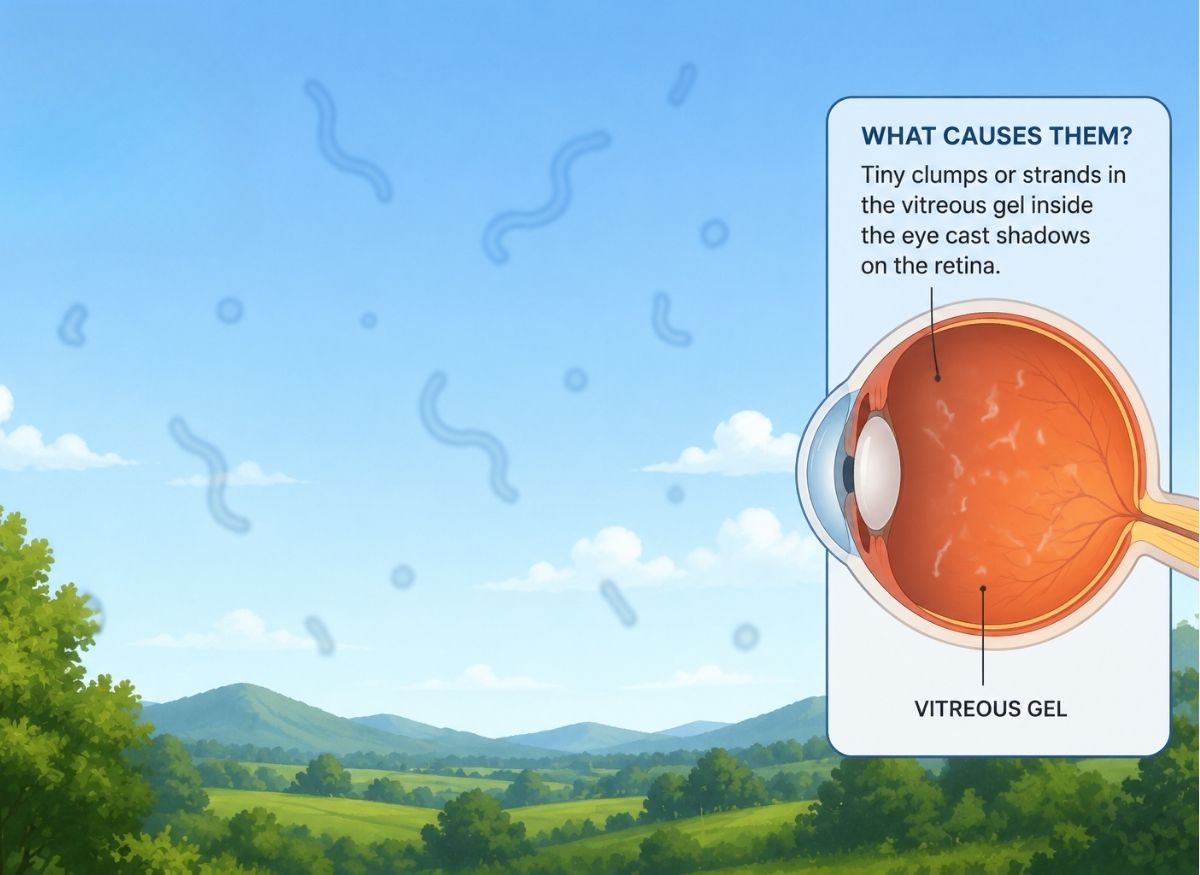
Have you ever noticed tiny shadows, spots, or wavy lines moving across your vision, especially when looking at something bright like the sky or a plain wall? These are known as eye floaters. They are very common and, although they may seem concerning, they are usually harmless.
Eye floaters can look like small dots, threads, or cobwebs that appear to move whenever you move your eyes. They develop from tiny clumps of gel or cells inside the vitreous, the clear, jelly-like substance that fills the inside of the eye. As people get older, the vitreous may shrink and become more watery, allowing particles inside it to move around and cast shadows on the retina. These shadows are what you see as floaters.
Although floaters are often connected with normal aging, they can sometimes point to an underlying eye problem. Seeing a few floaters is usually not a reason to panic, but a sudden increase in floaters or the appearance of flashes of light should not be ignored.
A sudden change in the number or appearance of floaters can sometimes be associated with retinal tears, diabetic retinopathy, or other eye conditions that require prompt medical attention. Knowing why floaters develop and understanding when they may indicate something more serious is important for protecting your vision. In this article, we’ll look at six common reasons you might see eye floaters and what they may mean.
What Are Eye Floaters?
Understanding what are eyeball floaters begins with knowing that they are not simply an illusion created by light. They are physical structures located inside the eye. Although they may seem as though they are sitting on the surface of your vision, the eye floater meaning is connected to the vitreous humor, the jelly-like material that helps maintain the shape of the eye.
The Origin of the “Floatie” in the Eye
In a young and healthy eye, the vitreous humor is generally clear and evenly structured. With age, however, a natural process called vitreous syneresis can occur. During this process, the gel starts becoming more liquid, while the tiny collagen fibers that previously gave it structure can begin sticking together.
These clumps become the things floating in eye that you notice. Because they are denser than the surrounding liquid, they can move around inside the back portion of the eye.
When light enters the eye, these clumps can block part of the light and create shadows on the retina at the back of the eye. Your brain then interprets those shadows as floating dots in vision, threads, or cobweb-like shapes. This is also why seeing black floating spots is often easier against bright, plain surfaces such as a white wall or computer screen. The contrast makes the shadows more noticeable.
One of the frustrating things about a floater eye is that it may move away whenever you try to look directly at it. This occurs because the dots in vision are suspended inside the fluid of the eye. When you move your eyes, the vitreous can shift and swirl because of inertia.
Think of the eye like a snow globe. When you move the globe, the “snow,” similar to the black floaters in vision, moves around inside it. Since the floaters are not attached to one fixed point, they move with the fluid instead of staying exactly where you are looking.
This is why a black dot in vision floating may continue drifting even after you stop moving your eyes. It can move past the area where you first noticed it and then gradually settle again.
Adaptation and Persistence
For many people, what do floaters look like may seem to change over time because the brain becomes accustomed to them. This process is often called “neuro-adaptation.” The brain can gradually learn to filter out repeated visual information that does not pose a threat.
If a floatie in eye remains in roughly the same area, your brain may eventually stop paying attention to its shadow. You may only notice it when you deliberately look for it or when it moves into the center of your vision.
Understanding what causes floaters in eyesight can be reassuring because many floaters are simply part of the normal aging process. However, if dark floating spots in vision appear together with other changes in eyesight, they may indicate a change involving the vitreous and retina.
6 Common Reasons for Seeing Eye Floaters
Although the most common eye floater meaning is associated with normal aging, there are six main reasons these floating dots in vision can develop. Whether a floatie in eye is simply caused by a harmless change in the vitreous or is related to a more serious problem, such as a retinal tear cause, often depends on how suddenly it appeared and whether other vision symptoms occur at the same time.
Age-Related Vitreous Changes and PVD
Most dark floating spots in vision develop because of normal changes in the vitreous humor as we age. Over time, the vitreous gel gradually becomes more liquid, causing collagen fibers to clump together.
For many people, this process eventually leads to Posterior Vitreous Detachment (PVD), which commonly occurs after age 50. During a PVD, the shrinking vitreous pulls away from the retina.
This process can release small pieces of cellular debris or form a Weiss ring, which may appear as a large, circular black dot in vision floating near the center or side of your vision. Although PVD is usually harmless, a sudden shower of new spots should be examined by an eye professional to make sure the retina has not been damaged.
Posterior Uveitis (Inflammation)
Posterior uveitis refers to inflammation toward the back of the eye. It can cause black floaters in vision that are related to inflammation rather than normal structural changes.
When the uvea becomes inflamed because of an infection or autoimmune condition, inflammatory cells and other debris can enter the vitreous. Instead of appearing as sharp lines or dots, these floaters may look more like a hazy cloud or “snowballs.”
Because these dots in vision may be connected with conditions such as lupus or sarcoidosis, proper medical evaluation and treatment may be needed to help prevent lasting eye problems.
Vitreous Hemorrhage (Internal Bleeding)
When blood vessels in the retina break or leak, red blood cells can enter the clear vitreous gel. This can lead to black floating spots that may appear as a sudden group of tiny pepper-like dots or dark streaks.
If the bleeding is more severe, it may create a reddish or cloudy haze that makes it difficult to see clearly. Vitreous hemorrhage can occur with conditions such as diabetic retinopathy, where fragile blood vessels may bleed easily, or high blood pressure.
Because blood can block light inside the eye and create noticeable shadows, these floaters can be alarming and require prompt medical evaluation.
Retinal Tears and Detachment
A retinal tear cause is one of the most serious reasons for suddenly developing new floaters. When the vitreous shrinks while remaining firmly attached to the retina, it can pull strongly enough to tear the delicate retinal tissue.
A tear can release pigment cells and sometimes blood into the vitreous, resulting in a sudden shower of black floaters in vision. If fluid passes through the tear, it can cause the retina to separate from the back of the eye.
Knowing what does a detached retina look like is important. A detached retina may cause a dark, fixed curtain or shadow to appear across part of your peripheral vision. This is a medical emergency that requires immediate attention.
Post-Surgical and Medication Complications
Certain eye procedures can change the way things floating in eye are noticed. For example, cataract surgery may disturb the vitreous and make existing collagen clumps easier to see.
Intravitreal injections used for conditions such as macular degeneration can sometimes introduce very small air bubbles into the eye. These may appear as round, dark floating dots in vision, often toward the lower part of the visual field. They generally disappear as the bubbles dissolve.
More complicated eye surgeries may also leave tiny silicone oil droplets behind. These can sometimes remain in the eye and appear as long-lasting but non-threatening floaters.
High Myopia and Ocular Trauma
People with high myopia, or severe nearsightedness, have a greater risk of developing floaters. Because highly myopic eyes are often longer than average, the vitreous may become stretched and liquefy earlier in life.
As a result, people with high myopia may experience seeing light flashes in vision and floaters during their 20s or 30s. Physical trauma can also affect the vitreous. A strong impact, such as being hit by a ball, may cause a sudden PVD or retinal tear.
Any injury followed by a new black dot in vision floating should be evaluated promptly because of the potential risk of retinal damage.
When Are Eye Floaters a Sign of A Medical Emergency?
Most eye floaters are harmless and develop as part of normal aging. However, they can sometimes be an early warning sign of a condition that may seriously affect vision. Since the retina does not contain pain receptors, a retinal tear or detachment may not cause pain. Instead, changes in vision may be the first warning.
Knowing when a floatie in eye has changed from a minor annoyance into a possible emergency is extremely important.
The “Shower” of New Floaters
One of the most important warning signs is a sudden and noticeable increase in black floaters in vision. Seeing an occasional new floater over a long period is common, but suddenly seeing a large number of dots, spots, or cloud-like shapes should be taken seriously.
A sudden “shower” may happen when the retina is torn. The tear can release pigment cells and, in some cases, red blood cells into the vitreous. To the person experiencing it, this may look like a burst of pepper-like spots or a dense cobweb appearing very quickly.
Flashes of Light (Photopsia)
Seeing light flashes in eye, particularly eye flashes in corner of eye, can happen when the retina is being physically stimulated. As the vitreous pulls on the retina, the brain may interpret that physical stimulation as a flash of light.
These flashes in peripheral vision may look like lightning streaks, brief bursts, or camera flashes. They are often easier to notice in darker surroundings.
When new floating dots in vision appear together with seeing light flashes in vision, it can be a warning that the vitreous is pulling on the retina. Because this can be associated with a retinal tear cause, an immediate dilated eye examination may be necessary.
The “Curtain” or Shadow
A dark shadow, veil, or curtain that appears from the side of your vision and remains in place is another major warning sign. This can be a classic symptom of a detached retina.
As fluid moves through a retinal tear, the retina can separate from the tissue that supplies it. The affected portion of the retina may stop functioning properly.
Unlike a black dot in vision floating, which usually moves when you move your eyes, a retinal detachment-related shadow can remain fixed. If the curtain or shadow progresses toward the center of your vision, the macula may become involved, potentially causing permanent vision loss.
Sudden Loss of Vision or Eye Pain
Most retinal problems do not cause pain. However, if floaters in one eye occur along with sudden, severe blurring or a dull ache, further evaluation becomes especially important.
- Vitreous Hemorrhage: A large amount of blood inside the eye can act like a thick filter and cause a sudden and significant reduction in vision.
- Inflammation (Uveitis): When dark floating spots in vision occur with eye pain and strong sensitivity to light, it may point toward an inflammatory or infectious problem requiring medical treatment.
Who is More at Risk of Developing Eye Floaters?
Age is the most common factor, but several health and eye-related conditions can increase the likelihood of developing floaters earlier. Understanding what causes floaters in eyesight involves considering the shape and structure of the eye as well as the condition of its blood vessels.
Because the vitreous can respond to changes in the structure and health of the eye, some people may notice floating dots in vision earlier than others.
Age and the 50+ Demographic
For many people, the most common eye floater meaning is simply a normal result of aging. After age 50, the chance of developing a Posterior Vitreous Detachment (PVD) increases.
As the vitreous becomes more liquid through syneresis, its collagen fibers can become less transparent and clump together. This can create the familiar black floaters in vision that resemble cobwebs, threads, or drifting shapes.
The Myopia (Nearsightedness) Factor
People with high myopia are more likely to develop floaters at a younger age. A nearsighted eye is often longer than average, which can stretch the vitreous and retina.
This may cause the vitreous to break down and liquefy earlier. Because of this, it is possible for myopic individuals to notice a floatie in eye or seeing black floating spots during their 20s or 30s.
Post-Surgical and Trauma Patients
The eye is a delicate internal structure. Even successful procedures, including cataract surgery, may disturb the vitreous and make existing collagen clumps easier to notice.
- Surgery: Some people notice a new black dot in vision floating after cataract or glaucoma procedures.
- Trauma: A significant injury to the head or eye can trigger a traumatic PVD. The sudden movement may release pigment cells or cause bleeding, leading to an immediate “shower” of dots in vision.
Individuals with Chronic Health Conditions
Overall health can affect eye health, particularly the condition of the blood vessels inside the eye.
- Diabetes: People with diabetic retinopathy have an increased risk of vitreous hemorrhage. Blood entering the eye can create a group of black floaters in vision that may resemble small pepper flakes.
- Autoimmune Disorders: Conditions associated with systemic inflammation, including lupus or rheumatoid arthritis, may be linked with posterior uveitis. Inflammation can release white blood cells into the vitreous, producing a cloudy or hazy floater eye.
How Does a Doctor Diagnose The Cause of Eye Floaters?
Finding the cause of eye floaters involves more than checking whether you can read letters on an eye chart. A doctor needs to examine the inside of the eye to identify the source of the floaters and determine whether the retina has been affected.
An optometrist or ophthalmologist may use eye dilation and specialized magnification tools to distinguish normal age-related changes from a potentially serious retinal tear cause.
The Necessity of Dilation
A dilated eye examination is one of the most important parts of evaluating new floaters. Normally, the pupil becomes smaller when exposed to bright light. This can limit how much of the retina a doctor can see, especially toward the outer edges.
Dilating drops enlarge the pupil, allowing the doctor to examine a much wider area of the retina with specialized lenses. This helps them look for retinal tears or detachments that could otherwise be difficult to detect in the peripheral retina.
Specialized Diagnostic Tools
After the eye has been dilated, the doctor may use several tools to identify the source of your floating dots in vision:
- Slit-Lamp Examination: This binocular microscope gives the doctor a highly magnified, three-dimensional view of the eye. A narrow beam of light can help reveal different parts of the vitreous, including collagen clumps or a Weiss ring.
- Indirect Ophthalmoscopy: For a wider examination of the retina, the doctor may use a binocular indirect ophthalmoscope along with a special lens. This allows them to inspect areas where the vitreous may have pulled on the retina and caused a tear.
- Ocular Ultrasound: If blood inside the vitreous or a dense cataract prevents a clear view of the retina, an ultrasound may be used. Sound waves create images of the internal eye structures and can help determine whether the retina remains attached.
The Difference Between Eye Floaters and Flashes of Light
Eye floaters and light flashes in eye may occur during the same condition, such as a posterior vitreous detachment, but they are not the same thing. The main difference is that floaters are physical particles or structures that create shadows, while flashes are visual sensations caused by mechanical stimulation.
Understanding the eye floater meaning and how it differs from flashes can help you recognize potentially serious changes in vision.
Floaters: The Internal Shadows
An eye floater is a physical structure within the eye. It may appear as a black dot in vision floating, a thread, or a cobweb-like shape. These things floating in eye can consist of collagen clumps, cells, or other material suspended in the vitreous.
They do not produce light themselves. Instead, they block some of the light entering the eye and create shadows on the retina. Your brain then interprets those shadows as moving shapes.
This explains why floating dots in vision are usually easier to notice when looking at a bright, plain background. More light creates a stronger contrast, making the shadows easier to see.
Flashes: The Mechanical “False Alarm”
Flashes in peripheral vision, also called photopsia, are different because they are not caused by a physical object inside the eye. Instead, they can happen when the retina is physically stimulated.
The retina sends signals that the brain interprets as light. Therefore, when the shrinking vitreous pulls on the retina, the brain may perceive that stimulation as a sudden flash.
These eye flashes in corner of eye can be described as:
- Lightning Streaks: Short, jagged lines of light.
- Camera Flashes: Sudden bright or white bursts, especially in darker surroundings.
- Stars: Small shimmering points that may resemble the spots seen after an impact or injury.
The Danger of the Combined Symptom
A single floatie in eye is often related to normal age-related changes. However, seeing floaters together with flashes can be a significant warning sign.
If light flashes in vision occur at the same time as a sudden shower of black floaters in vision, the vitreous may be pulling on the retina strongly enough to cause a retinal tear cause.
When these symptoms appear together, it can be thought of as the vitreous being pulled away from the retina. This is why understanding what do floaters in your eye mean when they occur alongside flashes is important: the combination can be an early warning of retinal damage or detachment.
Can Eye Floaters Be Treated or Removed?
Most eye floaters do not require treatment and may remain visible for some time. For many people, the most effective approach is simply allowing the brain to adjust to them.
Through neuro-adaptation, the brain can gradually become less aware of the shadows created by floating dots in vision. As the black floaters in vision move through the vitreous, they may also settle lower in the eye and become less noticeable.
If a floatie in eye temporarily moves into the center of your vision, moving your eyes from side to side or up and down may cause the vitreous to shift. This can sometimes move the black dot in vision floating away from the center.
However, in some cases, floaters can become dense or persistent enough to interfere with activities such as reading or driving. In those situations, an eye specialist may discuss treatment options.
Laser Vitreolysis: Vaporizing the Debris
Laser Vitreolysis is a less invasive treatment option sometimes used for large or persistent floaters. During this procedure, an ophthalmologist uses a specialized YAG laser to target the collagen clumps.
- The Goal: The laser does not physically take the floater out of the eye. Instead, it breaks a larger floater into much smaller particles that may be less noticeable.
- The Risks: This treatment is not suitable for every floater. If a floater is too close to the retina or lens, using the laser may increase the risk of complications, including a retinal tear cause or cataract.
Vitrectomy: The Surgical “Last Resort”
If dark floating spots in vision seriously affect someone’s quality of life, a doctor may consider a vitrectomy. This is a surgical procedure in which the vitreous gel containing the floaters is removed.
- The Procedure: The surgeon makes very small openings in the eye to remove the vitreous and replace it with a sterile saline solution. The eye can later replace this solution with its own natural fluid.
- The Complications: Because vitrectomy is an eye surgery, it carries risks such as infection, increased eye pressure, and faster cataract development. It can also increase the risk of retinal detachment, which is why it is generally reserved for situations where the vision is significantly affected.
Conclusion
Eye floaters are usually a normal part of aging, but it is still important to pay attention to sudden changes in your vision. Many people experience floaters during their lifetime, and most are harmless. However, a sudden increase in floaters, flashes of light, or a shadow or curtain in your peripheral vision can be a warning sign of a more serious problem.
Conditions such as retinal tears or retinal detachment may require urgent treatment, so these symptoms should not be ignored.
Regular eye examinations can help monitor your vision and identify potential problems early. Learning what can cause eye floaters and recognizing warning signs can help you stay aware of changes in your eye health. If you are concerned about new or changing floaters, contacting an eye-care professional for an evaluation is important.
FAQ
What causes eye floaters?
Eye floaters develop from tiny clumps of gel, collagen, or cells inside the vitreous humor of the eye. As the vitreous changes with age and becomes more liquid, these particles can cast shadows onto the retina, which the brain perceives as floaters.
Most floaters are harmless and associated with normal aging. However, a sudden increase in floaters can sometimes indicate an eye problem that needs prompt medical evaluation.
Are eye floaters a sign of a serious eye condition?
Most eye floaters are harmless and are often part of normal aging. However, a sudden appearance of many floaters, especially when combined with flashes of light or loss of peripheral vision, can indicate a more serious condition such as a retinal tear or detachment.
These symptoms should be evaluated promptly to reduce the risk of further vision problems.
Can eye floaters go away?
Eye floaters do not always disappear completely, but they can become much less noticeable over time. The brain may gradually learn to ignore them, while the floaters themselves can move away from the central field of vision.
Some people continue to notice them, especially when looking at bright backgrounds. If persistent floaters interfere with daily activities, an eye doctor can discuss possible management or treatment options.
How can I prevent eye floaters?
Most age-related eye floaters cannot be completely prevented. However, taking care of your overall eye health can help protect your vision and allow conditions that may contribute to floaters to be identified early.
Regular eye examinations can help detect problems such as retinal tears or diabetic retinopathy. Protecting your eyes from injury, following a healthy diet, and managing underlying health conditions can also support overall eye health.
When should I see a doctor about eye floaters?
You should seek medical attention if you suddenly notice many new eye floaters, particularly if they occur with flashes of light, a dark shadow or curtain over your vision, or loss of peripheral vision.
These symptoms can be associated with retinal tears or retinal detachment and require prompt medical evaluation. If you are worried about new or changing floaters, an eye doctor can perform a thorough examination and determine the cause.