
Hyperopia (Farsightedness): Symptoms and Vision Correction Options
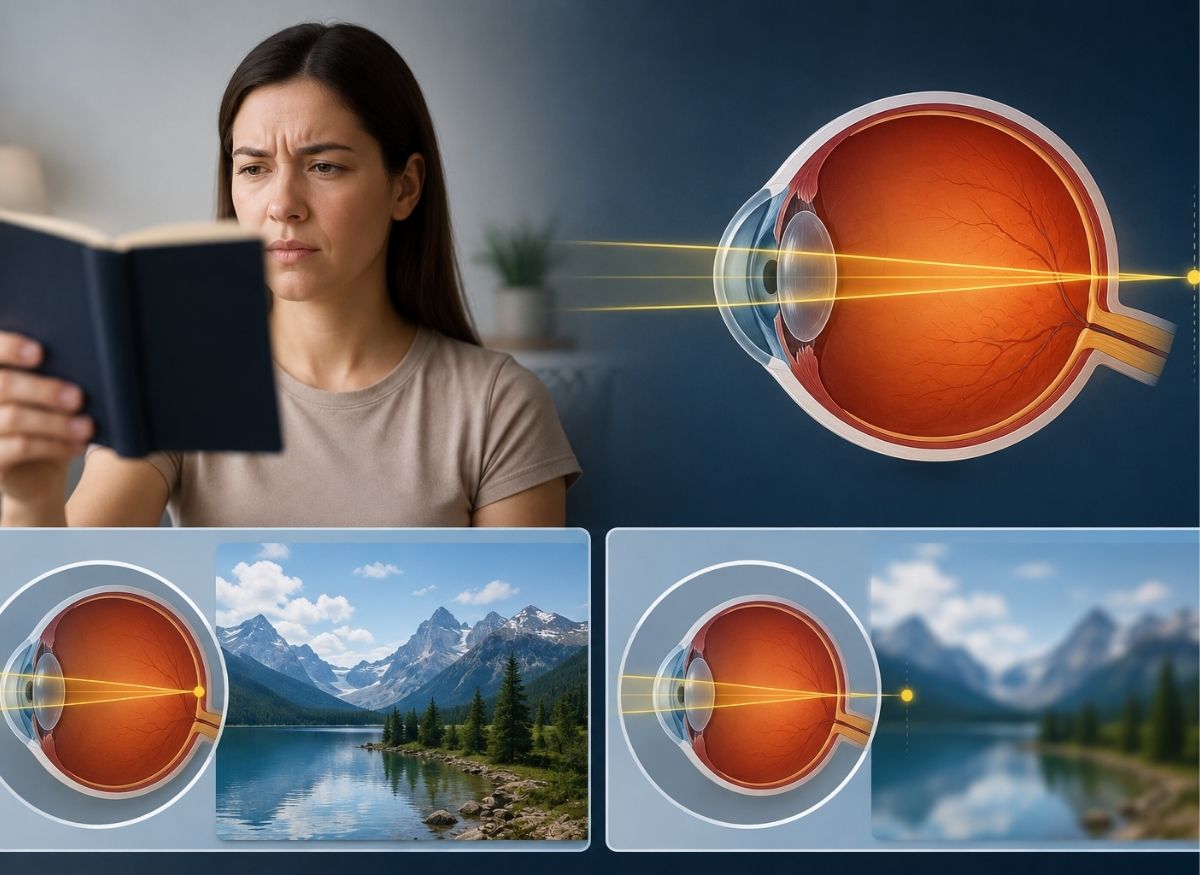
Hyperopia, better known as farsightedness, is a refractive condition where far-off objects look clear while anything up close appears blurry. It happens because of the way the eye is shaped: light entering the eye lands behind the retina instead of landing directly on it, which makes near-vision tasks feel strained or fuzzy. This condition isn’t limited to any age group it shows up in kids and adults alike. Mild cases often go completely unnoticed, but stronger degrees of hyperopia can bring on headaches, tired eyes, and trouble with reading. Knowing the warning signs and the ways to correct it can go a long way toward keeping your eyes comfortable.
Farsightedness can run in families, be present from birth, or creep in gradually as the cornea and lens shift with age. Kids often mask the problem by straining harder to focus, which can quietly cause tiredness or make schoolwork harder than it needs to be. Adults, on the other hand, usually notice near-vision problems more directly. This guide walks through the typical symptoms of hyperopia, the complications it can cause, and the main ways to correct it glasses, contacts, and surgery so you can keep your eyes healthy and comfortable.
What Is Hyperopia?
Farsightedness is one of the most common refractive errors, and it means objects in the distance stay sharp while nearby objects blur. The root cause is either an eyeball that’s shorter than average or a cornea that’s too flat either way, light entering the eye converges behind the retina rather than right on it. This forces the eye to work overtime to bring close objects into focus, which is why headaches, sore eyes, and general fatigue tend to follow, particularly during reading or screen time.
Hyperopia doesn’t discriminate by age children, working adults, and older people can all have it. When it’s mild, the eye is often able to self-correct by boosting its focusing power, so a person may not even realize anything is off. But when the degree is higher, it can genuinely disrupt everyday life and even a child’s ability to learn, which is why catching it early matters. Correction methods glasses, contacts, or refractive surgery work by redirecting light so it lands squarely on the retina, sharpening vision at both near and far distances.
The Symptoms of Hyperopia
The name “farsightedness” makes it sound like a simple case of good distance vision and bad near vision, but the reality is more layered than that. Since the eye is constantly flexing internal muscles to compensate for the misdirected light, an uncorrected case puts ongoing physical stress on the visual system.
That nonstop effort produces a recognizable set of visual glitches and bodily discomforts that can wear down your focus and your day-to-day comfort.
Visual Distortions in Everyday Activities
The hallmark symptom is a struggle to focus naturally on anything within arm’s reach. Since a farsighted eye is either too short or has a cornea that’s too flat, incoming light rays are aimed at a spot that technically sits behind the retina.
To pull that focal point forward, the eye leans on accommodation the ciliary muscle tightens up and reshapes the lens to compensate. When that muscular workaround gets pushed too far, ordinary close-up tasks start to feel like a chore:
Trouble Reading and Writing: Text on a page or a screen can look blurry, doubled, or like it keeps drifting in and out of focus. One classic giveaway of hyperopia is holding books or phones farther away than usual, almost instinctively, to force the words into a sharper zone.
Screen Fatigue: Scrolling through a phone or staring at a monitor demands sustained near-focus. For someone who’s farsighted, that sustained effort drains the eye’s flexing ability fast, leading to blurry text and exhausting workdays.
Struggles with Fine, Close-Up Work: Activities that need precision at close range stitching, drafting, building small models, detailed crafts become surprisingly tiring. The eyes can’t lock onto fine detail easily, which leads to more errors and a tendency to avoid these tasks altogether. In kids, this often shows up simply as disinterest in reading, drawing, or coloring.
Physical Discomforts of Uncorrected Hyperopia
Many of the more disruptive symptoms of hyperopia aren’t really about vision at all they’re the physical fallout of eye muscles being kept in constant tension.
Chronic Eye Strain (Asthenopia)
Asthenopia is the go-to physical complaint tied to an uncorrected refractive error. It shows up as a deep ache, a burning or itchy feeling, or plain exhaustion around the eyes. The reason is simple: the ciliary muscles stay clenched for hours without a break. Think of it like standing on your toes all day eventually your calves would cramp. Your eye muscles react the same way when they never get to relax.
Frontal and Temporal Headaches
That same nonstop muscular effort to redirect light onto the retina often triggers tension-type headaches. These usually feel like a dull, heavy pressure across the forehead, near the temples, or right behind the eyes. They typically build up after extended close-up work and tend to fade once you rest your eyes and look off into the distance. For a lot of people, these recurring headaches are actually the first clue that pushes them to book an eye exam.
Reflexive Squinting and Eye Fatigue
Squinting is an automatic reflex the body uses to sharpen a blurry image. Narrowing the eyelids reduces the amount of light hitting the pupil, creating a “pinhole effect” that filters out scattered light and momentarily clears things up. But relying on squinting constantly keeps the muscles around your eyes, brow, and eyelids tense. Combined with the internal focusing strain, this leaves eyes feeling raw, tired, dry, or watery by the end of the day.
What Causes Farsightedness?
Hyperopia is fundamentally a structural issue with the eye. As a refractive error, it comes down to a mismatch between the eyeball’s physical shape and how its focusing components are supposed to work together.
Rather than bending light into one sharp point right on the retina, a farsighted eye sends that light to the wrong spot. To understand why, it helps to look at both the eye’s physical build and the genetics that shape how eyes develop from birth through adulthood.
The Optical Geometry: How Eye Shape Dictates Focus
Picture the eye like a camera: the cornea and the internal lens act as the focusing elements, while the retina at the back works like the sensor. For a sharp image, light needs to bend just enough to converge exactly on that retinal surface. In a farsighted eye, this balance gets thrown off by one of two structural issues:
Axial Hyperopia (a Short Eyeball)
This is the most frequent cause. Here, the eyeball itself is physically shorter, front to back, than a typical eye.
Even with a perfectly curved cornea and a normally functioning lens, that shorter length means the retina sits closer to the front than it should. Since it lands ahead of where light rays are actually converging, the image formed there is blurry and unfocused for anything nearby.
Refractive Hyperopia (Weak Focusing Power)
Less common, this version happens when the eye’s length is normal but its focusing components aren’t strong enough. Two structural reasons drive this:
- Corneal Flatness: The cornea lacks enough curve, so it can’t bend light sharply enough.
- Lenticular Insufficiency: The internal lens isn’t dense or thick enough to properly focus incoming light.
Whether it’s a short eyeball, a flat cornea, or both, the outcome is the same light converges behind the retina instead of on it. To make up for this, the ciliary muscles have to keep contracting to thicken the lens, and that ongoing overwork is what drives the chronic strain and headaches.
The Genetic Blueprint of Farsightedness
If you’re wondering why your eyes are shaped the way they are, the answer is mostly written in your genes. Hyperopia tends to run in families, and research consistently shows that the eye’s size and focusing strength are largely inherited.
A Trait Shaped by Many Genes
Eye shape isn’t controlled by one single gene it’s the combined result of several genes passed down from both parents. If your parents have strong hyperopic prescriptions, you’re statistically more likely to inherit the same genetic tendencies toward a shorter eyeball or flatter cornea.
Family Patterns and Twin Research
Eye doctors have long noticed that refractive errors tend to cluster within families. Twin studies offer the clearest evidence of this genetic link.
Identical twins, who share the same DNA, tend to have remarkably similar hyperopic prescriptions. Fraternal twins, who only share about half their genes, show much more variation which points to genetics playing a bigger role than environment.
Childhood Development: The Growth Clock
The genetic angle gets even more interesting when you look at how eyes grow. Nearly every baby is born with a mild degree of hyperopia that’s completely normal, since infant eyes are naturally small and short. As a child grows, the body runs a natural calibration process called emmetropization:
- The eyeball gradually lengthens from front to back.
- As it lengthens, the retina shifts backward until it lines up with where the cornea and lens are actually focusing light, giving the child clear vision without any correction.
But in kids with a strong genetic tendency toward farsightedness, this growth process stalls early. The eye simply stops elongating before reaching its ideal length, leaving it permanently short or the cornea stays too flat well into the teen and adult years.
Since the eye never closes that structural gap on its own, the hyperopia sticks around, and the person ends up relying on muscular effort and eventually glasses, contacts, or surgery to see clearly.
Vision Correction Options for Farsightedness
Fixing hyperopia is really about correcting a structural mismatch. Since a farsighted eye is too short or has too flat a cornea, light lands behind the retina rather than on it.
To fix that, correction methods use convex lenses thicker in the middle, thinner at the edges, marked with a “+” on a prescription. These add the missing focusing power so light converges right where it should. Correction generally falls into two categories: non-surgical wearable options and permanent surgical procedures.
Non-Surgical Solutions: Wearable Optical Aids
For most people, farsightedness is managed comfortably with external lenses that redirect light without touching the eye itself.
Eyeglasses (The Baseline Defense)
Glasses are the simplest and most widely used way to correct farsightedness. They take the burden off the ciliary muscles entirely, easing strain and headaches.
- Single-Vision Lenses: A consistent prescription across the whole lens the standard pick for kids and younger adults who need help with near vision.
- Bifocal and Progressive Lenses: As people age and develop presbyopia alongside hyperopia, a single prescription often isn’t enough. Bifocals split the lens into a distance zone and a reading zone with a visible line; progressives blend those zones smoothly without any visible division.
Contact Lenses (The Borderless Alternative)
For those who’d rather skip frames, contacts sit directly on the eye’s surface and use the same convex shape as glasses to redirect light before it hits the cornea.
They’re especially convenient for sports and active routines, and come in several wear schedules daily disposables, bi-weekly, and extended-wear monthly lenses.
Permanent Surgical Solutions: Refractive Procedures
For adults who’d rather not depend on glasses or contacts long-term, refractive surgery offers a lasting fix by reshaping the cornea or replacing the internal lens.
LASIK (Laser-Assisted in Situ Keratomileusis)
LASIK is the most common laser procedure for mild-to-moderate hyperopia.
- How it works: A femtosecond laser creates a thin, hinged flap on the cornea’s surface. Once lifted, an excimer laser removes tissue around the cornea’s edges, causing the center to steepen and bulge forward, which boosts its focusing power.
- Recovery: The flap settles back naturally without stitches, and most people see clearly again within a day.
PRK (Photorefractive Keratectomy)
PRK skips the flap entirely, making it a solid option for people with thin corneas, dry eyes, or active lifestyles where eye trauma is more likely.
- How it works: The outer layer of the cornea (the epithelium) is gently removed, and the laser reshapes the tissue underneath to steepen the center.
- Recovery: A protective bandage contact lens covers the eye while the epithelium regrows over roughly 3 to 5 days. The end result matches LASIK, but healing takes longer and involves a bit more discomfort along the way.
Refractive Lens Exchange (RLE)
RLE takes a different approach entirely, targeting the internal lens instead of the cornea using the same technique as cataract surgery.
- How it works: The surgeon removes the eye’s natural lens through a tiny incision and replaces it with an artificial intraocular lens (IOL) calibrated to the patient’s exact eye measurements.
- Result: RLE works especially well for adults over 40-50 dealing with significant hyperopia or presbyopia. Multifocal or accommodating IOLs can restore clear vision at every distance, and since the natural lens is gone, cataracts are no longer a future concern.
Selecting Your Path
Choosing the right correction method calls for a proper eye exam measuring corneal thickness, calculating the exact prescription, checking tear film health, and factoring in age and lifestyle.
Whether it’s progressive glasses, daily contacts, or a permanent surgical fix, modern eye care makes it possible to bring the eye’s focus back into alignment for clear, comfortable vision.
Other Important Considerations for Hyperopia
Managing hyperopia well takes more than just picking a lens prescription. Since eyes change constantly across a lifetime, farsightedness affects people very differently depending on their age.
Keeping vision healthy long-term means understanding how doctors diagnose it, the risks it poses for young children, and how aging naturally brings on new symptoms.
The Comprehensive Diagnostic Protocol
A real diagnosis needs more than a basic school eye screening or an automated scanner. A full eye exam uses several tests to check how light travels through the eye and whether its internal structures are healthy.
The Core Refraction Pathway
- Visual Acuity Testing: Starts with reading letters off a Snellen chart. This checks sharpness, but many farsighted people can still read the chart clearly by straining their focusing muscles, which can hide the underlying issue.
- Phoropter Refraction: Looking through a phoropter, the doctor swaps in different convex lenses and asks which looks clearer. This pinpoints the exact prescription strength needed.
- Cycloplegic Drops: Since younger patients have strong focusing muscles that can mask blur, doctors sometimes use cycloplegic drops to temporarily relax those muscles and dilate the pupils. This reveals the true degree of farsightedness for a more accurate prescription.
Supplemental Structural Screenings
- Retinoscopy: A light is shone into the eye, and the doctor studies how the reflection moves to estimate the prescription especially useful for infants or patients who can’t respond verbally.
- Tonometry: Measures pressure inside the eye. Because farsighted eyes tend to be smaller, they can be more prone to certain forms of glaucoma.
- Slit-Lamp Examination: A magnified light exam of the cornea, iris, lens, and retina, confirming that symptoms are due to a refractive error and not another eye condition.
Pediatric Complications of Uncorrected Hyperopia
In adults, uncorrected hyperopia mostly causes temporary discomfort. In young children, though, an uncorrected high prescription can permanently affect how the eyes and brain work together, sometimes causing lasting vision loss.
Because a child’s visual system is still developing, the brain needs sharp, matched images from both eyes to wire itself correctly.
Accommodative Strabismus (Crossed Eyes)
Focusing and eye alignment are naturally linked when the eye muscles contract to focus up close, the eyes also turn slightly inward. A highly farsighted child has to strain so much to focus that this inward pull becomes excessive, sometimes causing one or both eyes to visibly cross.
Amblyopia (Lazy Eye)
When eyes are misaligned, or one eye has a much stronger prescription than the other, the brain gets two mismatched images one sharp, one blurry. To avoid double vision, the brain simply tunes out the weaker eye’s signal. If that goes untreated during early childhood, the neural pathway from that eye never fully develops, leading to permanent vision loss that later correction can’t fix.
Developmental and Academic Delays
Kids with undiagnosed hyperopia often can’t hold focus on schoolwork or reading, since the fatigue and blur set in fast. This frequently gets mistaken for a behavioral problem or a learning disability, when the real issue is simply an uncorrected eye shape.
The Aging Timeline: Does Hyperopia Get Worse?
Adults often wonder if their farsightedness is getting worse. Structurally, it isn’t the eye’s shape stays fixed once growth stops in the early twenties.
But symptoms and prescription strength do tend to increase with age, driven by the natural decline in the eye’s focusing ability.
- Under 30 Hidden and Masked: The lens is still soft and flexible, so the eye can easily compensate for mild hyperopia. Vision often tests as 20/20 with no noticeable symptoms.
- 30s-40s Symptoms Emerge: The lens starts stiffening, reducing its flexibility. As accommodation weakens, hidden hyperopia becomes noticeable eye strain, squinting, and headaches after screen work start showing up.
- 40+ Presbyopia Compounds the Problem: By the mid-forties, the lens becomes significantly rigid, and its ability to compensate is mostly gone. Near vision worsens fast, and even distance vision can start to blur. Multifocal glasses, bifocal contacts, or RLE surgery become the go-to solutions for balancing vision across all distances.
Conclusion
Hyperopia is a common, manageable condition, and understanding its symptoms and treatment options can make a real difference in daily comfort. Catching it early allows for timely correction, cutting down on strain, headaches, and fatigue especially during reading or screen use. Routine eye exams remain key to tracking changes and keeping corrective measures effective over time.
Addressing hyperopia early on helps prevent long-term strain and keeps vision clear and comfortable for everyday activities. With the right awareness and timely correction whether through glasses, contacts, or surgery clear vision at every distance is well within reach.
FAQ
What is hyperopia and how does it affect vision?
Hyperopia is a refractive error where far-off objects look sharper than close ones. It happens when the eyeball is too short or the cornea too flat, causing light to focus behind the retina. Common effects include blurry near vision, strain, headaches, and focusing trouble. It affects both kids and adults, and catching it early helps prevent fatigue and learning setbacks.
What are the common symptoms of hyperopia?
Typical symptoms include difficulty focusing up close, eye strain, tiredness after near work, headaches, and squinting. Mild cases might not show obvious symptoms at first, but as it progresses, close-up tasks become harder. Some kids develop habits like holding books farther away, which can be a sign worth checking with an eye exam.
How is hyperopia diagnosed?
It’s diagnosed through a full eye exam that may include visual acuity testing, refraction checks, and an overall eye health assessment. Doctors measure exactly how light focuses on the retina to gauge the degree of farsightedness, allowing for the right corrective plan.
What are the vision correction options for hyperopia?
Options include eyeglasses, contact lenses, and refractive surgery. Glasses and contacts redirect light onto the retina for clearer near vision, while surgical options like LASIK or lens replacement offer a more permanent fix. The right choice depends on age, lifestyle, severity, and overall eye health.
Can hyperopia worsen over time?
It can change with age, mainly due to presbyopia as the lens loses flexibility. Mild cases may stay stable, but the need for stronger prescriptions often increases as near-vision tasks get harder. Regular exams help track these shifts and keep prescriptions current.
How can hyperopia be managed in children?
Kids should get routine vision screenings to catch farsightedness early and support normal eye development. Corrective lenses may be needed if symptoms interfere with reading or schoolwork. Catching it early helps reduce fatigue, prevent headaches, and support healthy learning and visual development.