
8 Benefits of SMILE Vision Correction Over LASIK
Laser eye surgery now gives people more ways than ever to see clearly without glasses or contact lenses. One of the newest options is SMILE (Small Incision Lenticule Extraction), a minimally invasive laser treatment for nearsightedness and astigmatism.
LASIK requires a corneal flap. SMILE instead removes a tiny piece of corneal tissue through a small incision, which reshapes the eye while keeping more of the cornea’s natural structure intact. For suitable patients, this can bring real advantages, and it is why SMILE has become a popular alternative for people who want lasting vision correction.
This article walks through 8 key benefits of SMILE over LASIK and explains why many surgeons and patients see it as an attractive choice.
SMILE and LASIK Vision Correction Procedures
Both SMILE and LASIK correct vision by reshaping the cornea with a laser, and both treat myopia (nearsightedness) and astigmatism. The difference is in how they work. LASIK is the long-established method, while SMILE is a newer, less invasive approach.
The core distinction is how the surgeon reaches the corneal tissue. LASIK cuts a large, hinged flap on the surface of the cornea. SMILE works beneath the surface and removes tissue through a tiny keyhole incision.
The Fundamental Principle Behind the LASIK Procedure
LASIK follows a two-step “flap and ablate” process. The surgeon first creates a thin, hinged flap, then uses an excimer laser to reshape the tissue underneath. It has been a standard in laser vision correction for decades because of its fast visual recovery and high success rates.
Step 1: Flap Creation
The eye is numbed with anesthetic drops, a speculum holds the eyelids open, and a suction ring keeps the eye steady. In modern all-laser LASIK, a femtosecond laser creates an even flap, usually about 100 to 120 microns thick.
The flap involves a circular incision of roughly 20 millimeters. It stays attached by a small “hinge,” so the surgeon can lift it like a page in a book and expose the stroma, the middle layer of the cornea.
Step 2: Laser Ablation
Next, a computer-guided excimer laser sends out pulses of cool ultraviolet light. These vaporize tiny amounts of stromal tissue in a pattern based on the patient’s specific prescription.
Once the reshaping is done, the surgeon lays the flap back in place, where it sticks on its own without stitches. The flap works like a natural bandage, but it also leaves a permanent interface in the cornea. If the eye suffers trauma later in life, that interface can lead to flap-related problems.
How Does the SMILE Procedure Work Differently Without a Flap?
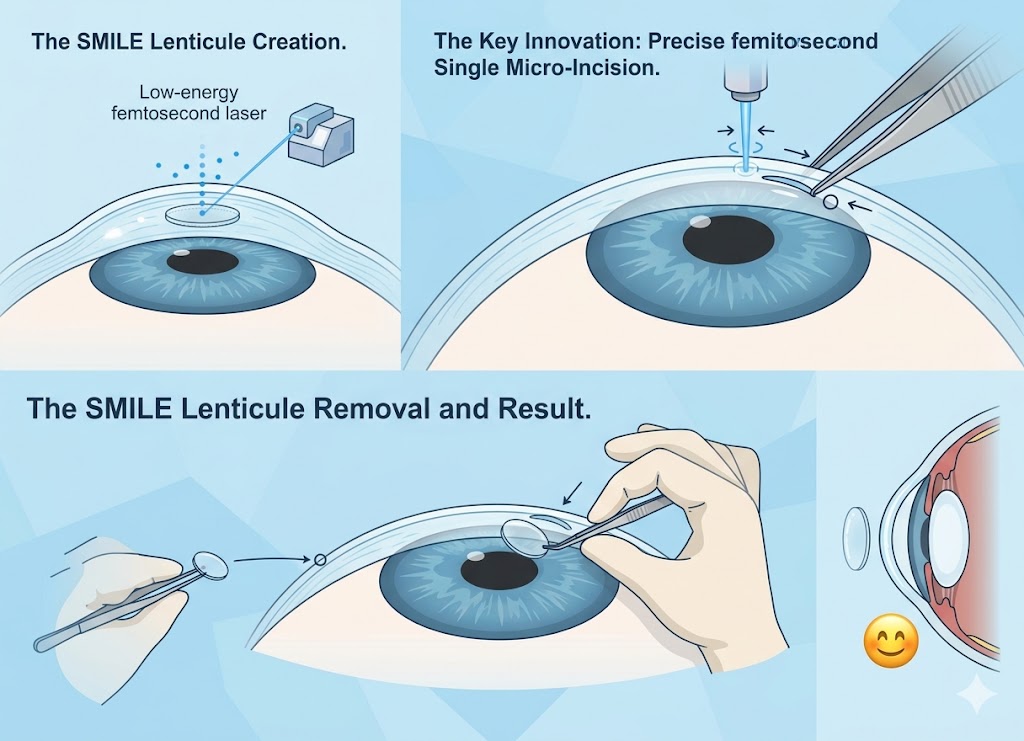
SMILE is a single-step, flapless technique. A femtosecond laser forms a small, lens-shaped piece of tissue called a lenticule inside the intact cornea. The surgeon then removes it through a tiny keyhole incision.
Because the cornea is reshaped without a large surface cut, this is a real step forward in minimally invasive eye surgery.
The whole procedure uses just one laser, a specialized femtosecond system, which keeps the experience quiet and smooth for the patient.
Tissue Definition
The femtosecond laser creates two layers of microscopic bubbles inside the corneal stroma. It outlines the lower surface of the lenticule first, then the upper surface. The shape and thickness of the lenticule are calculated to match the patient’s exact prescription.
Keyhole Incision
The same laser then makes a small incision, usually only 2 to 4 millimeters wide, at the edge of the cornea. That is far smaller than the roughly 20 mm cut needed for a LASIK flap.
Lenticule Extraction
The laser step takes less than 30 seconds. The surgeon then uses a fine instrument to separate the lenticule from the surrounding tissue and gently draws it out through the keyhole.
Taking out this small piece of tissue changes the curvature of the cornea, so light focuses properly on the retina. The corneal surface stays mostly untouched, which keeps the eye’s natural strength and cuts far fewer of the nerves near the surface.
This flapless, bladeless design is why SMILE offers better structural safety and a much lower risk of dry eye after surgery.
8 Major Benefits of SMILE Vision Correction Compared to LASIK
All eight benefits come from the same source: SMILE is flapless and minimally invasive. As a result, the eye stays more stable, the risk of chronic dry eye is lower, flap complications disappear, and long-term safety improves, especially for people with active lifestyles.
Both procedures deliver excellent vision. SMILE, however, causes less trauma to the eye and offers a more comfortable, predictable journey from the operating room through recovery.
Benefit 1: Dramatically Reduced Surgical Impact
SMILE uses a keyhole incision of just 2 to 4 millimeters. That is up to 80% smaller than the roughly 20-millimeter circular cut used to create a standard LASIK flap.
Because the surgeon works inside the cornea instead of lifting a large surface flap, there is less damage to the epithelium, Bowman’s layer, and the corneal nerves.
- Epithelial protection: The corneal epithelium is the eye’s first barrier against infection. A LASIK flap breaks this barrier along its whole 20-millimeter edge, leaving cut edges where bacteria could enter. The tiny SMILE incision seals within hours, which greatly reduces irritation after surgery.
- Preservation of surrounding cells: The femtosecond laser separates tissue using photodisruption, which produces microscopic gas bubbles at low energy and very little heat. This protects nearby cells, leaves a minimal biological footprint, and makes for a smoother recovery.
Benefit 2: Profoundly Lower Risk of Dry Eye Syndrome
SMILE lowers the risk of lasting dry eye because its small, peripheral incision cuts far fewer of the corneal nerves that keep the tear film healthy. The cornea is packed with nerves. They detect dryness and trigger the reflex that tells the tear glands to produce moisture.
A LASIK flap requires a large circular cut that severs surface nerves across the central and mid-peripheral cornea. These nerves do grow back, but it can take many months or even years, and some patients are left with chronic grittiness and burning.
The SMILE keyhole incision sits entirely in the far edge of the cornea, so the nerve endings across the center remain intact. Clinical studies show that corneal sensitivity returns to near-normal much faster after SMILE. This makes it a good choice for people with mild existing dryness or those who spend long hours in air-conditioned spaces.
Benefit 3: Preservation of Corneal Biomechanical Strength
Because SMILE is flapless, it leaves the strong front layers of the cornea, the anterior stromal lamellae, almost completely intact. Most of the cornea’s strength comes from the tightly interwoven collagen fibers in this front third, which carries most of the mechanical load.
Cutting a LASIK flap severs these key fibers across a wide area. Even after the flap is smoothed back into place, that interface never fully regains its original strength.
SMILE avoids the problem by forming and removing the lenticule from the middle of the stroma, well below the strong front layers. With the anterior stroma left alone, the cornea keeps much more of its original strength, which means better long-term stability.
Benefit 4: Complete Elimination of Flap-Related Complications
With no flap, SMILE removes the short-term and long-term complications that come with cutting one. These common LASIK flap risks simply do not exist with SMILE:
- Flap dislocation: A LASIK flap leaves a permanent line of weakness. A serious blow to the eye, even years later, can displace the flap and require emergency treatment. SMILE patients have no flap to move.
- Flap striae: These are tiny wrinkles or folds that can form in the flap as it heals. If they fall in the line of sight, they can cause glare, halos, or ghosting.
- Epithelial ingrowth: Surface cells can slip under the edge of the flap and grow on the corneal bed. Left untreated, this can cause irregular astigmatism and blurred vision.
- Diffuse lamellar keratitis (DLK): Nicknamed “Sands of the Sahara,” this is an inflammatory reaction between the flap and the tissue beneath it. It can require intensive steroid drops.
Benefit 5: A More Comfortable Visual Recovery Process
Both procedures can give very sharp vision on day one, but recovery after SMILE is usually less irritating to the eye’s surface.
After flap surgery, many patients feel as if an eyelash or a grain of sand is stuck in the eye. This “foreign body sensation” happens when the raw edge of the large flap rubs against the eyelid during blinking. SMILE’s micro-incision is so small and so far out at the edge that this gritty feeling is almost absent.
Light sensitivity and watery eyes are also common reactions to surface laser treatment. SMILE causes less surface inflammation and does not use an excimer laser, so these effects are usually mild and short-lived. Most patients can return to quiet activities comfortably the same day.
Benefit 6: An Ideal Profile for Active Lifestyles and Contact Sports
A SMILE-treated cornea is structurally stronger, which makes the procedure a safer choice for people with active lifestyles, first responders, military personnel, and contact-sport athletes.
Martial artists, basketball players, police officers, and soccer players all face a regular risk of an accidental poke, elbow, or hard hit to the eye. For them, knowing there is no flap that could be knocked loose brings real peace of mind.
After SMILE, the cornea’s strength is closer to that of an eye that has never had surgery. It is better able to handle physical stress and trauma, without the weak point a permanent flap creates.
Benefit 7: Enhanced Capacity for Higher Degrees of Myopia
SMILE can often treat higher levels of nearsightedness safely, up to about -10.00 diopters, because it preserves more of the cornea’s structure. Laser correction works by removing tissue to flatten the cornea, so the stronger the prescription, the more tissue must be removed.
Surgeons measure the “residual stromal bed” (RSB), which is the thickness of untouched corneal tissue left beneath the treated area to keep the eye stable. A LASIK flap, typically 100 to 120 microns thick, uses up a good share of the cornea’s structural tissue just to form the flap. That leaves less available for the correction itself.
SMILE does not give up any tissue to a flap, so the entire front of the cornea stays intact. The surgeon can make a deeper correction while keeping the eye more stable afterward. This makes SMILE a workable option for people with high prescriptions or corneas that are on the thinner side of normal.
Benefit 8: A Quieter, Less Intimidating Surgical Experience
The SMILE experience is quiet, smooth, and less overwhelming for anxious patients. A typical LASIK procedure uses two lasers. The patient lies under a femtosecond laser for the flap, then is often moved under an excimer laser for the reshaping.
The excimer laser makes a loud, rapid clicking sound and gives off a noticeable ozone-like smell as it vaporizes tissue, which can make some patients nervous.
SMILE uses a single femtosecond laser system for the whole process, so the patient stays in one comfortable position from beginning to end. The laser itself is completely silent and odorless.
The patient just looks at a soft green light for about 25 to 30 seconds while the laser outlines the lenticule inside the cornea. The rest of the procedure is done by hand and is calm and uneventful.
Who Is a Better Candidate for SMILE Than for LASIK?
The best candidate for SMILE over LASIK is usually someone with nearsightedness or astigmatism who puts long-term safety first and has traits that make a flapless procedure especially useful.
These traits include a tendency toward dry eyes, regular participation in contact sports, a high prescription, or real anxiety about having a flap cut in the cornea. SMILE’s minimally invasive approach addresses the main drawbacks of flap-based surgery, which is why it often suits this group best.
Are Patients with Pre-Existing Dry Eyes Better Suited for SMILE?
Yes. People with mild to moderate dry eye, or with severe dryness from years of wearing contact lenses, are generally much better suited to SMILE. This is one of the strongest clinical reasons to choose the keyhole method over a flap procedure.
The reason is SMILE’s nerve-sparing design, which does not worsen an already sensitive eye surface. Dry eye is often caused or made worse by damage to the corneal nerves that control the tear reflex, and LASIK is a well-known trigger for temporary or prolonged dryness.
The large circular LASIK flap cuts through many of the nerves near the surface. This weakens the eye’s ability to sense dryness and signal the brain to produce tears. For someone whose tear film is already poor in quality or quantity, this can turn a manageable condition into a long-lasting, troublesome one.
Nerves take months or even years to recover after LASIK, and in some cases they never return fully to their original function.
SMILE, on the other hand, keeps most of these nerves intact because the laser works inside the cornea. The small peripheral incision leaves the dense nerve network in the central cornea largely undisturbed. Studies consistently show that corneal sensitivity recovers faster and more completely after SMILE.
Since the eye’s natural feedback loop for tear production stays intact, an ophthalmologist will very often steer a patient with a history of dry eye toward SMILE for better long-term comfort and eye health.
Which Professions or Hobbies Make Someone a Stronger Candidate for SMILE?
Jobs and hobbies that carry a higher risk of physical contact, dust, or direct trauma to the face and eyes make someone a much stronger candidate for SMILE. The deciding factor is that there is no corneal flap, and so no lifelong risk of it being knocked out of place. For these people, strong and resilient eyes matter for both safety and career longevity.
High-Risk Profiles and Lifestyles
Contact Sports Athletes
Athletes in mixed martial arts (MMA), boxing, Brazilian jiu-jitsu, rugby, and basketball are always at risk of accidental pokes, elbows, or direct blows to the eye. In these settings, a displaced LASIK flap could be a serious medical emergency and even end a career.
Law Enforcement and Military Personnel
Police officers, tactical teams, and military personnel in combat roles work in unpredictable settings where physical fights, debris, and injury are common. Elite military units often prefer flapless procedures for their operators for exactly this reason.
First Responders
Firefighters, paramedics, and search-and-rescue workers face harsh conditions where blows to the face, chemicals, or smoke can occur. The stability of a SMILE-treated cornea gives them added confidence during demanding work.
Outdoor and Action Hobbyists
Even non-professionals who enjoy mountain biking, rock climbing, skiing, or surfing gain from the added safety. A fall, or a fast hit from sand, water, or branches, poses far fewer structural risks when the cornea has no permanent flap interface.
For people with these backgrounds, the choice is clear. SMILE delivers the sharp vision needed to perform at a high level without adding a permanent weak point that could threaten their sport or their job.
What Are Other Important Considerations for Laser Eye Surgery?
Beyond comparing the procedures themselves, patients should think about practical matters such as cost, follow-up treatment options, alternative surgeries, and newer technology.
Understanding these points helps patients make an informed choice that fits their clinical needs, budget, expectations for future care, and comfort with the technology available.
How Does the Cost of SMILE Compare to the Cost of LASIK?
Cost is one of the most practical things to weigh. In general, SMILE costs slightly more than LASIK.
Prices for both vary widely depending on location, the surgeon’s experience, and the technology a clinic uses, but patients can usually expect to pay a bit extra for the keyhole technique. Three main factors explain the difference:
Technology Capital Investment
SMILE relies entirely on an advanced femtosecond laser system, a very large investment for a surgical center. LASIK often divides the work between a femtosecond laser and a separate excimer laser or, in older and cheaper setups, a mechanical blade.
Manufacturer Licensing and Consumables
Clinics that offer SMILE pay the laser manufacturer a licensing fee for each procedure they perform. Every surgery also needs a single-use patient interface kit to connect the laser to the eye, which adds a fixed cost each time.
The Long-Term Value Proposition
For people with active lifestyles, contact lens intolerance, or mild dry eye, the slightly higher upfront price is often seen as worth it. Protecting the cornea’s structure can help avoid later costs such as ongoing dry eye drops, specialist visits, or flap-related checkups.
Are Enhancement or Re-Treatment Procedures Possible After SMILE?
SMILE is highly predictable and successful, but vision can still shift naturally over the years as the eye ages, and a later adjustment may be needed.
It is important to know that SMILE cannot simply be repeated on the same eye. The first procedure creates and removes a single internal lens of tissue (the lenticule). That tissue plane has already been altered, so a second lenticule cannot be safely cut in the same space. Enhancements are still very possible, though, using other proven laser methods:
Photorefractive Keratectomy (PRK)
This is the most common and preferred choice for enhancing SMILE results. The surgeon gently removes the thin outer layer of the eye (the epithelium) and uses an excimer laser to reshape the surface of the stroma. It avoids creating a new incision plane or going deeper into the cornea, which makes it a very safe way to fine-tune any remaining prescription.
Sub-Flap LASIK Enhancement
When the remaining cornea is especially thick and stable, a surgeon may convert the enhancement into a thin-flap LASIK procedure. This means creating a shallow flap directly over the area where the lenticule was taken out. Whether this is possible depends entirely on a detailed map of the patient’s remaining corneal thickness.
If a small regression appears years later, a full consultation and corneal scan will show the safest way forward, keeping long-term flexibility and stable vision.
How Does SMILE Compare to Other Vision Correction Alternatives Like PRK?
SMILE is often compared with LASIK, but PRK is a useful comparison too. PRK was the original form of laser vision correction and is still valuable, especially for patients with unusually thin corneas. Like SMILE, PRK is flapless, so there is no risk of a flap moving out of place. The patient experience and the way each heals are quite different, though:
| Feature | SMILE Vision Correction | Photorefractive Keratectomy (PRK) |
|---|---|---|
| Surgical Approach | Tissue is removed from inside the cornea through a tiny 2–4 mm keyhole incision at the edge. | The outermost corneal layer (epithelium) is completely removed, by hand or with chemicals. |
| Laser Mechanism | One silent femtosecond laser cuts an internal lenticule. | An excimer laser vaporizes tissue directly on the exposed surface. |
| Epithelial Impact | The surface epithelium stays intact, and the keyhole edge seals within hours. | The central epithelium must grow back from scratch over several days. |
| Initial Recovery | Little discomfort, with clear, crisp vision within 24 to 48 hours. | Slower healing, with 3 to 5 days of gritty pain, light sensitivity, and blurry vision. |
| Post-Op Protection | No special shields or bandage lenses are normally needed. | A clear bandage contact lens is worn for several days to protect the raw surface. |
This comparison shows why many see SMILE as a bridge between technologies. It offers PRK’s main safety benefit, a flapless cornea, together with the fast, comfortable visual recovery people associate with LASIK.
What Is SMILE Pro and How Is It Different?
Laser eye surgery keeps advancing, and new platforms appear regularly. SMILE Pro is the latest step forward for the standard procedure, and it runs on advanced high-frequency laser systems such as the Zeiss VisuMax 800. It is not a different surgery. It is a technology upgrade that improves precision, speed, and comfort.
The main improvements over the standard treatment are:
Drastically Reduced Laser Time
In standard SMILE, the laser takes about 25 to 30 seconds to outline the lenticule, and the patient must hold the eye still under light suction the whole time. The Pro system finishes the same step in under 10 seconds. The eye spends less time under pressure, which eases anxiety and makes it easier to stay focused.
Automated Centration and Alignment
Pro software includes digital tools that automatically work out the patient’s visual axis. It also has automated cyclotorsion compensation, which adjusts the laser pattern in real time if the eye rotates slightly while the patient is lying down. This improves precision when correcting complex astigmatism.
Enhanced Patient Comfort
Shorter suction time also lowers the chance of minor side effects such as subconjunctival hemorrhages, which are harmless red spots on the white of the eye caused by brief pressure. The result is a reliable procedure that feels faster, gentler, and more automated.
FAQs
What is SMILE vision correction?
SMILE is a minimally invasive laser eye surgery that corrects nearsightedness and astigmatism by removing a small piece of corneal tissue through a tiny incision.
How is SMILE different from LASIK?
The main difference is that SMILE does not need a corneal flap. It uses a small incision instead, which may help keep the cornea stronger.
Is SMILE vision correction safe?
Yes. SMILE is considered safe and effective for eligible patients, and it is approved in many countries around the world.
Who is a good candidate for SMILE?
Good candidates are usually adults with stable vision, nearsightedness, and certain levels of astigmatism who meet specific eye health requirements.
Does SMILE vision correction hurt?
Most patients feel little or no pain during the procedure because numbing drops are used.
How long does recovery take?
Many patients see better within a few days, although vision may take several weeks to fully settle.
Does SMILE cause dry eyes?
Dry eye symptoms can appear after any laser eye procedure, but some studies suggest SMILE may cause less dryness afterward than LASIK.
Can SMILE treat farsightedness?
SMILE is mainly used for nearsightedness and astigmatism. Whether it can treat other conditions depends on regulatory approvals and future technology.
How long do SMILE results last?
Results are generally long-lasting, as long as your prescription was stable before surgery.
Is SMILE better than LASIK?
Neither is better for everyone. The right choice depends on your eye anatomy, prescription, lifestyle, and your surgeon’s advice.
Conclusion
SMILE has become a popular alternative to LASIK for many people who want freedom from glasses and contact lenses. Its minimally invasive approach, smaller incision, and preservation of corneal structure make it appealing for the right candidates.
Both SMILE and LASIK give excellent visual results, but SMILE may offer specific advantages: less disruption of corneal nerves, potentially fewer dry eye symptoms, and no corneal flap. These benefits have made it increasingly popular among active people and those looking for advanced vision correction.
If you are thinking about laser eye surgery, a thorough eye exam is essential to find out whether SMILE is right for you. An experienced eye care professional can explain your options and help you choose the procedure that best fits your vision goals.