
10 Signs of the Somogyi Effect in Diabetes
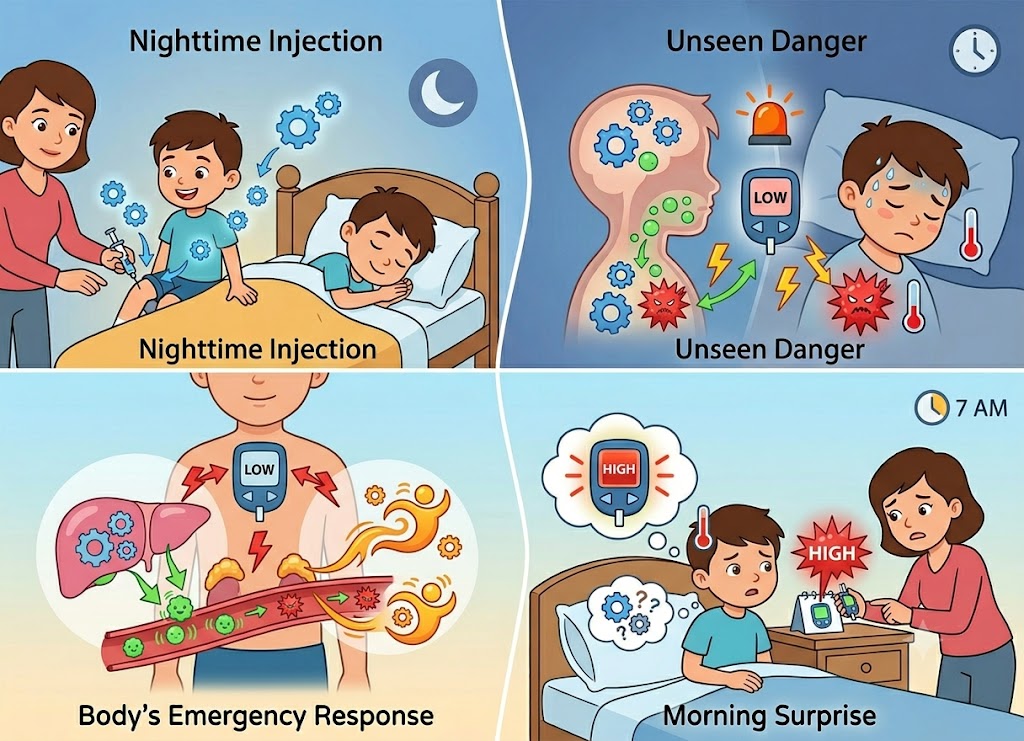
The Somogyi effect can happen in people with diabetes when blood sugar falls too low overnight. The body reacts by releasing stress hormones, and these push glucose up so that it is unusually high by morning. Many see this as the body’s built-in defense against hypoglycemia, though diabetes specialists still debate how real and how common it is.
If you often wake up with a high reading you can’t explain, this matters. A high morning number can look like poor diabetes control when the real problem is a low during the night. Once the true cause is found, your care team can adjust insulin doses, meal timing, or your overall plan.
This article covers 10 possible signs of the Somogyi effect, how it differs from the dawn phenomenon, and when to talk to your healthcare provider.
The Definition of the Somogyi Effect
The Somogyi effect, also called rebound hyperglycemia, is a pattern where low blood sugar (hypoglycemia) during the night causes the body to overcorrect. The result is a very high reading in the morning.
It is mostly seen in people who use insulin. The sequence goes like this:
- Blood sugar drops too low, often between 2 a.m. and 4 a.m.
- The person doesn’t notice because they are asleep.
- The body senses danger and releases counter-regulatory hormones.
- These hormones tell the liver to release stored glucose, which prevents a severe low.
The problem is that the response is often too strong. By the time the person wakes up, blood sugar has climbed well above the normal range.
What Is Rebound Hyperglycemia?
Rebound hyperglycemia is the medical term for the high reading that follows the body’s overcorrection of a low. It is the defining result of the Somogyi phenomenon.
When glucose falls too far, the body treats it as an emergency and responds in two ways:
- Glucagon release: The pancreas releases glucagon, which makes the liver turn stored glycogen into glucose (glycogenolysis).
- Stress hormone surge: The adrenal glands release cortisol and adrenaline. These push out more glucose and also cause short-term insulin resistance, so cells struggle to take up the sugar in the blood.
Together, these actions flood the bloodstream with glucose. A person without diabetes would simply release a matching amount of insulin to bring things back under control. In someone with diabetes, that balancing insulin response is missing or too weak.
More glucose plus less insulin sensitivity means a fast spike. So the high morning number does not mean you lacked insulin overnight. It is a delayed defensive reaction to having too much insulin working earlier in the night.
Is the Somogyi Effect a Common Cause of Morning High Blood Sugar?
The Somogyi rebound is a well-described process, but how often it actually causes morning highs is debated. For years it was a popular explanation for unexplained fasting hyperglycemia.
Continuous glucose monitors (CGMs) changed that picture. They record glucose all night, and many endocrinologists now say true rebound hyperglycemia is fairly rare. Current evidence points to the dawn phenomenon as the more common cause of morning highs.
The dawn phenomenon is a natural rise in blood sugar in the early morning, usually between about 4 and 8 a.m. It happens because the body releases cortisol and growth hormone on a regular daily rhythm to prepare you for waking. Unlike the Somogyi effect, it is never preceded by a low. Glucose just climbs steadily from a normal or already high starting point.
This distinction matters because the fixes are opposite. A true rebound calls for reducing evening insulin, while the dawn phenomenon may call for increasing or delaying it. The only reliable way to tell them apart is to check glucose between 2 a.m. and 4 a.m. or review CGM data. A documented low in the middle of the night points to a rebound. A stable or rising reading suggests a dawn spike.
10 Signs of the Somogyi Effect
The 10 signs are:
- High fasting blood glucose
- Waking with a headache
- Night sweats
- Restless sleep or nightmares
- Ketones in the urine
- Morning fatigue
- Increased thirst on waking
- Blurry vision
- Nighttime lows on a CGM
- A rapid heart rate
These signs matter because they hint at the overnight low that sets off the rebound. A high morning reading is the most obvious clue. But it is the combination of that reading with other symptoms that points toward the Somogyi effect rather than the dawn phenomenon or fading insulin. Each sign reflects part of your body’s stressful response to a blood sugar crisis during sleep.
What Specific Symptoms Can Point to Rebound Hyperglycemia?
Taken together, these morning complaints and measurements can show a night spent struggling with glucose control. Each one comes either from the original low or from the high that follows.
1. High Fasting Blood Glucose
This is the central sign. You go to bed with a normal or slightly high reading, then wake up with a surprisingly high one. That morning high is the rebound from a low you never noticed.
2. Waking with a Headache
A dull, lingering headache on waking is common. The brain depends heavily on glucose and reacts badly to rapid swings. Both the drop and the surge of stress hormones can bring on head pain.
3. Night Sweats
Damp pajamas or sheets, even in a cool room, are a classic sign of a nighttime low. As glucose falls, adrenaline triggers a “fight or flight” response that causes sweating, clamminess, and unease.
4. Restless Sleep or Nightmares
The adrenaline that causes sweating can also disturb your sleep. You may have vivid or frightening dreams, wake often, toss and turn, or even cry out. You might not remember the dream, but you’ll wake up feeling unrested.
5. Ketones in the Urine or Blood
This one can be confusing because ketones are usually linked to long stretches of high blood sugar and diabetic ketoacidosis. However, during a significant low the body may start breaking down fat for energy and produce ketones. Moderate ketones alongside a high morning reading can hint that a real low happened earlier.
6. Fatigue and Grogginess
Waking up exhausted, irritable, or “hungover” after a full night in bed is common. The stress of the low and the hormone surge that follows drains you and blocks restful sleep.
7. Increased Thirst on Waking (Polydipsia)
High morning glucose makes your kidneys work harder to flush out the extra sugar in urine. This pulls water from your body, leaving you dehydrated and very thirsty when you wake.
8. Blurry Vision in the Morning
High glucose can make the lens of the eye swell, which temporarily changes its shape and makes focusing harder. It usually clears once blood sugar returns to normal. It is unsettling, but it is a clear sign that glucose was high.
9. Unexplained Drops in Blood Sugar During the Night
For CGM users, this is the most telling sign. The graph shows a clear dip, often between 2 and 4 a.m., followed by a sharp, steady climb toward morning.
10. Rapid Heart Rate on Waking (Tachycardia)
The adrenaline released during a night-time low can make your heart race or pound. That feeling can carry into the morning and leave you anxious or shaky, a direct result of your body’s stress response.
How Do Night Sweats and Nightmares Relate to the Somogyi Effect?
Night sweats and nightmares come straight from the first stage of the Somogyi effect: nocturnal hypoglycemia. When glucose drops dangerously low during sleep, your body reads it as a threat to life and launches an emergency response.
The autonomic nervous system drives this response. It triggers a sudden release of counter-regulatory hormones, mainly glucagon and catecholamines such as adrenaline (epinephrine) and norepinephrine. The adrenaline surge is what causes these distressing symptoms.
Adrenaline’s job is to mobilize the body’s resources quickly. It prompts the liver to release glucose, but it also creates classic “fight or flight” effects.
Night sweats: Adrenaline activates the sweat glands, which can soak your clothes and bedding (diaphoresis). It is your body signaling distress even while you sleep.
Nightmares and restless sleep: The brain is very active during sleep, and a rush of adrenaline can disrupt normal sleep cycles, especially REM sleep. This can produce vivid, frightening, or strange dreams.
You may wake suddenly with a pounding heart, feeling anxious and disoriented, and sometimes remembering the nightmare clearly. Even if you don’t fully wake, your sleep quality suffers, which adds to the fatigue the next day. These symptoms are more than side effects. They are warning signs that a significant low has occurred.
The Causes of the Somogyi Effect
The main cause is an episode of low blood sugar during the night. Common triggers include too much evening insulin, a missed bedtime snack, hard exercise late in the day, and alcohol without enough carbohydrates.
The Somogyi effect is reactive. The real root cause is whatever pushed your glucose down overnight, and the rebound high is just the body’s exaggerated reply.
Knowing the triggers is the foundation of prevention. They almost always come from a mismatch between insulin action, food, and activity, which drives glucose too low while you are asleep and can’t respond.
How Does Nighttime Hypoglycemia Trigger the Somogyi Effect?
Nighttime hypoglycemia sets off a coordinated but often excessive hormonal cascade meant to protect the brain and vital organs. It begins once blood sugar falls below a critical level, typically around 70 mg/dL.
Phase 1: Detection and glucagon release.
Glucose-sensing cells, mainly in the brain and pancreas, detect the dip and alert the endocrine system. The pancreas reduces any remaining insulin secretion and releases glucagon. Glucagon travels to the liver and tells it to break down stored glycogen into glucose and release it into the blood (glycogenolysis).
Phase 2: The stress hormone surge.
At the same time, the adrenal glands release cortisol, adrenaline (epinephrine), and norepinephrine. Adrenaline acts fast, speeding up the liver’s glucose release and causing sweating and a rapid heartbeat.
Phase 3: Induced insulin resistance.
Cortisol and growth hormone act more slowly but for longer. They cause temporary insulin resistance, so body tissues respond poorly to insulin. Cells can’t absorb sugar well, and the glucose released by the liver stays in the blood.
In the Somogyi pattern, this protective response overshoots. With no active natural insulin to temper it, glucose rockets from dangerously low to very high by morning, completing the rebound cycle.
Common Triggers for a Hypoglycemic Event at Night
Most triggers come down to daily management imbalances, where the insulin in your body temporarily outweighs the glucose available. Careful tracking can often reveal and fix them.
- Excessive evening insulin doses: This is the most frequent cause. Too much long-acting (basal) or intermediate-acting insulin (like NPH) can keep pushing glucose down all night, long after dinner has been digested. The risk is higher if a bedtime correction dose was miscalculated to treat a high evening reading.
- Skipping a prescribed bedtime snack: Many insulin plans assume you’ll eat a complex carbohydrate or protein snack before bed. That snack releases glucose slowly and offsets insulin’s peak action overnight. Skipping it leaves you exposed to a sharp drop during deep sleep.
- Strenuous late-night exercise: Exercise raises insulin sensitivity for up to 24 hours and uses up glycogen stores in muscles and the liver. If you work out in the evening without lowering your night-time insulin or eating an extra snack, your muscles keep pulling glucose from your blood as they refill, which can cause an overnight crash.
- Alcohol before bed: Drinking, especially on an empty stomach, greatly raises the risk of a nighttime low. The liver puts breaking down alcohol ahead of everything else, which blocks gluconeogenesis (making new glucose from non-carbohydrate sources). With that backup disabled, blood sugar can fall unchecked several hours later.
How Is the Somogyi Effect Managed?
Management is mainly about preventing night-time lows by adjusting insulin doses, medication timing, and lifestyle habits, always with your healthcare provider.
The key point is not to treat the morning high with more insulin. That can trap you in a dangerous loop of deeper lows and bigger rebounds. Instead, the focus should be on finding and removing the real cause, the unnoticed overnight low.
Good management takes careful glucose monitoring, a review of your patterns, and targeted changes to your care plan.
Adjustments to Insulin or Medication Are Typically Made
Insulin changes for the Somogyi effect often feel backward, because the visible problem is high blood sugar. The natural but wrong response is to raise the evening insulin dose to push the morning number down.
That only makes things worse. It causes a deeper night-time low and an even bigger rebound. The usual clinical approach is to reduce the insulin that is active overnight.
Lowering basal doses.
This usually means reducing the evening dose of long-acting (basal) insulin such as glargine, detemir, or degludec, or of intermediate-acting insulin (NPH). The reduction is typically gradual, perhaps 10% to 20%, followed by several nights of monitoring to check that the change is safe and stable.
Shifting injection timing.
Changing when you inject can also help. For example, moving an evening NPH dose from dinnertime closer to bedtime shifts its peak later in the night. That may line up better with the early-morning glucose rise of the dawn phenomenon instead of causing a mid-night dip.
Programming insulin pumps.
People on pumps can program basal rates to drop during the hours when lows usually happen, for instance lowering the rate from 1 a.m. to 4 a.m.
Sometimes a provider may suggest switching to a modern insulin analog with a flatter, more predictable action profile, which lowers the risk of unexpected overnight peaks and dips.
Role Diet and Bedtime Snacking Play in Prevention
Food plays an active part in prevention. Eating well before bed gives you a steady supply of glucose to balance insulin action through the night. The goal is to prevent the initial dip that sets off the whole rebound.
Insulin adjustments are a key long-term fix, but what and when you eat before bed matters just as much, especially on a fixed insulin regimen. Skipping a bedtime snack can be a main trigger for a nighttime low if your evening dose was set assuming you would eat.
A good bedtime snack is about composition, not just calories. It should combine complex carbohydrates, lean protein, and a little healthy fat.
- Complex carbohydrates: Foods like whole-grain crackers or a small piece of fruit digest slowly and release glucose gradually over several hours.
- Protein and fat: These slow digestion and absorption of the carbs, which helps keep glucose steady overnight.
This combination creates a stable “glucose plateau” and helps avoid the sharp drops that can happen when you eat only simple sugars, or nothing at all.
Some effective snack ideas:
- A small apple with a tablespoon of peanut butter
- A few whole-grain crackers with a slice of cheese
- A small bowl of unsweetened Greek yogurt
A registered dietitian or certified diabetes educator can help you choose the right snack and portion for your insulin regimen and overnight needs.
Related Concepts and Diagnostic Challenges of the Somogyi Effect
The Somogyi effect is closely tied to other concepts, especially the dawn phenomenon. Diagnosing it is hard because you need precise overnight glucose data to tell it apart from other causes of morning highs.
Getting it right matters because the treatment is the opposite of the fix for other morning-high causes, so a misdiagnosis can be dangerous. The main challenges are catching the initial low and telling the hormonal overcorrection apart from a natural, unrelated rise in glucose.
The Difference Between the Somogyi Effect and the Dawn Phenomenon
Telling these two apart is one of the most common challenges in managing morning highs, since both leave you with high blood sugar on waking. Their causes and treatments, however, are opposite.
The underlying mechanism
- Somogyi effect: A reactive rebound triggered by nighttime hypoglycemia, often caused by too much evening insulin, a skipped bedtime snack, or hard evening exercise. The body’s hormonal response to the low overshoots, and glucose surges into the high range by morning.
- Dawn phenomenon: A natural, planned process that is not preceded by a low. It occurs as the body prepares to wake, typically between about 3 and 8 a.m., when cortisol, growth hormone, and glucagon are released as part of the normal daily rhythm. These hormones raise insulin resistance and signal the liver to release glucose for the day ahead.
Overnight glucose trends
To diagnose a true Somogyi effect, you should see a “U-shaped” curve: a clear drop in blood sugar (typically below 70 mg/dL) in the middle of the night, then a sharp rise. With the dawn phenomenon, glucose stays stable or climbs slowly overnight, then rises faster in the early morning.
Management strategies
- Somogyi effect: Usually managed by reducing the evening or long-acting insulin dose, or by adding a carbohydrate-containing bedtime snack to prevent the initial low.
- Dawn phenomenon: Often managed by increasing the evening insulin dose, changing medication timing, or programming an insulin pump to give more insulin in the pre-dawn hours.
How Is the Somogyi Effect Officially Diagnosed?
Diagnosis depends on proving that the morning high comes directly from an earlier night-time low. That takes a systematic look at overnight glucose patterns.
Historical inconvenience: finger-prick testing
In the past this was disruptive. Under medical guidance, patients set alarms and tested their blood sugar by hand around 2 or 3 a.m., when the lowest point (nadir) usually occurs. It worked, but one normal or high reading at 3 a.m. can’t fully rule out the condition, since the low might have happened earlier or later.
The gold standard: continuous glucose monitoring (CGM)
Today, CGM offers a complete, minimally invasive answer. A small sensor placed just under the skin measures interstitial glucose every few minutes.
- Continuous trend data: A CGM draws a full graph of the night, capturing the dip and the spike that follows.
- Pattern analysis: By reviewing several nights, a provider can check whether low-then-rebound happens consistently, which removes the guesswork.
- Accurate differentiation: You can see at a glance whether the graph stays flat before a morning rise (dawn phenomenon) or dips sharply before climbing (Somogyi rebound).
What Counter-Regulatory Hormones Are Involved in the Somogyi Effect?
The rebound is driven by several counter-regulatory hormones. They are released in response to the stress of dangerously low blood sugar and work together to raise glucose quickly, opposing the effects of active insulin.
This hormonal teamwork is a vital survival mechanism, but in people with diabetes it can cause large swings in glucose:
- Glucagon: Made by the pancreas’s alpha cells, it is the fastest responder. It acts directly on the liver to trigger glycogenolysis (breaking stored glycogen into glucose) and gluconeogenesis (making new glucose from non-carbohydrate sources).
- Epinephrine (adrenaline): Released by the adrenal glands in the “fight-or-flight” response, it quickly speeds glucose release from the liver. It also suppresses any remaining insulin secretion and limits glucose uptake in body tissues.
- Cortisol: Also made by the adrenal glands, this steroid hormone acts more slowly but lasts longer. It increases glucose production in the liver and promotes prolonged insulin resistance throughout the body.
- Growth hormone: Released by the pituitary gland, it reduces the ability of insulin to move glucose into cells, which further boosts the liver’s glucose output overnight.
Should You Talk to Your Doctor if You Suspect the Somogyi Effect?
Yes. If you suspect these overnight rebounds, it is essential to talk to your doctor or endocrinologist. Trying to diagnose yourself and change your diabetes plan, especially your insulin dose, is highly risky.
The main reason is the danger of misreading the cause of your morning highs. Because the fix for the Somogyi effect is the opposite of the fix for the dawn phenomenon, a wrong adjustment can cause serious problems.
The danger of wrong adjustments
- If you cut your evening insulin when the real cause is the dawn phenomenon, your morning highs will get worse.
- If you have a Somogyi pattern and raise your insulin to fight the morning high, you will deepen the overnight low, risking a severe, life-threatening low during sleep.
Professional guidance
A physician can review objective data, arrange a structured CGM trial, and confirm the diagnosis safely. They can then build a personalized plan to adjust your long-acting insulin or your eating habits under close supervision.
FAQs
What is the Somogyi effect?
It is a theory that low blood sugar at night triggers hormones that push glucose too high by morning.
What causes the Somogyi effect?
Possible causes include too much insulin at night, a skipped bedtime snack, extra physical activity, or anything else that leads to an overnight low.
What are the common signs of the Somogyi effect?
Signs may include high morning blood sugar, night sweats, nightmares, restless sleep, headaches on waking, and other symptoms of nighttime hypoglycemia.
How is the Somogyi effect different from the dawn phenomenon?
The dawn phenomenon is a natural rise in blood sugar in the early morning with no low beforehand. The Somogyi effect is believed to be a rebound after an overnight low.
How can I tell if I have the Somogyi effect?
Checking your glucose between 2 a.m. and 4 a.m., or using a continuous glucose monitor (CGM), can help reveal overnight lows.
Is the Somogyi effect common?
Nobody is sure how often it occurs, and experts disagree. Overnight glucose swings themselves, however, are common in diabetes.
Can the Somogyi effect be prevented?
Prevention may include adjusting insulin doses, reviewing meal timing, monitoring overnight glucose, and following your provider’s advice.
Should I increase insulin if my morning blood sugar is high?
Not necessarily. Morning highs can have several causes, and raising insulin without knowing why could make overnight lows worse.
Can continuous glucose monitors help detect the Somogyi effect?
Yes. CGMs show overnight glucose trends and can reveal lows that happen while you sleep.
When should I contact my doctor?
Contact your provider if you often have high morning readings, suspect night-time lows, or notice large swings in your blood sugar.
Conclusion
The Somogyi effect is one possible explanation for high morning blood sugar in people with diabetes, especially when an overnight low is involved. Researchers are still studying how common it is, but knowing the warning signs can help patients and providers make sense of unusual glucose patterns.
Because many factors can cause morning highs, accurate monitoring is essential. Keep a record of your readings, use a CGM if you can, and review the trends with a healthcare professional to find the real cause.
If you keep waking up with high blood sugar despite following your plan, don’t change your medication on your own. Work with your healthcare team so treatment decisions are safe and fit your needs.